

Ex-PM Khan can’t pressure government, military establishment into calling early election — interior minister

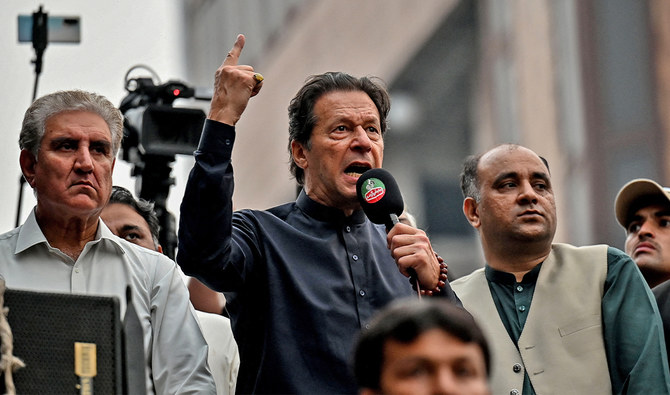
Pakistan's former prime minister Imran Khan (C) addresses his supporters during an anti-government march towards capital Islamabad, demanding early elections, in Gujranwala, Pakistan, on November 1, 2022. (AFP/File)
Short Url
Updated 15 December 2022
Follow

Ex-PM Khan can’t pressure government, military establishment into calling early election — interior minister

  • Khan has recently threatened to dissolve legislative assemblies of Khyber Pakhtunkhwa and Punjab, the two provinces where his PTI party is in government
  • The dissolution of the two provincial parliaments could trigger a constitutional crisis in the South Asian nation, already facing political and economic instability

ISLAMABAD: Interior Minister Rana Sanaullah on Wednesday reiterated the stance of Prime Minister Shehbaz Sharif government that it would not hold early polls, warning ex-premier Imran Khan that he would be unsuccessful in putting pressure on the government or the military establishment to help get an election date.

Khan, who was ousted in a parliamentary vote of no-confidence in April this year, has blamed the United States, the military, and his political rivals, now in power, for conspiring to remove him from office. All three deny the charge.

Since his ouster, Khan has also been staging rallies across the country to pressure the government into announcing early elections. Recently, Khan has threatened to dissolve the legislative assemblies of Khyber Pakhtunkhwa and Punjab, the two provinces where his PTI party is in government with coalition partners.

Khan hopes this might force early general elections as the government would have to then hold by-polls on over 550 seats. The dissolution of the two provincial parliaments could thus trigger a constitutional crisis in the South Asian nation, which is already facing political and economic instability.

“If he has already decided to dissolve the assemblies, then he should go ahead and do so instead of announcing new dates every now and then,” Sanaullah said in an interview to a local news channel.

“The government, after weighing all the pros and cons of the situation, has decided that if the assemblies are dissolved, then an election will be held in that particular assembly. Meanwhile, we will conduct by-elections on the seats that will be left vacant if PTI members tender their resignations.”

Sanaullah added that neither the military establishment nor the government would be pressurised into announcing early elections.

“The establishment will not be pressurized by Khan’s blackmailing tactics and threats, and they will definitely not help him get an election date, no matter what he does,” Sanaullah added.

There have been widespread reports in recent days that Khan has proposed to talk to the government on snap polls, an offer that is seen as a step back by the ex-premier, who has previously been refusing to negotiate with the coalition government, which contains former opposition parties he has said comprise a corrupt political elite. The parties reject that allegation.

Khan rode to power after winning a general election in 2018, which his opponents say he secured through a rigged ballot engineered by the country’s powerful military, a charge both Khan and the army deny.


Pakistan eyes collaboration with Saudi Arabia, Indonesia, China for local vaccine production

Updated 5 sec ago
Follow

Pakistan eyes collaboration with Saudi Arabia, Indonesia, China for local vaccine production

  • Pakistan last week held talks with a visiting Saudi delegation on partnering to manufacture vaccines locally
  • Government working on “war footing” to ensure local production of vaccines by 2030, says health minister

ISLAMABAD: Pakistan is eyeing collaboration with Saudi Arabia, Indonesia and China to produce vaccines locally, Health Minister Syed Mustafa Kamal said on Thursday, adding that Islamabad was exploring both government-to-government and business-to-business opportunities in this regard. 

Kamal told Arab News last week that Islamabad was “very close” to an agreement with Saudi Arabia that would enable Pakistan to manufacture vaccines locally. The development took place as a Saudi delegation, led by the Kingdom’s senior adviser to the minister of industry Nizar Al-Hariri, arrived in Pakistan last week and held talks with health officials on a partnership with Pakistan which would enable it to manufacture vaccines locally. 

The efforts take place amid Pakistan’s push to strengthen its health security and industrial capacity. The country of more than 240 million currently imports all vaccines used in its national immunization campaigns, relying heavily on international partners to help cover the costs.

“Mustafa Kamal said Pakistan is exploring collaboration with Saudi Arabia, Indonesia and China for local production of these vaccines,” state broadcaster Radio Pakistan reported. 

Kamal said the government is working on a “war footing” to ensure the local production of vaccines before 2030. 

The health minister reiterated that Pakistan has the potential to locally produce raw materials of the 13 vaccines that it provides free of cost. He added that the government will also export vaccines once it starts producing them at home. 

“Mustafa Kamal said the government is exploring both government-to-government and business-to-business collaboration to achieve our objectives in vaccine production,” Radio Pakistan said. 

Pakistan’s health ministry has said it imports all 13 vaccines that it provides masses for free at an annual cost of about $400 million.

International partners currently cover 49 percent of these costs, with the remainder borne by the Pakistani government. This external support, Kamal has warned, is expected to end after 2030.