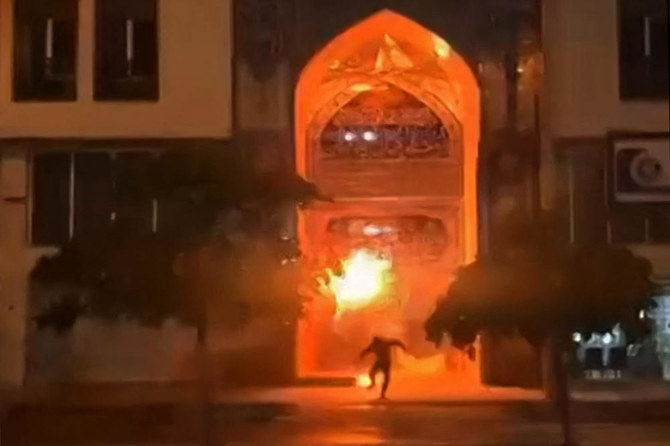
TEHRAN: A young Iranian who had been sentenced to death for his actions during protests over the death of Mahsa Amini has been given a stay of execution, his lawyer said Wednesday.
Mahan Sadrat was one of nearly a dozen Iranians sentenced to death after being convicted of capital offenses during the nationwide protests that erupted in mid-September.
“My client, Mahan, was saved from execution,” lawyer Abbas Mousavi announced in an Instagram post.
Iran’s semi-official ISNA news agency quoted a statement from the supreme court media office as saying the death sentence against Sadrat had been “suspended.”
Sadrat, who is in his early 20s, had been found guilty of “moharebeh” — or “enmity against God” — an Islamic sharia law offense that carries the death penalty in Iran.
His conviction was based on allegations he had drawn a knife, causing fear and insecurity, Iran’s official IRNA news agency said.
At his court hearing on November 3, Sadrat pleaded not guilty to the knife charge, but admitted to setting a motorbike on fire, according to court documents cited by IRNA.
Iran has been gripped by demonstrations since the September 16 death in custody of Amini, a young Iranian Kurd who had been arrested for allegedly violating the country’s strict dress code for women.
Authorities have since made thousands of arrests in a crackdown on what they regard as “riots.”
Iran’s judiciary has said it has handed down 11 death sentences in connection with the protests.
In the past week, it has hanged Mohsen Shekari and Majidreza Rahnavard, both 23, the latter in public rather than in prison as has been usual in Iran in recent years.
Campaigners say a dozen other defendants face charges that could see them also receive the death penalty.

Stay of execution for Iran protester on death row: lawyer
Short Url
https://arab.news/9exqg
Stay of execution for Iran protester on death row: lawyer
- Mahan Sadrat was one of nearly a dozen Iranians sentenced to death after being convicted of capital offences
- "My client, Mahan, was saved from execution," lawyer Abbas Mousavi announced in an Instagram post
Israel’s Supreme Court suspends govt move to shut army radio
- Israel’s Supreme Court has issued an interim order suspending a government decision to shut down Galei Tsahal, the country’s decades-old and widely listened-to military radio station
JERUSALEM: Israel’s Supreme Court has issued an interim order suspending a government decision to shut down Galei Tsahal, the country’s decades-old and widely listened-to military radio station.
In a ruling issued late Sunday, Supreme Court President Isaac Amit said the suspension was partly because the government “did not provide a clear commitment not to take irreversible steps before the court reaches a final decision.”
He added that Attorney General Gali Baharav-Miara supported the suspension.
The cabinet last week approved the closure of Galei Tsahal, with the shutdown scheduled to take effect before March 1, 2026.
Founded in 1950, Galei Tsahal is widely known for its flagship news programs and has long been followed by both domestic and foreign correspondents.
A government audience survey ranks it as Israel’s third most listened-to radio station, with a market share of 17.7 percent.
Prime Minister Benjamin Netanyahu had urged ministers to back the closure, saying there had been repeated proposals over the years to remove the station from the military, abolish it or privatise it.
But Baharav-Miara, who also serves as the government’s legal adviser and is facing dismissal proceedings initiated by the premier, has warned that closing the station raised “concerns about possible political interference in public broadcasting.”
She added that it “poses questions regarding an infringement on freedom of expression and of the press.”
Defense Minister Israel Katz said last week that Galei Tsahal broadcasts “political and divisive content” that does not align with military values.
He said soldiers, civilians and bereaved families had complained that the station did not represent them and undermined morale and the war effort.
Katz also argued that a military-run radio station serving the general public is an anomaly in democratic countries.
Opposition leader Yair Lapid had condemned the closure decision, calling it part of the government’s effort to suppress freedom of expression ahead of elections.
Israel is due to hold parliamentary elections in 2026, and Netanyahu has said he will seek another term as prime minister.
In a ruling issued late Sunday, Supreme Court President Isaac Amit said the suspension was partly because the government “did not provide a clear commitment not to take irreversible steps before the court reaches a final decision.”
He added that Attorney General Gali Baharav-Miara supported the suspension.
The cabinet last week approved the closure of Galei Tsahal, with the shutdown scheduled to take effect before March 1, 2026.
Founded in 1950, Galei Tsahal is widely known for its flagship news programs and has long been followed by both domestic and foreign correspondents.
A government audience survey ranks it as Israel’s third most listened-to radio station, with a market share of 17.7 percent.
Prime Minister Benjamin Netanyahu had urged ministers to back the closure, saying there had been repeated proposals over the years to remove the station from the military, abolish it or privatise it.
But Baharav-Miara, who also serves as the government’s legal adviser and is facing dismissal proceedings initiated by the premier, has warned that closing the station raised “concerns about possible political interference in public broadcasting.”
She added that it “poses questions regarding an infringement on freedom of expression and of the press.”
Defense Minister Israel Katz said last week that Galei Tsahal broadcasts “political and divisive content” that does not align with military values.
He said soldiers, civilians and bereaved families had complained that the station did not represent them and undermined morale and the war effort.
Katz also argued that a military-run radio station serving the general public is an anomaly in democratic countries.
Opposition leader Yair Lapid had condemned the closure decision, calling it part of the government’s effort to suppress freedom of expression ahead of elections.
Israel is due to hold parliamentary elections in 2026, and Netanyahu has said he will seek another term as prime minister.
© 2025 SAUDI RESEARCH & PUBLISHING COMPANY, All Rights Reserved And subject to Terms of Use Agreement.