

Riyadh-based Pakistani gets second lease of life with bionic arm from Karachi startup

In this combination of pictures, created on December 14, 2022, Pakistani expatriate Shaham Zaki poses with his AI-powered prosthetic arm at Riyadh airport on December 5, 2022. (Photo courtesy: Anas Niaz)
Short Url
Updated 14 December 2022
Follow

Riyadh-based Pakistani gets second lease of life with bionic arm from Karachi startup

  • Shaham Zaki, aged 32, lost one of his arms to a car accident in Riyadh some 15 years ago
  • Zaki found a mind-controlled prosthetic arm this year from Karachi-based startup BIONIKS

ISLAMABAD: Shaham Zaki, a 32-year-old Pakistani expatriate, thought his life was over when he lost his right arm to a car accident in the Saudi capital of Riyadh 15 years ago. But a Karachi startup that has fitted him with an artificial intelligence-powered prosthetic arm has given him a second lease on life.

Zaki, who was born and raised in the Kingdom, underwent four surgeries in Riyadh but the doctors had to amputate his arm to prevent the infection from spreading further.

The expat said he tried to search for a prosthetic arm solution in Riyadh but it was very costly and hence he got it from the Karachi-based BIONIKS startup, which provides orthotics and prosthetics solutions, for around $7,000.

“I found about BIONIKS online and then visited their office during my vacation in Karachi this year and after seeing their products, I decided to use their bionic arm,” he told Arab News on Tuesday.

“It took almost 40 days in preparation of the personalized arm and training with a physiotherapist to use it.”
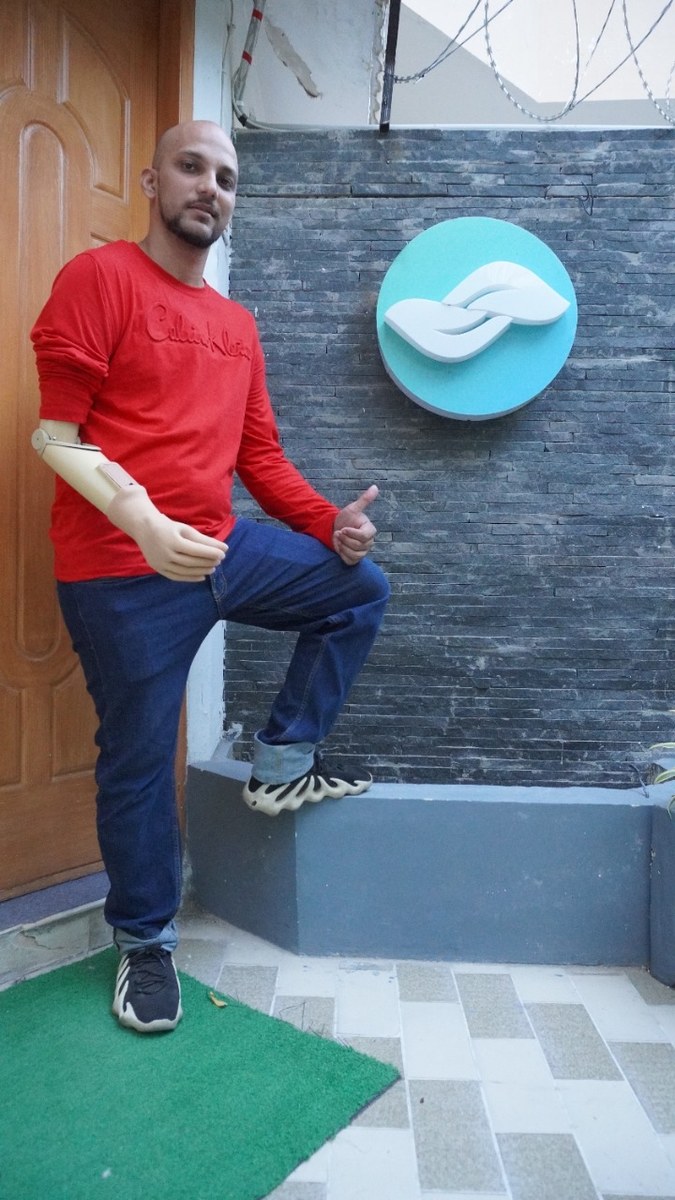


Riyadh based Pakistani expatriate, Shaham Zaki poses with his AI-powered prosthetic arm at BIONIKS care center in Karachi, Pakistan on October 17, 2022. (Photo courtesy: Anas Niaz)

The expat said the prosthetic arm eased his life a lot: “I am working as a junior accountant in Riyadh and it has also increased my confidence as earlier I was unable to meet people due to the stigma attached with disabilities,” he added.

Mechatronic grads, Anas Niaz and Ovais Hussain Qureshi, conceived the idea of establishing BIONIKS when the father of five-year-old Mir Bayyan Baloch asked them in 2016 to make a personalized prosthetic arm for his son who was born with the disability.

Niaz and Qureshi discovered during the project that AI-based prosthetic limbs were expensive and rarely available, which moved them to provide such solutions through BIONIKS. Since then, more than 300 people have benefitted from their services.

Niaz said the BIONIKS provided unique, AI-powered limbs to people with disabilities that could be remotely calibrated, maintained and improved through an application.
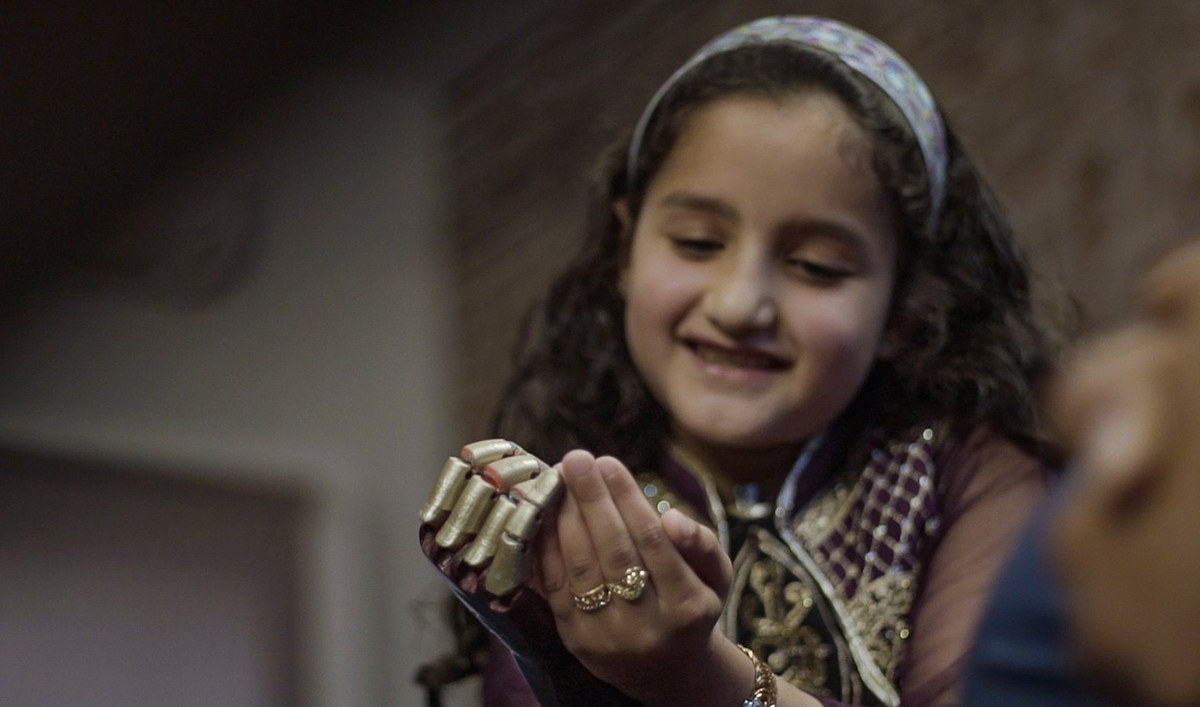


In this picture taken on April 12, 2018, eight-year-old, Sanaya Abbasi poses with her bionic arm in Karachi, Pakistan. (Photo courtesy: Anas Niaz)

“BIONIKS is currently working on upper limbs, lower limbs and exo-glove for people with minimum mobility and the cost ranges from $2,000 to $5,000, depending upon amputation and advancement requirement,” he told Arab News.

“We started BIONIKS as a social enterprise where we provide free-of-cost products to those who cannot afford and charge those who can afford it.”

Niaz said similar prosthetics cost between $10,000 to $200,000 globally.

Irtaza Hassan, a Pakistani expatriate working as an electrical engineer in Jeddah since 2012, also feels relieved after finding a bionic limb for his six-year-old daughter Fatimah Hassan, who was born with a congenital amputation.
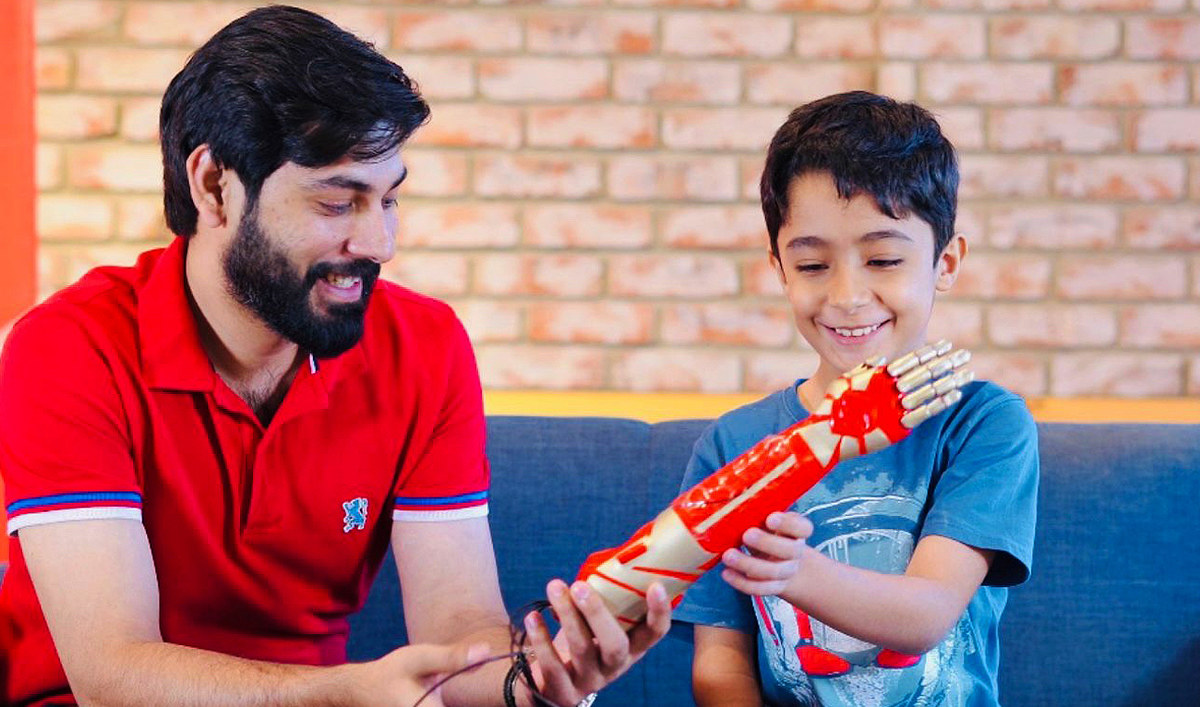


In this picture taken on December 15, 2018, BIONIKS CEO Anas Niaz (left) is presenting a modified personalized prosthetic arm to a five-year child Mir Bayyan Baloch (right) in Karachi, Pakistan. (Photo courtesy: Anas Niaz)

“I had approached many hospitals in Pakistan even the expensive ones, but could not get any solution,” he told Arab News over the phone.

“I found out about Niaz’s work through social media and during my visit to Pakistan in May this year, we found a bionic limb for my daughter.”

Hassan said his daughter has been doing her everyday chores easily for the last six months.

He said he paid $1,500 for the replacement of his daughter’s arm, which was almost half of the fee charged by European prosthetic firms.
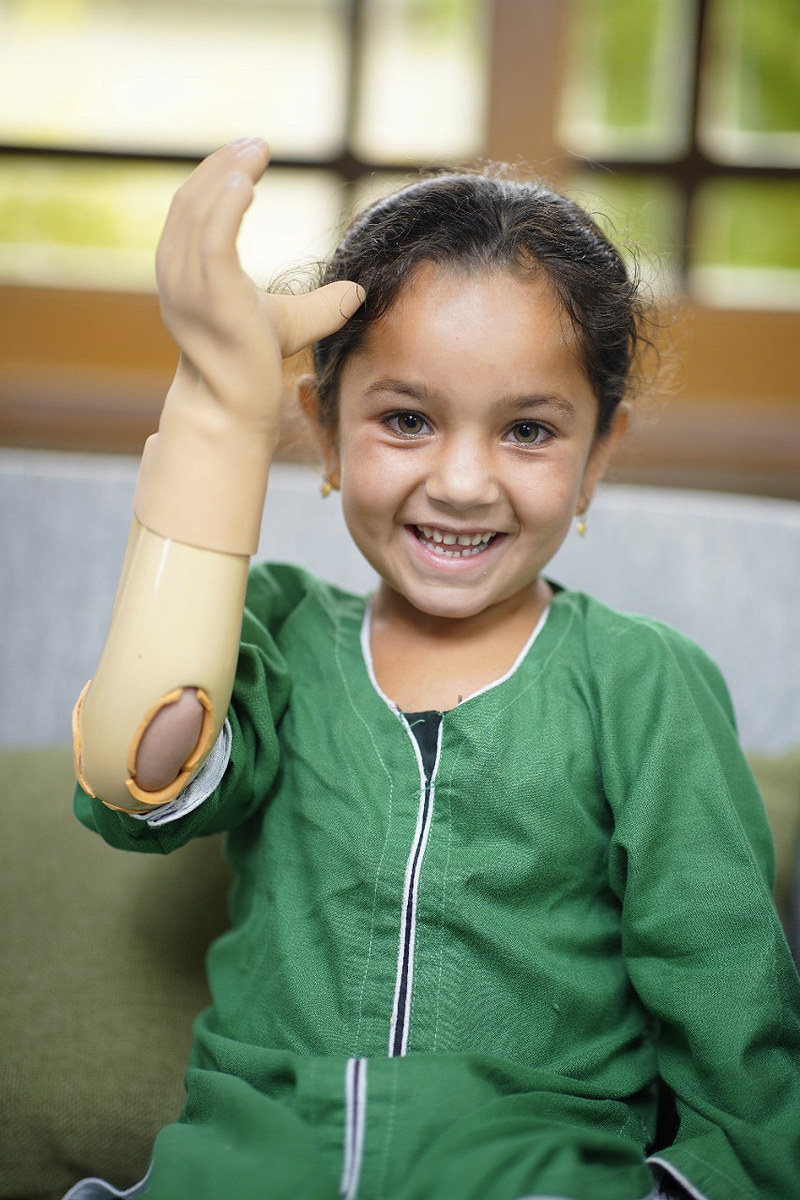


In this picture taken on November 13, 2018, four-year-old, Khirad Zahra poses with her bionic arm in Karachi, Pakistan. (Photo courtesy: Anas Niaz)

According to the World Health Organization, around 15 percent of the world’s population, which is more than 1.2 billion, has a disability and over 90 million of these people are from Southeast Asia.

Saudi Arabia is home to more than 2.5 million Pakistani expatriates mostly laborers and low-skilled workers, who find it difficult to afford such an expensive solution in case of accidental amputation.


Pakistan PM orders accelerated privatization of power sector to tackle losses

Updated 15 December 2025
Follow

Pakistan PM orders accelerated privatization of power sector to tackle losses

  • Tenders to be issued for privatization of three major electricity distribution firms, PMO says
  • Sharif says Pakistan to develop battery energy storage through public-private partnerships

ISLAMABAD: Pakistan’s prime minister on Monday directed the government to speed up privatization of state-owned power companies and improve electricity infrastructure nationwide, as authorities try to address deep-rooted losses and inefficiencies in the energy sector that have weighed on the economy and public finances.

Pakistan’s electricity system has long struggled with financial distress caused by a combination of factors including theft of power, inefficient collection of bills, high costs of generating electricity and a large burden of unpaid obligations known as “circular debt.” In the first quarter of the current financial year, government-owned distribution companies recorded losses of about Rs171 billion ($611 million) due to poor bill recovery and operational inefficiencies, official documents show. Circular debt in the broader power sector stood at around Rs1.66 trillion ($5.9 billion) in mid-2025, a sharp decline from past peaks but still a major fiscal drain. 

Efforts to contain these losses have been a focus of Pakistan’s economic reform program with the International Monetary Fund, which has urged structural changes in the energy sector as part of financing conditions. Previous government initiatives have included signing a $4.5 billion financing facility with local banks to ease power sector debt and reducing retail electricity tariffs to support economic recovery. 

“Electricity sector privatization and market-based competition is the sustainable solution to the country’s energy problems,” Prime Minister Shehbaz Sharif said at a meeting reviewing the roadmap for power sector reforms, according to a statement from the prime minister’s office.

The meeting reviewed progress on privatization and infrastructure projects. Officials said tenders for modernizing one of Pakistan’s oldest operational hubs, Rohri Railway Station, will be issued soon and that the Ghazi Barotha to Faisalabad transmission line, designed to improve long-distance transmission of electricity, is in the initial approval stages. While not all power-sector decisions were detailed publicly, the government emphasized expanding private sector participation and completing priority projects to strengthen the electricity grid.

In another key development, the prime minister endorsed plans to begin work on a battery energy storage system with participation from private investors to help manage fluctuations in supply and demand, particularly as renewable energy sources such as solar and wind take a growing role in generation. Officials said the concept clearance for the storage system has been approved and feasibility studies are underway.

Government briefing documents also outlined steps toward shifting some electricity plants from imported coal to locally mined Thar coal, where a railway line expansion is underway to support transport of fuel, potentially lowering costs and import dependence in the long term.

State authorities also pledged to address safety by converting unmanned railway crossings to staffed ones and to strengthen food safety inspections at stations, underscoring broader infrastructure and service improvements connected to energy and transport priorities.
