

UK sanctions Russian military commanders, Iranian businessmen

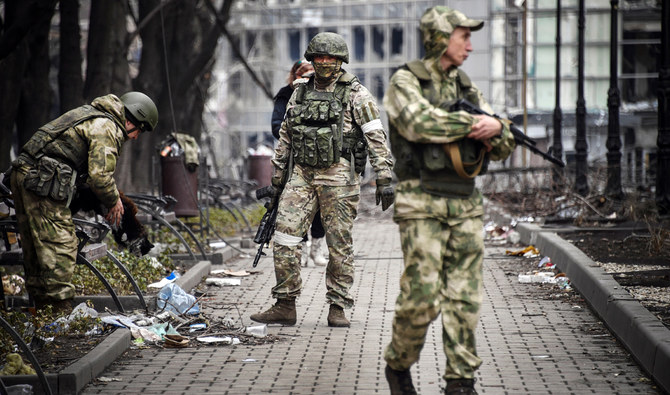
Russian soldiers walk along a street in Mariupol on April 12, 2022. (Photo courtesy: AFP/File)
Short Url
Updated 14 December 2022
Follow

UK sanctions Russian military commanders, Iranian businessmen

  • Britain said Iranian-manufactured drones had played a central role in attacks on civilians in Ukraine
  • US information shows Iran has become one of Russia’s top military backers, sending hundreds of drones

LONDON: Britain on Tuesday said it had sanctioned 12 Russian military commanders implicated in missile strikes on Ukrainian cities as well as Iranian businessmen involved in the production and supply of military drones used in the attacks.

On Monday, Ukraine said Russian missiles, artillery and drones had hammered targets in eastern and southern Ukraine.

Britain said Iranian-manufactured drones had played a central role in attacks on civilians, citing US information showing Iran has become one of Russia’s top military backers, sending hundreds of drones to Russia.

Tehran and Moscow have denied Western accusations that Russia is using Iranian drones to attack targets in Ukraine.

“Russian forces’ calculated attacks on cities and innocent civilians in Ukraine will not go unanswered,” British Foreign Secretary James Cleverly said.

“The Iranian regime is increasingly isolated in the face of deafening calls for change from its own people and is striking sordid deals with Putin in a desperate attempt to survive.”

Britain said among those sanctioned were Major General Robert Baranov, believed to be the commander of a unit responsible for programming and targeting Russian cruise missiles.


EU eyes migration clampdown with push on deportations, visas

Updated 5 sec ago
Follow

EU eyes migration clampdown with push on deportations, visas

  • Irregular arrivals in the 27-nation bloc were down by more than a quarter in 2025
  • “The priority is clear: bringing illegal arrival numbers down and keeping them down,” Brunner said

BRUSSELS: The European Union on Thursday laid out plans to overhaul its visa system and step up deportations as part of a five-year migration strategy that cements a hardening line on the hot-button issue.
Irregular arrivals in the 27-nation bloc were down by more than a quarter in 2025, according to the EU’s border agency — but political pressure to act remains high.
“The priority is clear: bringing illegal arrival numbers down and keeping them down,” Magnus Brunner, the EU’s commissioner for migration, said.
The strategy unveiled Thursday stressed the need to boost deportations of failed asylum-seekers among the bloc’s priorities.
“Abuse gives migration a bad name — it undermines public trust and ultimately takes away from our ability to provide protection and undercuts our drive to attract talent,” said Brunner.
The European Parliament is currently examining a legal text put forward by the European Commission allowing for so-called “return hubs” to be set up outside the EU’s borders.
Criticized by rights groups, the proposal also envisages harsher penalties for migrants who refuse to leave European territory, including longer periods of detention.
European governments are under pressure to take a tougher stance amid a souring of public opinion on migration that has fueled a rightward shift across the bloc.

- ‘Flawed’ approach -

The strategy also mentioned reinforcing an “assertive migration diplomacy” to persuade third countries to help stop migrants from reaching Europe and take back their nationals with no right to stay.
Brussels recently struck or is negotiating deals with Northern African countries including Tunisia, Mauritania, Egypt and Morocco, whereby it gets help controlling migration flows in return for aid and investments.
Amnesty International criticized the EU’s approach as “flawed.”
It “only heightens its dependence on third countries to manage migration, while making it complicit in any rights violations that may result,” said Olivia Sundberg Diez, a policy analyst with the human rights group.
Brussels also put forward a brand-new visa strategy, with the stated objective of using the granting of access to EU territory to certain nationals as a diplomatic means to foster its policy goals.
It’s “one of the strongest tools in our hands,” said a commission source.
In particular, the EU wants to sanction countries that refuse to take back their nationals by restricting the issuance of visas, while easing procedures to attract skilled workers.
The commission is expected to present a plan for reform by the end of the year.