


RIYADH: To enable Saudi Arabia’s private sector to thrive and create a more resilient domestic economy, the Kingdom’s sovereign wealth fund is focusing on promoting local content — goods and services.
In order to enable the Public Investment Fund to achieve its aim of increasing its contribution to local content to 60 percent and creating up to 1.8 million direct and indirect jobs by the end of 2025, the fund’s National Development Division launched a Local Content Growth Program in October.
Designed to drive innovation, encourage local private sector products and services, and increase confidence in local materials and designs, the program will catalyze the development of at-scale, competitive and innovative sectors and industries in Saudi Arabia and spur industries to competitive levels globally.
“Launching the PIF Local Content Growth Program strengthens PIF’s position as a key enabler of a thriving private sector and a more resilient domestic economy in Saudi Arabia,” Jerry Todd, head of the PIF’s National Development Division, said.
“This move will help build local capabilities, create opportunities for private sector players across the value chain, and build on Saudi Arabia’s position at the regional and global level in line with Vision 2030,” Todd added.
In a statement, PIF said the program was in line with its strategic objective of building partnerships with, and enabling, the private sector to boost Saudi Arabia’s gross domestic production and will further boost the private sector and number of Saudi-made products.
It will facilitate investment opportunities for local players, strengthen supply chains and create high-value jobs.
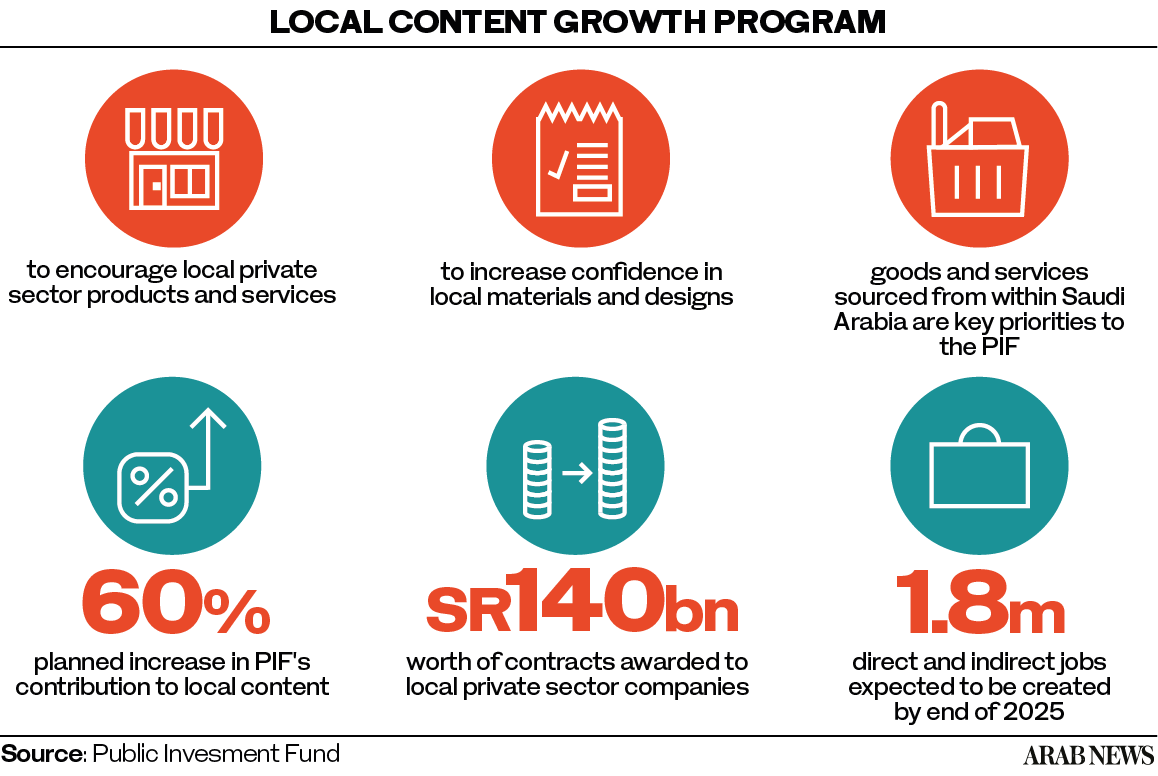
The statement said that in 2021, PIF’s portfolio companies awarded SR140 billion ($37 billion) worth of contracts to local companies in the private sector, nearly 60 percent of which went to the construction materials and services, information technology and telecommunications, and financial services sectors.
The statement cited the examples of real estate developer ROSHN, who selected development company Retal as its first developer partner to establish residential neighborhoods within the SEDRA community and entertainment megaproject Qiddiya’s SR2.8 billion construction contract to build the region’s largest water theme park.
Tourism developer Red Sea Global, the statement said, has also awarded contracts worth more than SR32 billion to local companies to date, with approximately 70 percent of the total value awarded to Saudi companies.
Saudization, officially known as the Saudi nationalization scheme, Nitaqat, is a crucial step in increasing local content.
The Kingdom’s efforts to create more jobs in line with Vision 2030 are showing fruition with the country coming first in the labor force growth rate among the Group of 20 countries during the period 2012 - 2021, according to a recent report launched by the National Labor Observatory.
According to Saudi Arabia’s Central Department of Statistics and Information, the unemployment rate in the Kingdom decreased to 5.8 percent in the second quarter of 2022 from 6 percent in the first quarter of 2022.
To achieve its Vision 2030 goals, Saudi Arabia is not only encouraging the recruitment of nationals to private sector jobs but is also encouraging adequate investment in their future to ensure their retention by employers as well as their contribution to a vibrant and diverse economy.


