

ICC second demerit for Rawalpindi flat wicket raises danger of suspension as international venue

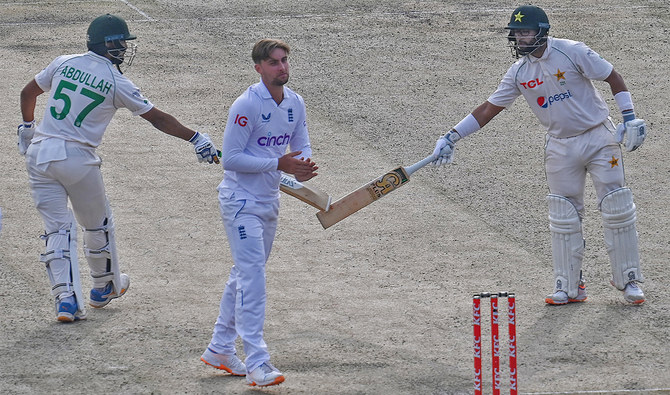
Pakistan's Abdullah Shafique (L) and teammate Imam-ul-Haq (R) bump their bats during the second day of the first cricket Test match between Pakistan and England at the Rawalpindi Cricket Stadium, in Rawalpindi, Pakistan, on December 2, 2022. (AFP/File)
Short Url
Updated 13 December 2022
Follow

ICC second demerit for Rawalpindi flat wicket raises danger of suspension as international venue

  • A venue can be suspended from hosting international cricket if it accumulates five demerit points within five years
  • PCB chairman Ramiz Raja labelled the pitch ‘embarrassing,’ match referee Andy Pycroft rated pitch “below average”

ISLAMABAD: The flat wicket at Pindi Cricket Stadium has received a second demerit point within nine months from the International Cricket Council after England clinched a 74-run win at Rawalpindi in the tourist’s first Test in Pakistan for 17 years.

A venue can be suspended from hosting international cricket if it accumulates five demerit points within five years.

“PCB chairman Ramiz Raja labelled the pitch as ‘embarrassing’ and Andy Pycroft of the Emirates ICC Elite Panel of Match Referees agreed with his prognosis,” the ICC said on its website, adding that the pitch provided bowlers with very little assistance throughout the five-day contest.

“It was a very flat pitch which gave almost no assistance to any type of bowler,” Pycroft said. “That was the main reason why batters scored very fast and both sides posted huge totals. The pitch hardly deteriorated during the course of the match. Since there was very little in it for the bowlers, I found the pitch to be ‘below average’ as per the ICC guidelines.”

England went on to score 657 in 101 overs before Pakistan also replied with 579, with three batters from the home team scoring hundreds. England has since clinched the series with a narrow win in the second cricket test at Multan.

In March, a similar type of wicket at the same venue received a demerit point from the ICC when only 14 wickets fell over five days in a test match between Pakistan and Australia.

“Demerit points remain active for a rolling five-year period and when a venue accumulates five demerit points it is suspended from staging any international cricket for a period of 12 months,” the ICC said.


Pakistan Navy tests missile, loitering munitions and unmanned vessel at Arabian Sea

Updated 5 sec ago
Follow

Pakistan Navy tests missile, loitering munitions and unmanned vessel at Arabian Sea

  • The exercise reflects growing focus on air defense and autonomous systems in modern warfare

ISLAMABAD: Pakistan’s navy conducted live firing of a surface-to-air missile, tested loitering munitions and carried out open-sea trials of an unmanned surface vessel during a major exercise in the North Arabian Sea on Saturday, highlighting a growing focus on air defense and unmanned warfare amid evolving regional security dynamics.

The exercise, which demonstrated both conventional and autonomous capabilities, comes at a time when Pakistan is increasingly emphasizing advanced technology and multi-domain operations following last year’s four-day conflict with nuclear-armed India, which reinforced the importance of air defense, surveillance and precision strike systems.

“Pakistan Navy demonstrated its operational readiness and combat preparedness through a comprehensive exercise in the North Arabian Sea, showcasing both conventional and unmanned capabilities, as per dictates of evolving naval warfare,” the Navy’s Directorate General Public Relations said in a statement.

“The exercise included the successful live firing of LY-80(N) Surface to Air Missile (SAM) from Vertical Launching System at extended range, validating the long-range capabilities of Pakistan Navy’s modern air defense systems,” it added. “LY-80(N) SAM successfully engaged and neutralized an aerial target, demonstrating Pakistan Navy’s robust air defense capabilities.”

The statement said the exercise also featured the successful engagement of surface targets using a loitering munition, which it said demonstrated the navy’s precision strike capability.

“Successful open-sea trials of Unmanned Surface Vessel (USV) were also conducted, marking a significant leap in autonomous naval technology,” it continued. “The trials validated the platform’s ability to combine high-speed performance with mission-critical durability.”

Pakistan’s armed forces routinely hold large-scale exercises to enhance operational readiness, but recent drills have placed greater emphasis on emerging technologies, reflecting lessons drawn from modern conflicts.

Key capabilities demonstrated during the exercise included extreme maneuverability, precision navigation and weather resilience.

Chief of the Naval Staff Admiral Naveed Ashraf commended officers and men of the Pakistan Navy for their professionalism and operational competence, reiterating the navy’s resolve to ensure the seaward defense of the country and safeguard its maritime interests.