GAZA CITY: Christians in the Gaza Strip hope to celebrate Christmas each year and reunite with their families, but Israeli restrictions on movement are preventing thousands from taking part in the occasion.
Israel has been accused of strictly limiting permits to pray in the Church of the Nativity in Bethlehem to a limited number of worshipers.
The Palestinian Civil Affairs Authority — the body responsible for communicating with Israeli officials at Erez crossing — said that Israel rejected more than 260 applications.
An anonymous source told Arab News that the authority received approval for only about 640 people from the more than 900 applications submitted.
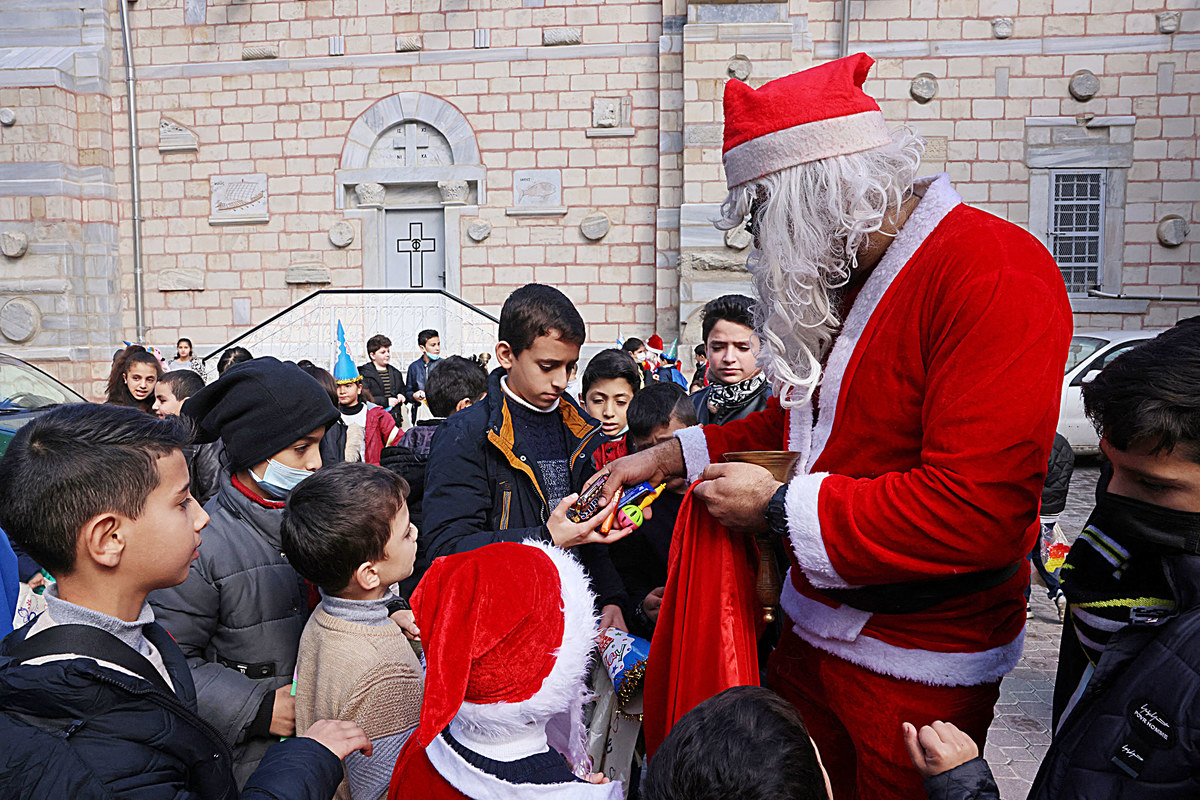
A Palestinian man, dressed as Santa Claus, distributes gifts to children outside a church during Christmas celebrations in Gaza City on Dec. 24, 2021. (AFP)
A senior Israeli security official told journalists in a phone briefing that about 200 people were denied access to Israel after being denied security clearances.
About 1,100 Christians live in the Gaza Strip, according to statistics issued by the Latin Monastery Church in Gaza.
The number of Christians in Gaza has fallen in past years as a result of migration, owing to the dire economic situation, siege and successive Israeli offensives.
Many have moved to the West Bank or emigrated abroad.
“We feel very sorry that not all Christians were granted the necessary permits,” Kamel Ayad, director of public relations at the Greek Orthodox Church in Gaza, told Arab News.
“It is our right as Christians to witness Christmas celebrations in the birthplace of Christ in Bethlehem as it is available to all Christians of the world to travel to,” said Ayad.
Ayad added that the usual practice every year was to send a list of the names of Christians who wish to obtain a permit to travel during the Christmas period.
In most cases the issuance of permits is random, meaning that only some members of Christian families can visit Bethlehem, said Ayad.
The YMCA in Gaza lights up a large Christmas tree each year at the association square with participation of Christians and Muslims.
Israel has imposed a strict blockade on the Gaza Strip since Hamas took control of the area by the armed force in mid-2007.
Hani Farah, secretary-general of Gaza’s YMCA, said that Israel “practices all forms of repression and violations against the Palestinians, regardless of their religion or gender.”
He added: “Just as Israeli bombs and missiles do not differentiate between the Palestinian and the Palestinian, the blockade and its repressive measures do not differentiate between a Muslim and a Christian. We are all trapped in Gaza and we share pain and suffering.”
Sanaa, a Gaza Strip Christian, received approval for a permit, but her husband and her three children did not.
She said: “What should I do with the permit alone without my family?”
Sanaa told Arab News: “The spirit of Christmas is for all family members to gather in one place. I cannot attend the Christmas celebration in Bethlehem alone. This happens every year. One or two members of the family only get a permit.”
Israel controls the entry and exit of Palestinians through the Erez crossing in the northern Gaza Strip, and grants permits only to humanitarian cases and several thousand daily workers, in addition to some aid workers in international organizations.
Hamas condemned the Israeli ban of Christians from traveling to the West Bank during Christmas.
“We condemn the Israeli occupation’s banning of Christian Gazans from accessing sacred places in Jerusalem and Bethlehem on religious holidays,” said a statement.
“As the Israeli move restricts the Palestinian Christians’ access to holy places, we deem it a flagrant violation of the right to worship.”