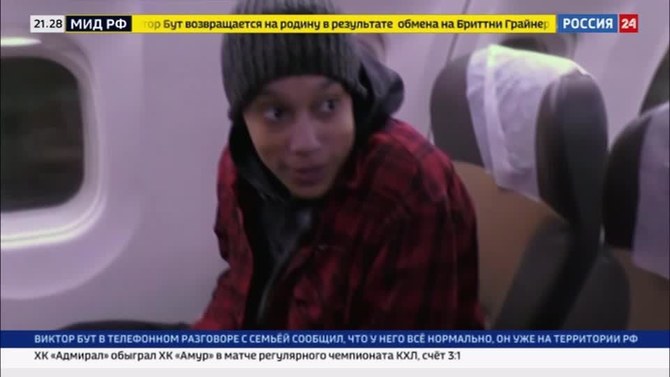
Brittney Griner back home in US after Russian prisoner swap

A Russian TV shows US basketball player Brittney Griner after the prisoner swap. (Reuters/WNE)
Short Url
Updated 09 December 2022
Follow

Brittney Griner back home in US after Russian prisoner swap

  • Russia's invasion of Ukraine after her arrest complicated matters further
  • The deal that saw Griner exchanged for notorious arms dealer Viktor Bout achieved a top goal for President Joe Biden

SAN ANTONIO, United States: Brittney Griner returned to the United States early Friday, nearly 10 months after the basketball star’s detention in Russia made her the most high-profile American jailed abroad and set off a political firestorm.
Griner’s status and prominence in women’s basketball and her imprisonment heightened concerns for her and brought tremendous attention to the case. Russia’s invasion of Ukraine after her arrest complicated matters further.
The deal that saw Griner exchanged for notorious arms dealer Viktor Bout achieved a top goal for President Joe Biden. But the US failed to win freedom for another American, Paul Whelan, who has been jailed for nearly four years.
Asked if more such swaps could happen, Russian President Vladimir Putin said Friday that “everything is possible,” noting that “compromises have been found” to clear the way for Thursday’s exchange.
Biden’s authorization to release Bout, the Russian felon once nicknamed “the Merchant of Death,” underscored the heightened urgency that his administration faced to get Griner home, particularly after the recent resolution of her criminal case on drug charges and her subsequent transfer to a penal colony.
Griner, a two-time Olympic gold medalist and Phoenix Mercury pro basketball star, was seen getting off a plane that landed Friday at Joint Base San Antonio-Lackland in Texas.
“So happy to have Brittney back on US soil. Welcome home BG!” tweeted Roger Carstens, the special presidential envoy for hostage affairs.
The WNBA star, who also played pro basketball in Russia, was arrested at Moscow’s Sheremetyevo Airport in February after Russian authorities said she was carrying vape canisters with cannabis oil. The US State Department declared Griner to be “wrongfully detained” — a charge that Russia has sharply rejected.
Griner pleaded guilty in July but still faced trial because admitting guilt in Russia’s judicial system does not automatically end a case. She was sentenced to nine years.
She acknowledged in court that she possessed canisters with cannabis oil but said she had no criminal intent and accidentally packed them. Her defense team presented written statements that she had been prescribed cannabis to treat pain.
The Russian Foreign Ministry confirmed Thursday’s swap, saying in a statement carried by Russian news agencies that the exchange took place in Abu Dhabi and Bout had been flown home.
Biden spoke by phone with Griner. US officials said she would be offered specialized medical services and counseling.
In releasing Bout, the US freed a former Soviet Army lieutenant colonel whom the Justice Department once described as one of the world’s most prolific arms dealers. He was arrested in Thailand in 2008 and extradited to the US in 2010.
Bout was serving a 25-year sentence on charges that he conspired to sell tens of millions of dollars in weapons that USofficials said were to be used against Americans.


Treason trial of South Sudan’s suspended VP is further eroding peace deal, UN experts say

Updated 5 sec ago
Follow

Treason trial of South Sudan’s suspended VP is further eroding peace deal, UN experts say

  • The experts said forces from both sides are continuing to confront each other across much of the country
  • “Years of neglect have fragmented government and opposition forces alike,” the experts said

UNITED NATIONS: The treason trial of South Sudan’s suspended vice president is further eroding a 2018 peace agreement he signed with President Salva Kiir, UN experts warned in a new report.
As Riek Machar’s trial is taking place in the capital, Juba, the experts said forces from both sides are continuing to confront each other across much of the country and there is a threat of renewed major conflict.
UN peacekeeping chief Jean-Pierre Lacroix told the UN Security Council last month that the crisis in South Sudan is escalating, “a breaking point” has become visible, and time is running “dangerously short” to bring the peace process back on track.
There were high hopes when oil-rich South Sudan gained independence from Sudan in 2011 after a long conflict, but the country slid into a civil war in December 2013 largely based on ethnic divisions, when forces loyal to Kiir, an ethnic Dinka, battled those loyal to Machar, an ethnic Nuer.
More than 400,000 people were killed in the war, which ended with the 2018 peace agreement that brought Kiir and Machar together in a government of national unity. But implementation has been slow, and a long-delayed presidential election is now scheduled for December 2026.
The panel of UN experts stressed in a report this week that the political and security landscape in South Sudan looks very different today than it did in 2018 and that “the conflict that now threatens looks much different to those that came before.”
“Years of neglect have fragmented government and opposition forces alike,” the experts said, “resulting in a patchwork of uniformed soldiers, defectors and armed community defense groups that are increasingly preoccupied by local struggles and often unenthused by the prospect of a national confrontation. ”
With limited supplies and low morale, South Sudan’s military has relied increasingly on aerial bombings that are “relatively indiscriminate” to disrupt the opposition, the experts said.
In a major escalation of tensions in March, a Nuer militia seized an army garrison. Kiir’s government responded, charging Machar and seven other opposition figures with treason, murder, terrorism and other crimes.
The UN experts said Kiir and his allies insist that, despite having dismissed Machar, implementation of the peace agreement is unaffected, pointing to a faction of the opposition led by Stephen Par Kuol that is still engaged in the peace process.
Those who refused to join Kuol and sided with Machar’s former deputy, Natheniel Oyet, “have largely been removed from their positions, forcing many to flee the country,” the experts said in the report.
The African Union, regional countries and the Intergovernmental Authority on Development, or IGAD, have all called for Machar’s release and stressed their strong support for implementation of the 2018 agreement, the panel said.
According to the latest international assessment, 7.7 million people — 57 percent of the population — face “crisis” levels of food insecurity, with pockets of famine in some communities most affected by renewed fighting, the panel said.