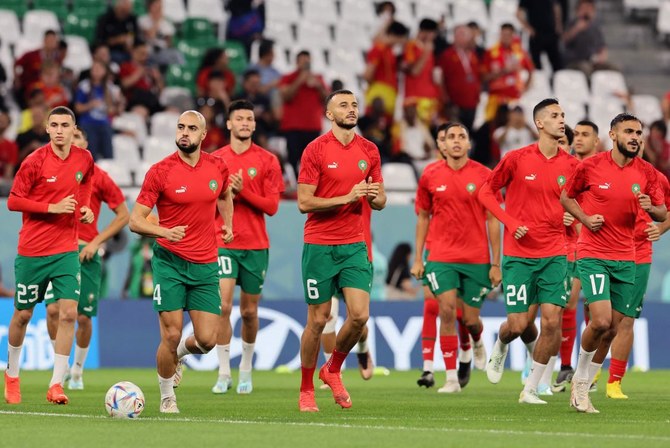
DOHA: These really are pinch-yourself times for Morocco: A first-ever spot in the quarterfinals of a World Cup — the first to take place in the Arab world, no less — and now a meeting with Portugal and their superstar striker, Cristiano Ronaldo.
Well, maybe.
Because Ronaldo has again managed to steal the spotlight in his inimitable way, even bumping Morocco’s historic run to the last eight off the top of the agenda before Saturday’s narrative-laden match.
Will he start, or won’t he? That’s the big question being asked about Ronaldo after he was dropped by Portugal coach Fernando Santos for the 6-1 win over Switzerland in the round of 16 on Tuesday.
Not only was the five-time world player of the year relegated to the bench, his replacement — 21-year-old Gonçalo Ramos — scored a hat trick to leave Santos with quite the selection dilemma against Morocco.
“I hope he won’t (play),” Morocco coach Walid Regragui said Friday of Ronaldo. “As a coach I know he’s one of the best players in history and so I’d be delighted if he didn’t play.”
The announcement of Portugal’s team about 90 minutes before the game at Al Thumama Stadium is keenly awaited as Ronaldo prepares to play in the quarterfinals of the World Cup for just the second time in his glittering career.
Santos declined to share selection thoughts Friday for what he said would be a different kind of game to the one against Switzerland, while noting that “90 percent of the questions” are about Ronaldo at Portugal’s pregame news conferences.
One inevitable question Santos faced was about reports in national media that Ronaldo threatened to leave the World Cup after being told he was benched. Not true, the coach said.
“He has never told me that he wanted to leave the national team,” Santos said through an interpreter. “Cristiano obviously wasn’t very happy about it. He told me ‘Do you really think it’s a good idea?’”
Portugal are at this stage for only the third time after 1966 and 2006, perhaps surprising given the talent to have come from the country down the years.
Four years ago, Portugal lost in the round of 16 to Uruguay, though a group-stage game against Morocco was “possibly the most difficult match” the team faced, Santos said Friday.
“We won 1-0 but we had to suffer a lot to win that match,” he said. “My players know that.”
As for Morocco, the nation is in uncharted territory after becoming only the fourth African country to reach the quarterfinals at soccer’s biggest tournament, after Cameroon (1990), Senegal (2002) and Ghana (2010). None of them reached the semifinals.
Morocco are also the only team from outside Europe or South America to make it to the last eight in Qatar.
The team’s penalty-shootout victory over Spain in the last 16 sparked wild celebrations not just among its many fans in Qatar and at home.
The excitement extended to the Moroccan diaspora of around 5 million people spread mostly around Europe, which has united behind the World Cup run of the team nicknamed the “Atlas Lions.”
Morocco fans poured into the streets of European cities to celebrate the team’s passage to the quarterfinals, which came after Morocco advanced from a group containing second-ranked Belgium and 2018 runner-up Croatia.
“We haven’t got carried away by the euphoria,” Regragui said. “We’ve just surprised a few people and surprised a few algorithms who expected Belgium to get through ... and expected Spain to get through. We are not satisfied with where we have come so far.”
Regragui, who was born in France, and 14 of the 26 players in the squad were born abroad — the highest proportion for any team at a World Cup being held in the Middle East for the first time in the tournament’s 92-year history.
The Arab world’s standard bearer, Morocco are in the quarterfinals on merit, too. The team have only conceded one goal — and that was an own-goal against Canada — and are proving so well-organized, with a sturdy back four headlined by Achraf Hakimi, a dedicated midfield anchored by Sofyan Amrabat, two mercurial wingers in Hakim Ziyech and Sofiane Boufal, and a striker in Youssef En-Nesyri, who occupies defenses with his relentless work rate.
Three key players might be struggling to be healthy enough to play against Portugal, though. Amrabat said he played with a back injury requiring painkilling injections in the match against Spain, during which captain Romain Saiss finished the game with his leg bandaged up after treatment, and fellow center back Nayef Aguerd hobbled off in tears with an apparent thigh injury.
“Yes, they are tired, yes, we have injuries. We are not going to hide it and we are not going to complain,” Regragui said. “We are here on a mission.”
Portugal doesn’t appear to have such problems, with Santos’ squad depth so impressive that he could afford to leave players like Ronaldo, João Cancelo and Rúben Neves on the bench against Switzerland after they started every group game.
Even if he is among the substitutes again, Ronaldo — playing in what is likely his last World Cup — is expected to see some time on the field. Given the drama constantly surrounding him, he’s sure to be a talking point whatever happens.

Ronaldo, Portugal look to end Morocco’s World Cup run
Short Url
https://arab.news/vdv4p
Ronaldo, Portugal look to end Morocco’s World Cup run
- Ronaldo has again managed to steal the spotlight in his inimitable way
- Will he start, or won’t he? That’s the big question being asked about Ronaldo
A powerful rivalry: Sabalenka and Svitolina set for Australian Open semifinal showdown
- Top-ranked Sabalenka, who is seeking a third title in four years in Australia, is from Belarus
- Players from Ukraine do not shake hands with players from Russia or Belarus at the net after matches
MELBOURNE: Naturally there’ll be attention on the backstory when Aryna Sabalenka and Elina Svitolina meet in the Australian Open women’s semifinals.
Top-ranked Sabalenka, who is seeking a third title in four years in Australia, is a 27-year-old from Belarus. She’s popular on TikTok for her humorous posts and dance routines.
Svitolina is a 31-year-old Ukrainian who will be returning to the Top 10 next week for the first time since returning from a maternity break she took in 2022. She reached her first Australian Open semifinal with a lopsided win over No. 3 Coco Gauff, needing only 59 minutes to end her run of three quarterfinal losses at Melbourne Park.
They’re both regularly asked questions relating to Russia’s war on Ukraine. Both have regularly said they want the focus to be on tennis. Svitolina is trying to bring joy to the people of Ukraine, of course. Sabalenka said she supports peace.
“It’s very close to my heart to see a lot of support from Ukrainians,” she said. “So I feel like (I) bring this light, a little light, you know, even just positive news to Ukrainian people, to my friends when they are watching.”
Players from Ukraine don’t shake hands with players from Russia or Belarus at the net after matches. It’s accepted on both sides.
They’re both on 10-match winning streaks so far in 2026 and entered the season’s first major with titles in warmup tournaments — Sabalenka in Brisbane, and Svitolina in Auckland, New Zealand, her 19th career title. That was Svitolina’s first foray back after an early end to the 2025 season for a mental health break.
Sabalenka, who has 22 career titles including back-to-back Australian championships in 2023 and ‘24 and back-to-back US Open triumphs in 2024 and last year, is 5-1 in career meetings with Svitolina. She is into the final 4 at a major for the 14th time, and has made the final seven times.
“It’s no secret that she’s a very powerful player. I watched a little bit of her (quarterfinal) match. She was playing great tennis, and I think, the power on all aspects of her game is her strengths,” Svitolina said of Sabalenka. “She’s very consistent. For me, I’ll have to ... try to find the ways and the little holes, little opportunities in her game.
“When you play the top players, you have to find these small opportunities and then be ready to take them.”
Svitolina is playing her fourth semifinal at a major — 2019 and 2023 at Wimbledon and the 2019 US Open — and aiming for her first final.
Sabalenka played her quarterfinal against 18-year-old Iva Jovic before the searing heat forced organizers to close the roof of the Rod Laver Arena stadium on Tuesday. She was long gone before Svitolina and Guaff played under the roof at night. At that stage, she didn’t know who she’d next be playing, but was sure “it’s going to be a battle.”
“Because whoever makes it there, it’s an incredible player,” she said. “I think my approach going to be the same. Doesn’t matter who I’m facing.
“I’ll just go, and I’ll be focused on myself and on my game.”
Rybakina-Pegula, 5 vs. 6
Sixth-seeded Jessica Pegula completed the final 4 when she held off fellow American Amanda Anisimova 6-2, 7-6 (1) to move into a semifinal against 2022 Wimbledon champion Elena Rybakina.
Pegula beat 2025 champion Madison Keys in the previous round before ending Anisimova’s run of back-to-back Grand Slam finals.
The sixth-seeded Pegula is hoping to emulate Keys’ run here last year and claim her maiden Grand Slam title in Australia.
“I’ve been waiting for the time when I can kind of break through,” Pegula said. “I feel like I really play some good tennis here and I like the conditions.”
With a 7-5, 6-1 victory in the center court opener Wednesday, Rybakina, the 2023 Australian Open runner-up, ended No. 2-ranked Iga Swiatek’s bid to complete a career Grand Slam — at least for this year.
Rybakina, who was born in Russia but represents Kazakhstan, said she’d focus on the lessons she’d taken from previous trips to the deciding end of the majors.
“Now I’m more calm. In the beginning, when it’s the first final and you go so far in the tournament, of course you are more emotional,” she said. “Now I feel like I’m just doing my job, trying to improve each day. So it’s kind of another day, another match.”
Top-ranked Sabalenka, who is seeking a third title in four years in Australia, is a 27-year-old from Belarus. She’s popular on TikTok for her humorous posts and dance routines.
Svitolina is a 31-year-old Ukrainian who will be returning to the Top 10 next week for the first time since returning from a maternity break she took in 2022. She reached her first Australian Open semifinal with a lopsided win over No. 3 Coco Gauff, needing only 59 minutes to end her run of three quarterfinal losses at Melbourne Park.
They’re both regularly asked questions relating to Russia’s war on Ukraine. Both have regularly said they want the focus to be on tennis. Svitolina is trying to bring joy to the people of Ukraine, of course. Sabalenka said she supports peace.
“It’s very close to my heart to see a lot of support from Ukrainians,” she said. “So I feel like (I) bring this light, a little light, you know, even just positive news to Ukrainian people, to my friends when they are watching.”
Players from Ukraine don’t shake hands with players from Russia or Belarus at the net after matches. It’s accepted on both sides.
They’re both on 10-match winning streaks so far in 2026 and entered the season’s first major with titles in warmup tournaments — Sabalenka in Brisbane, and Svitolina in Auckland, New Zealand, her 19th career title. That was Svitolina’s first foray back after an early end to the 2025 season for a mental health break.
Sabalenka, who has 22 career titles including back-to-back Australian championships in 2023 and ‘24 and back-to-back US Open triumphs in 2024 and last year, is 5-1 in career meetings with Svitolina. She is into the final 4 at a major for the 14th time, and has made the final seven times.
“It’s no secret that she’s a very powerful player. I watched a little bit of her (quarterfinal) match. She was playing great tennis, and I think, the power on all aspects of her game is her strengths,” Svitolina said of Sabalenka. “She’s very consistent. For me, I’ll have to ... try to find the ways and the little holes, little opportunities in her game.
“When you play the top players, you have to find these small opportunities and then be ready to take them.”
Svitolina is playing her fourth semifinal at a major — 2019 and 2023 at Wimbledon and the 2019 US Open — and aiming for her first final.
Sabalenka played her quarterfinal against 18-year-old Iva Jovic before the searing heat forced organizers to close the roof of the Rod Laver Arena stadium on Tuesday. She was long gone before Svitolina and Guaff played under the roof at night. At that stage, she didn’t know who she’d next be playing, but was sure “it’s going to be a battle.”
“Because whoever makes it there, it’s an incredible player,” she said. “I think my approach going to be the same. Doesn’t matter who I’m facing.
“I’ll just go, and I’ll be focused on myself and on my game.”
Rybakina-Pegula, 5 vs. 6
Sixth-seeded Jessica Pegula completed the final 4 when she held off fellow American Amanda Anisimova 6-2, 7-6 (1) to move into a semifinal against 2022 Wimbledon champion Elena Rybakina.
Pegula beat 2025 champion Madison Keys in the previous round before ending Anisimova’s run of back-to-back Grand Slam finals.
The sixth-seeded Pegula is hoping to emulate Keys’ run here last year and claim her maiden Grand Slam title in Australia.
“I’ve been waiting for the time when I can kind of break through,” Pegula said. “I feel like I really play some good tennis here and I like the conditions.”
With a 7-5, 6-1 victory in the center court opener Wednesday, Rybakina, the 2023 Australian Open runner-up, ended No. 2-ranked Iga Swiatek’s bid to complete a career Grand Slam — at least for this year.
Rybakina, who was born in Russia but represents Kazakhstan, said she’d focus on the lessons she’d taken from previous trips to the deciding end of the majors.
“Now I’m more calm. In the beginning, when it’s the first final and you go so far in the tournament, of course you are more emotional,” she said. “Now I feel like I’m just doing my job, trying to improve each day. So it’s kind of another day, another match.”
© 2026 SAUDI RESEARCH & PUBLISHING COMPANY, All Rights Reserved And subject to Terms of Use Agreement.


