

'Made-in-Sialkot' Adidas ball puts Pakistan in the World Cup

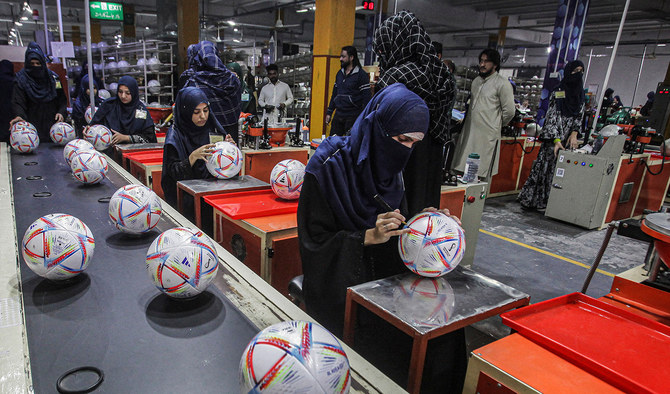
Workers conduct the final check to fix any cavity in the seams of balls inside the soccer ball factory in Sialkot, Pakistan on December 2, 2022. (REUTERS)
Short Url
Updated 09 December 2022
Follow

'Made-in-Sialkot' Adidas ball puts Pakistan in the World Cup

  • Sialkot has a rich history of making soccer balls and other sporting equipment dating back to colonial times
  • The eastern Pakistani city made more than 43 million balls valued at $191 million in the 2021-22 financial year

SIALKOT: Even though it is a cricket-mad nation, Pakistan is playing a big part in the soccer World Cup by making the balls used on the training fields in Qatar and the replicas sold to fans worldwide. 

Forward Sports, a multinational sports equipment company in the northeastern city of Sialkot, has been working with Adidas AG for almost 20 years. It is one of the two manufacturers of Adidas’ Al Rihla, the official World Cup ball. 
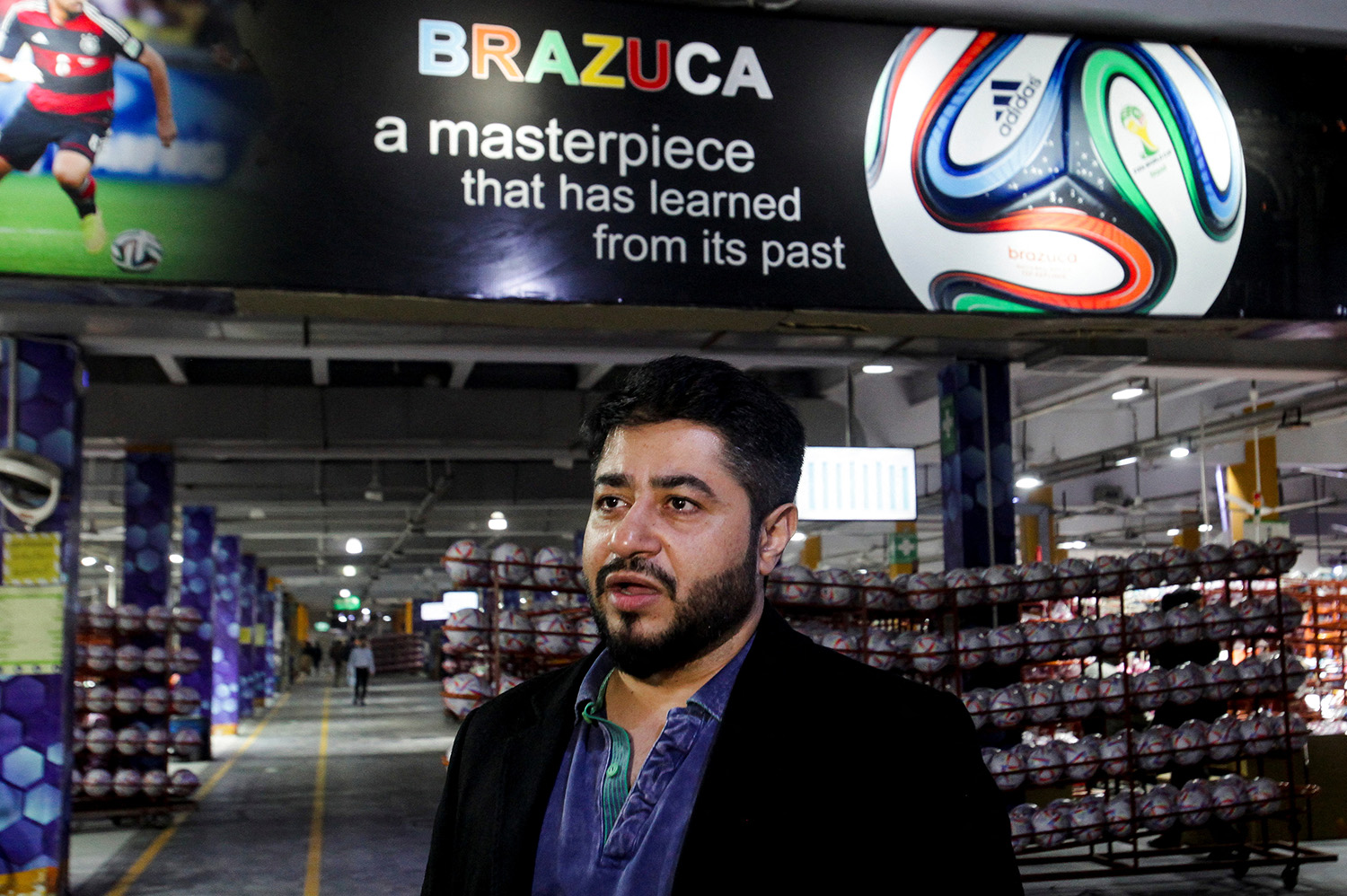


Hassan Masood Khawaja director of Forward Sports, the official manufacturer of sports goods for Adidas, speaks with Reuters at his factory in Sialkot, Pakistan on November 30, 2022. (REUTERS)

Forward Sports Director Hassan Masood Khawaja said his company had made 5.5 million Al Rihla balls, including 60,000 high-quality replicas of the balls used in matches, only without the real-time technology helping referees with offside and line calls. 

They are used by the teams as they train in Qatar, and sold as a premium product to football enthusiasts across the globe, with the rest sold as lower-priced leisure and souvenir balls. The match balls are made in China. Adidas declined to identify the manufacturer. 
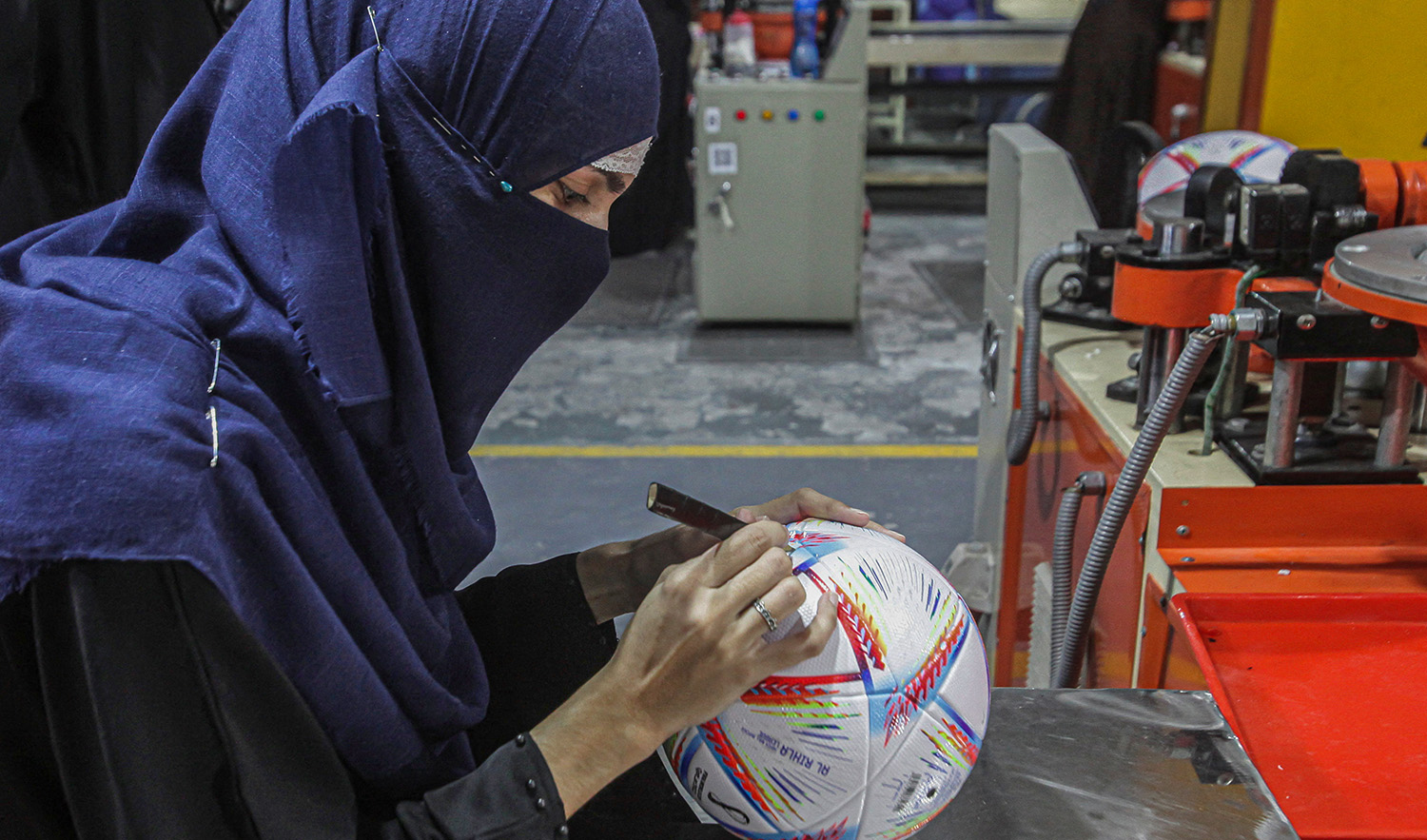


A worker conducts the final check to fix any cavity in the seams of a ball inside the soccer ball factory in Sialkot, Pakistan December 2, 2022. (REUTERS)

For the company, the contract is a source of pride. 

“More than business, it is a matter of prestige and honor for us to make the World Cup ball,” Khawaja said. 

“How do we do it? It’s the skill of the people ... and our love for the sport,” he said. 


Workers check the finish of the soccer balls before packing them inside the soccer ball factory, in Sialkot, Pakistan November 30, 2022. (REUTERS)

While soccer is popular among fans, the national side is ranked 194 out of 211 countries by FIFA. Cricket reigns supreme. 

Sialkot has a rich history of making soccer balls and other sporting equipment dating back to colonial times. 

Pakistan remains one of the world’s biggest manufacturers of soccer balls, along with China and India. The local chamber of commerce said more than 43 million balls valued at $191 million were made in Sialkot in the 2021/22 financial year. 

About 8 percent of Sialkot’s population of around 1 million people work in the industry, but many say they have little time to actually see their product in action. 

“We work all day,” said Forward Sports quality control inspector Amna, when asked if she watched soccer. “At night, when we go home, we need to rest.”


Pakistan finance chief calls for change to population-based revenue-sharing formula

Updated 14 February 2026
Follow

Pakistan finance chief calls for change to population-based revenue-sharing formula

  • Muhammad Aurangzeb criticizes current NFC formula, says it is holding back development
  • Minister says Pakistan to repay $1.3 billion debt in April as economic indicators improve

ISLAMABAD: Pakistan’s Finance Minister Muhammad Aurangzeb said on Saturday the country’s revenue-sharing formula between the federal and provincial governments “has to change,” arguing that allocating the bulk of funds on the basis of population was holding back long-term development.

The revenue-sharing is done under the National Finance Commission (NFC) Award that determines how federally collected taxes are divided between the center and the provinces. Under the current formula, much of the distribution weight is based on population, with smaller weightages assigned to factors such as poverty, revenue generation and inverse population density.

“Under the NFC award, 82 percent allocation is done on the basis of population,” Aurangzeb said while addressing the Federation of Pakistan Chambers of Commerce & Industry’s regional office in Lahore. “This has to change. This is one area which is going to hold us back from realizing the full potential of this country.”

Economists and policy analysts have long suggested broadening the NFC criteria to give greater weight to tax effort, human development indicators and environmental risk, though any change would require political consensus among provinces, making reform politically sensitive.

Aurangzeb also highlighted the economic achievements of the country in recent years, saying Pakistan’s import cover had improved from roughly two weeks just a few years ago to about 2.5 months currently, adding that the government had repaid a $500 million Eurobond last year.

“The next repayment is of $1.3 billion in April,” he continued, adding that “we will pay these obligations, which are the obligations of Pakistan, as we go forward.”

The minister also noted that unlike in 2022, when devastating floods forced Pakistan to seek international pledges at a Geneva conference, the government did not issue an international appeal during more recent flooding, arguing that fiscal buffers had strengthened.

“This time, the prime minister and the cabinet decided that we do not need to go for international appeal because we have the means,” he said.

He reiterated the government was pursuing export-led growth to avoid repeating past boom-and-bust cycles driven by import-led expansion that quickly depleted foreign exchange reserves and pushed Pakistan back into International Monetary Fund programs.