

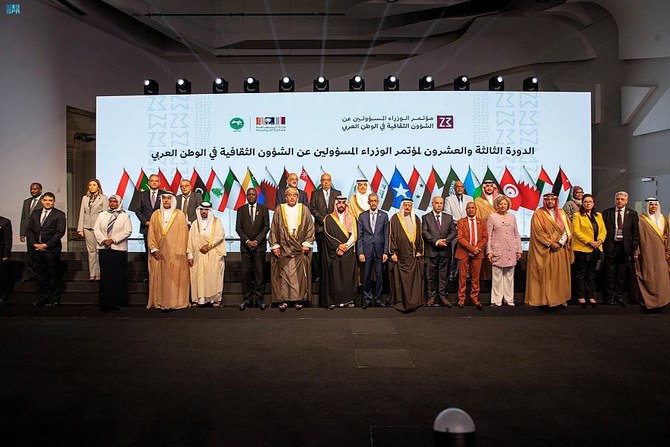
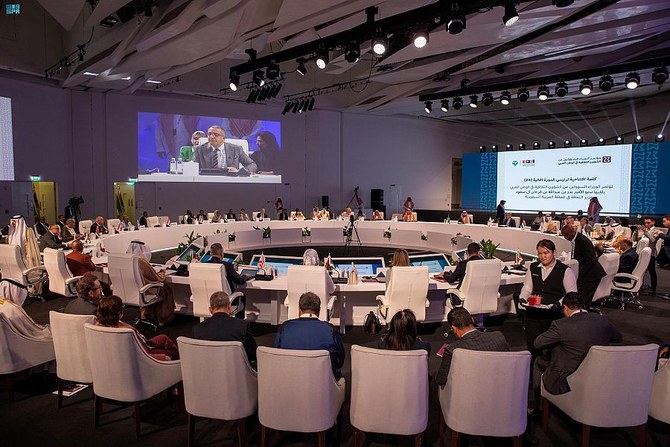

RIYADH: Saudi Arabia’s Ministry of Culture, in cooperation with the Arab League Educational, Cultural and Scientific Organization, on Wednesday organized the 23rd Conference of Arab Culture Ministers in the capital, Riyadh, the Saudi Press Agency reported.
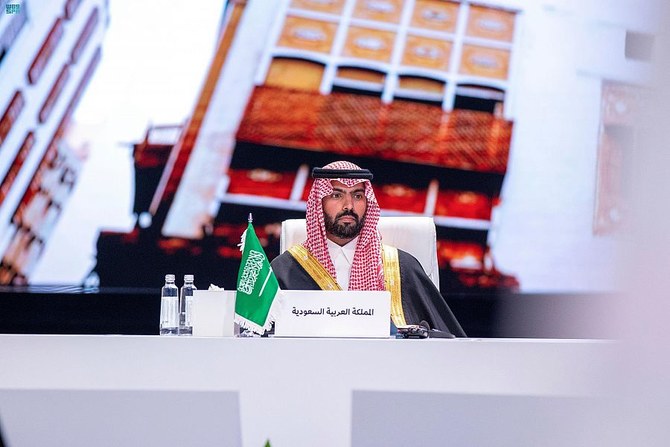
The event, which was held under the patronage of Prince Badr bin Abdullah bin Farhan, minister of culture, and chairman of the National Committee for Education, Culture and Science, was attended by ministers and officials from 20 Arab countries, as well as representatives of the Arab League, and regional and international organizations.
The minister of culture, who is also president of the 23rd session, said: “This year’s session, whose main theme is: ‘Culture and the green future,’ aims to make the cultural sector more sustainable, as we seek to make it the starting point of international efforts involving the cultural sector with its various branches, extending to cover all elements of its value chain.”
He added: “The utilization of culture toward the green future contributes to instilling culture in the global development debate, which receives the full attention of King Salman and Crown Prince Mohammed bin Salman, through the Kingdom’s participation in global cultural platforms, where the ‘Culture and the green future’ theme conforms to the goals of the Kingdom Vision 2030.”
He said that this, in return, highlights the Kingdom’s support of collective efforts to enhance knowledge, skills and practices related to making the cultural sector more sustainable and environmentally friendly.
During the conference, ministers focused on the role of culture in achieving sustainable development, while working to develop effective sectorial policies that bring added value to collective efforts to move toward a more creative and sustainable future.
Meanwhile, Prince Badr met with his Egyptian counterpart Nevin Al-Kilany on the sidelines of the forum, where the two sides signed a memorandum of understanding to enhance cooperation in the cultural field.
The memorandum included cultural fields, such as heritage, visual arts, performing arts, literature, books and publishing, Islamic decoration and other creative tracks.
It also included work to enhance the participation of Saudi and Egyptian intellectuals in festivals and cultural events held in the two countries, in addition to joint cooperation in training and qualifying local artistic cadres, and benefiting from experiences in the two countries in the fields of museums, urban heritage and handicraft industries.
Prince Badr praised the strong strategic relations that link the Kingdom with Egypt in all cultural fields. The two parties also discussed cooperation in the field of registering intangible heritage files with UNESCO, and cooperation in the field of exchanging expertise through cultural scholarship programs.
Prince Badr met with the Moroccan Minister of Youth, Culture and Communication Mohamed Mehdi Bensaid where another agreement was signed to enhance cultural cooperation in various fields, including literature, publishing and translation, heritage, architecture and design, museums, theater and performing arts.
The memorandum also included enhancing the participation of Saudi and Moroccan intellectuals in festivals and cultural events held in the two countries, in addition to exchanging expertise in organizations and cultural policies.
He also held similar meetings with the Director-General of the Islamic World Educational, Scientific and Cultural Organization Salem Al-Malik, and the Director-General of ALECSO, Mohamed Ould Amar, where they discussed the most prominent current cooperation programs between the organizations and the Kingdom, and memoranda of understanding were signed.
He also met with his Tunisian and Djiboutian counterparts, and the president of the Bahrain Authority for Culture and Antiquities.


