

Chinese president’s Saudi visit to boost investment in China-Pakistan corridor project: Experts

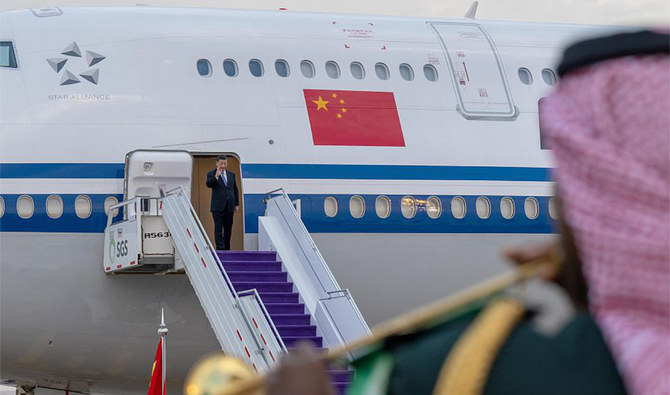
Xi arrived in Riyadh on Wednesday for a three-day visit aimed at bolstering trade ties and expected to lead to a “strategic agreement” between the regional powers. (SPA)
Short Url
Updated 07 December 2022
Follow

Chinese president’s Saudi visit to boost investment in China-Pakistan corridor project: Experts

  • Xi Jinping scheduled to meet other Arab leaders while visiting Kingdom
  • $65bn CPEC project an economic corridor in Pakistan connecting China to Arabian Sea

ISLAMABAD: Pakistan will benefit from stronger Saudi-China relations, experts said on Wednesday, as the visit of Chinese President Xi Jinping to the Kingdom was expected to bring in more investment to the China-Pakistan Economic Corridor project.

Xi arrived in Riyadh on Wednesday for a three-day visit aimed at bolstering trade ties and expected to lead to a “strategic agreement” between the regional powers.

The Chinese leader was due to meet Crown Prince Mohammed bin Salman and other heads of state from Gulf Arab nations when Saudi Arabia hosts China-Gulf and China-Arab summits in its capital.

Saudi Arabia and China were expected to sign more than 20 initial agreements worth more than $29.3 billion during Xi’s trip. The two countries were also discussing a plan to harmonize the implementation of Vision 2030 and China’s Belt and Road Initiative.

CPEC, a $65 billion economic corridor in Pakistan that connects China to the Arabian Sea and is part of Beijing’s infrastructure initiative, was also expected to feature in Xi’s meetings with the crown prince.

“Saudi Arabia is interested in becoming part of CPEC by investing heavily in it and also interested in BRI and this visit will improve things in this regard as China is the main initiator of both mega projects,” Pakistan’s former ambassador to China, Naghmana Hashmi, told Arab News.

Saudi Arabia, alongside the UAE and Germany, is among countries that have expressed interests in investing in CPEC. In 2019, the Kingdom announced plans to set up a $10 billion oil refinery in Pakistan’s deep-water port of Gwadar on the Arabian Sea.

CPEC is a sprawling package that includes everything from road construction and power plants to agriculture. In the South Asian nation, it has been billed as a massive development program that will bring new prosperity, where the average citizen lives on just $125 a month.

“The growing friendship between China and Saudi Arabia will benefit Pakistan as the country has very good relations with both, and both are pillars of strength for us,” Hashmi said.

International relations expert Zafar Jaspal told Arab News that the visit would have a “constructive and positive impact on CPEC” and “open the way for Saudi investment.”

Xi’s trip to Riyadh could serve as a “great convergence point” between Pakistan, China, and Saudi Arabia, according to Dr. Huma Baqai, an international relations expert and rector of the Millennium Institute of Technology and Entrepreneurship in Karachi.

“The visit can give the requisite push and momentum to the intended Saudi investment in the flagship project of the BRI,” she told Arab News.


First climate migrants arrive in Australia from sinking Tuvalu in South Pacific

Updated 3 sec ago
Follow

First climate migrants arrive in Australia from sinking Tuvalu in South Pacific

SYDNEY: The first climate migrants to leave the remote Pacific island nation of Tuvalu have arrived in Australia, hoping to preserve links to their sinking island home, foreign affairs officials said on Thursday.
More than one-third of Tuvalu’s 11,000 population applied for a climate visa to migrate to Australia, under a deal struck between the two countries two years ago.
The intake is capped at 280 visas annually to prevent a brain drain in the small island nation.
Among the islanders selected in the initial intake of climate migrants is Tuvalu’s first female forklift driver, a dentist, and a pastor focused on preserving their spiritual life thousands of kilometers (miles) from home, Australian government officials said.
Tuvalu, one of the countries at greatest risk from climate change because of rising sea levels, is a group of low-lying atolls scattered across the Pacific between Australia and Hawaii.
Manipua Puafolau, from Tuvalu’s main island of Funafuti, arrived in Australia a fortnight ago. A trainee pastor with the most prominent church in Tuvalu, he plans to live in the small town of Naracoorte in the state of South Australia, where several hundred Pacific Islanders work in seasonal agriculture and meat processing jobs.
“For the people moving to Australia, it is not only for their physical and economic well-being, but also calls for spiritual guidance,” he said in a video released by Australia’s foreign affairs department.
Tuvalu Prime Minister Feleti Teo visited the Tuvaluan community in Melton, Melbourne, last month to emphasize the importance of maintaining strong ties and cultural bonds across borders as citizens migrate, Tuvalu officials said.
On Tuvalu’s main atoll of Funafuti, the land is barely wider than the road in many stretches. Families live under thatched roofs, and children play football on the airport runway due to space constraints.
By 2050, NASA scientists project daily tides will submerge half of Funafuti atoll, home to 60 percent of Tuvalu’s residents, where villagers cling to a strip of land as narrow as 20 meters (65 feet). The forecast assumes a one-meter rise in sea levels, while the worst case, double that, would put 90 percent of the country’s main atoll under water.

CLIMATE VISAS OFFER ‘MOBILITY WITH DIGNITY’
Australia’s Foreign Minister Penny Wong said the climate migrants would contribute to Australian society.
The visa offered “mobility with dignity, by providing Tuvaluans the opportunity to live, study and work in Australia as climate impacts worsen,” Wong said in a statement to Reuters.
Support services are being established by Australia to help Tuvaluan families set up in the east coast city of Melbourne, Adelaide in South Australia and in the northern state of Queensland.
Kitai Haulapi, the first female forklift driver in Tuvalu, recently married and will relocate to Melbourne, population five million. In a video released by Australia’s foreign affairs department she says that she hopes to find a job in Australia and continue to contribute to Tuvalu by sending money back to her family.
Dentist Masina Matolu, who has three school-aged children and a seafarer husband, will move with her family to the northern Australian city of Darwin. She plans to work with indigenous communities.
“I can always bring whatever I learn new from Australia back to my home culture, just to help,” she said in a video statement.