Pakistan could be world’s sixth largest economy by 2075— Goldman Sachs report

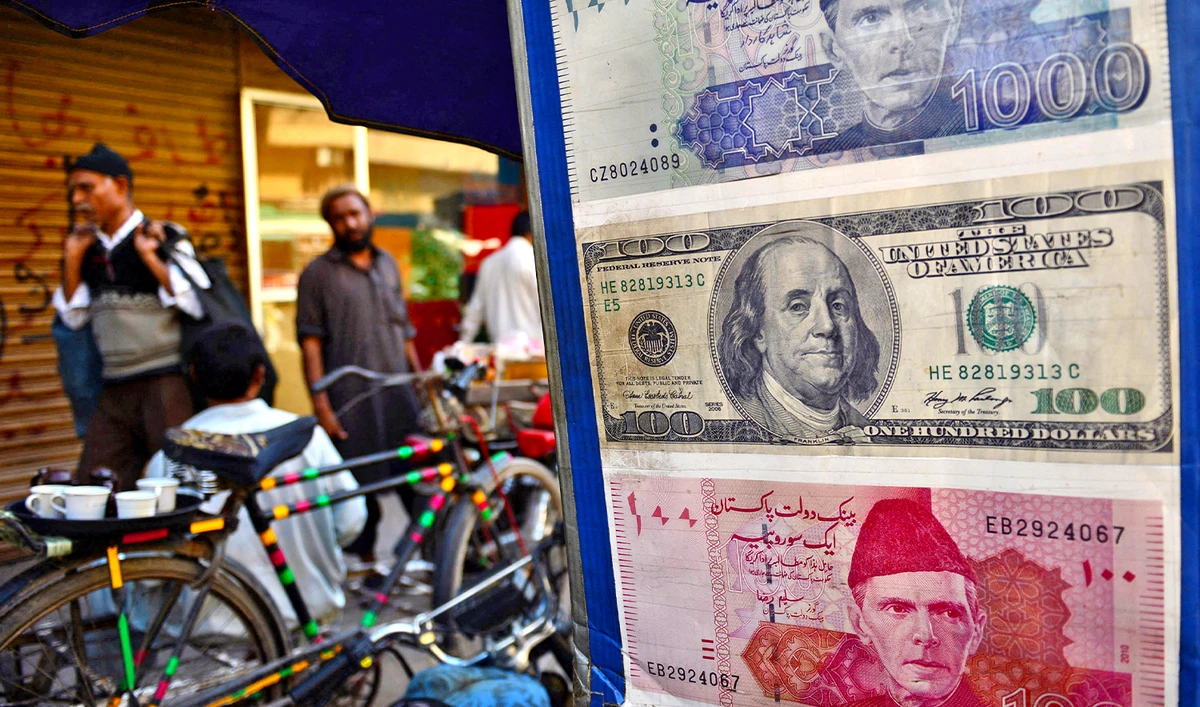
Pakistani pedestrians walk past a roadside currency exchange stall displaying examples of Pakistani and US currency notes in Karachi on February 11, 2013. (AFP/FILE)
Short Url
Updated 07 December 2022
Follow

Pakistan could be world’s sixth largest economy by 2075— Goldman Sachs report

  • China to overtake US as world’s largest economy by 2050, report says
  • Climate catastrophe, populist nationalists in power risk to projections

ISLAMABAD: Pakistan could be the sixth largest economy in the world by 2075, according to a report compiled by renowned US investment banking firm Goldman Sachs earlier this week.

Titled ‘The Path to 75’, the research report predicts the state of the global economy in the decades to come and goes as far as 2075. 

According to the report, China will dethrone the US in 2050 to become the largest economy in the world. However, by 2075, the report predicts the largest economies in the world would be China, India, the US, Indonesia, Nigeria and Pakistan.

“By 2075, with the appropriate policies and institutions, Nigeria, Pakistan and Egypt could be among the world’s largest economies,” it stated. The prediction regarding Pakistan’s growth was made due to the country’s population growth in the years to come.

The report warned, however, that climate catastrophes and populist leaders were risks to its projections.
It added that populist nationalists in power may lead to increased protectionism that could potentially result in the reversal of globalization which could increase income inequality across countries.

Furthermore, Goldman Sachs predicted that global growth will average just under 3 percent a year over the next decade, down from 3.6 percent in the decade before the financial crisis. The report said that global growth would be on a gradually declining path afterwards, reflecting a slowing of the labor force growth.

In another key projection, the report said that emerging markets would continue to converge with industrial nations as China, the US, India, Indonesia and Germany top the league table of the largest economies when measured in dollars.

Nigeria, Pakistan and Egypt could also be among the biggest, it added.


Pakistan’s deputy PM says country seeks to convert $1 billion UAE deposit into investment

Updated 17 sec ago
Follow

Pakistan’s deputy PM says country seeks to convert $1 billion UAE deposit into investment

  • Ishaq Dar says the UAE will acquire shares in Pakistani companies using the amount, with transaction to be completed by March 31
  • The UAE’s remaining $2 billion in deposits, part of funds used to shore up Pakistan’s foreign reserves, are due for rollover in January

ISLAMABAD: Pakistan is seeking to convert part of its financial support from the United Arab Emirates into long-term investment to reduce external debt, Deputy Prime Minister Ishaq Dar said on Saturday, following talks with UAE President Sheikh Mohamed bin Zayed Al Nahyan during his visit to Islamabad.

Dar said Pakistan was engaged with the UAE on converting $1 billion in deposits into equity investment, potentially involving stakes in companies linked to the Fauji Fertilizer Group, a move that would end Pakistan’s repayment obligation on that portion of the funds.

The UAE has been one of Pakistan’s key financial backers in recent years, providing $3 billion in deposits to the central bank as part of a broader effort to stabilize the country’s external finances and unlock support from the International Monetary Fund.

Speaking at a year-end briefing, Dar said Pakistan had already begun discussions with the UAE on rolling over the first $1 billion tranche, but Islamabad now wanted to replace short-term borrowing with investment.

“They will be acquiring some shares, and this liability will end,” Dar said, adding that discussions were under way for the transaction to be completed by March 31.

Dar said the Fauji Foundation Group was taking the lead in the process, with plans for partial disinvestment by Fauji-linked and other companies to facilitate the deal.

He added that Pakistan also raised the issue of a separate $2 billion rollover due in January during talks with the UAE leadership, saying Islamabad had conveyed that converting debt into investment would be preferable to repeated rollovers.

The issue was discussed during Al Nahyan’s visit, which Dar described as cordial, adding that the UAE had expressed willingness to expand its investment footprint in Pakistan.

Pakistan has relied on repeated rollovers of deposits from friendly countries to manage its balance-of-payments pressures, a practice economists say provides short-term relief but adds to debt vulnerabilities unless replaced with foreign direct investment.

The country acquired $5 billion from Saudi Arabia and $4 billion from China, which, along with the UAE, helped shore up its foreign reserves and meet IMF conditions at a time when its external account was under severe pressure.

Dar said Pakistan was now focused on shifting from temporary financing toward longer-term capital inflows to stabilize its economy and reduce reliance on external borrowing.