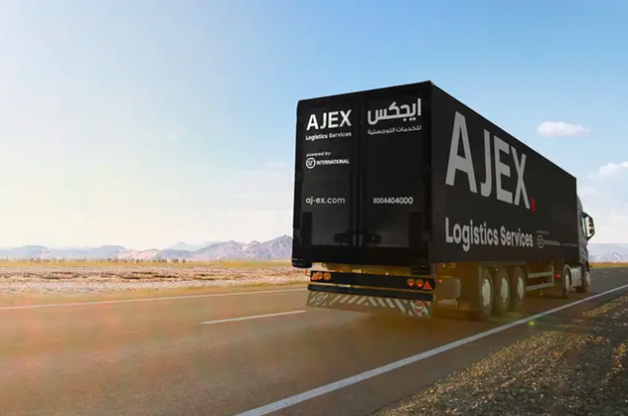
Saudi Arabia’s Ajex expands its logistics services to China and Middle East 

(AJEX)
Short Url
Updated 07 December 2022
Follow

Saudi Arabia’s Ajex expands its logistics services to China and Middle East 

RIYADH: Saudi firm Ajex Logistics Services has announced the launch of two new services as a part of its expansion strategy into China and the Middle East. 

The services are the AJEX international e-commerce express, known as ICX, and AJEX international express service, called IXS.  

They will provide businesses in China, Saudi Arabia, UAE, and Bahrain with a portfolio of express cross-border delivery services for customers.  

“Introducing ICX and IXS services in China, Saudi Arabia, UAE and Bahrain is an important enhancement to our service portfolio, driven by our customers’ requirements for speed, reliability, and transparency,” said Ajex's Chief Marketing & Experience Officer Nathalie Amiel-Ferrault.  

She added: “Saudi Arabia is the largest e-commerce market in the Middle East, and the end-consumers expect flexibility, late-night deliveries, and ease of payment, with cash-on-delivery representing more than 30 percent of e-commerce.”   

According to the report, customers will be able to send single-piece and multi-piece shipments from China to Saudi Arabia, UAE and Bahrain in four to seven days.  

Ajex is a joint venture between Ajlan & Bros Holding and SF Express. 

For Saudi Arabia, logistics is a crucial sector to achieve its goals outlined in Vision 2030, as the Kingdom is now diversifying its economy, which has been dependent on oil for several decades.  

Earlier in October, while speaking at the Supply Chain and Logistics Conference in Riyadh, Saudi Minister of Transport and Logistics Saleh Al-Jasser said that the Kingdom is working to inaugurate 59 logistic zones to bolster supply chains and logistic services.  

In June, in an exclusive interview with Arab News, Sulaiman Al-Mazroua, CEO of the National Industrial Development and Logistics Program, noted that the Kingdom’s logistics sector needs a huge investment combined between the government and private sector by 2030.  

He added that Saudi Arabia would provide the right business environment to attract world transportation companies to operate in the Kingdom, which will help the nation emerge as one of the world’s busiest logistics centers. 


Egypt signs energy MoUs with Syria, expanding regional supply role 

Updated 5 sec ago
Follow

Egypt signs energy MoUs with Syria, expanding regional supply role 

JEDDAH: Egypt has signed two memorandums of understanding with Syria to supply natural gas for electricity generation and provide petroleum products, as Cairo moves to strengthen its position as a regional energy transit hub.

According to Egypt’s petroleum ministry, the agreements were signed during talks between its Minister of Petroleum and Mineral Resources Karim Badawi and a Syrian delegation led by Deputy Minister of Energy for Oil Affairs Ghiath Diab.

The deals were formalized by Diab and Mohamed El-Bagoury, head of legal affairs at the Egyptian ministry. 

The agreements come as Egypt seeks to capitalize on its liquefied natural gas plants, pipelines and floating regasification units to position itself as a regional energy hub. 

Syria’s energy sector has been severely weakened by years of conflict and damaged infrastructure, prompting redevelopment efforts and regional cooperation which underscores the importance of external partnerships in rebuilding the country’s power and oil networks. 

“The meeting reflects Egypt’s role as a regional logistics hub for all types of energy, both fossil and non-fossil,” the ministry said in a statement, reaffirming its readiness to provide technical expertise and support to Syria’s energy sector as part of efforts to assist the Syrian people. 

Under the first MoU, Egypt will cooperate in supplying gas to Syria for power generation, using its existing infrastructure, including regasification vessels and transmission networks. 

The second agreement relates to meeting the country’s needs for petroleum products. 

The meeting also discussed opportunities to rehabilitate Syria’s oil and gas infrastructure and benefit from Egyptian expertise in the sector. 

The deals with follow recent energy cooperation with Lebanon and earlier arrangements with Cyprus aimed at routing Eastern Mediterranean gas through Egypt’s facilities. 

Speaking at the ADIPEC conference in Abu Dhabi in November, Badawi highlighted Egypt’s growing role as a regional hub for energy transit and trade, supported by fully integrated and ready infrastructure. 

He said this demonstrated the country’s ability to provide a fast, cost-effective and reliable route for delivering East Mediterranean gas resources to global markets at competitive prices. 

Badawi cited plans to connect Cyprus’s Cronos gas field to Egypt’s network as a key step toward deeper regional integration, allowing current and future Cypriot discoveries to be processed through Egyptian liquefaction and export facilities.