

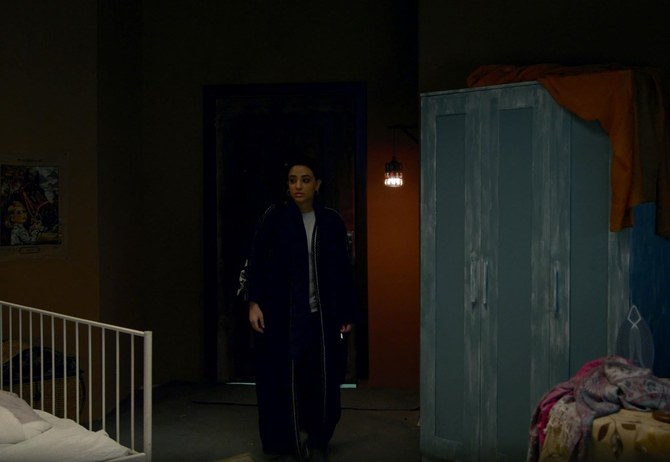

RIYADH: “Slave,” a sci-fi thriller, premiered at the Red Sea International Film Festival 2022 this week and the film’s executive producer and director gave a glimpse of what went behind the scenes.
“It is impossible for me to make another film in which I will have strong feelings like this movie because many of the events in this movie happened to me in real life or in a similar way,” said Mansour Assad. “The movie is a story that I have wanted to tell people for a long time.”

Mansour Assad, executive producer and director of ‘Slave.’ (Supplied)
The main cast of the film comprises Mohammed Ali, Khairiah Abulaban, and Ziyad Alamri.
The film tells the story of a man named Sakker and his wife, Latifa who made a movie that resulted in anger and backlash from society.
Sakker was then presented with an option to continue living his life the way it is with society enraged at him and his wife or travel back in time to appease his community.
“He is a slave to his family, friends, and people. He cares about their opinion and the opinion of society, and he cannot settle anything unless society approves of it, so he is a slave to society,” Assad explained.
Sakker decides to return back in time to conform to the expectations of his community but then finds himself stuck in an endless time loop, becoming a slave to societal norms.
“The name of the movie is ‘Slave’ because it’s bold. The filming method is bold, in which the colors are blue, pink, blue, and red. Everyone who wears these colors is considered strange,” Assad said.
“The story is bold. We did not adhere to the traditional boundaries of stories we are used to. The story is long and contains science fiction … it requires double the effort of a traditional film.”
The director explained that the filming of each scene was intricate and detailed, requiring comprehensive training to ensure authenticity in the situations.
“The film had many different scenes, some were action scenes others drama that required specific training. Every time we filmed a specific scene, there was a lot of training behind it,” Assad said.
“Sometimes we would go to the main character's apartment, Alamri and we would both just sit there alone and practice the different scenes.”
Assad highlighted that one of the film’s scenes took place in a hospital where one of the characters was being treated. Before filming the scene, the director brought in a doctor specializing in the condition the patient faced in order to give insights into mannerisms, treatment, and condition.
“The doctor gave us advice on the condition, and the equipment in the hospital used to treat the patient on the scene. Every detail was focused on from the way the doctor spoke to the appearance and all of the details around him. Each scene we filmed required this intense level of training,” Assad said.
The film, which began shooting in October 2021 and concluded in August 2022, was shot in Riyadh. The filming phase of the movie took 9 days only but was filmed in three phases throughout the year to acquire funding as the filming process progressed.
“The time of writing the script and filming the scenes was different in this film, firstly I wanted to create this film without waiting for anyone. I wanted to work on it, I didn’t want to wait until I received support or funding, or when I became a better director. I wanted to create this film whether it turns out good or bad, I wanted more experience to do feature films,” Assad said.
“I began the film without any support and we filmed in three phases, each phase we would finish and edit the film and then go acquire funding by showing the producer or fenders what we completed,” he added.
The director’s advice to budding filmmakers is to start independently and not to wait for formal funding or support to come to them.
“Start your project yourself and make mistakes. People aren't going to judge you because they'll know that you did everything yourself so they will overlook many of your mistakes in the film.
“You as a filmmaker will also gain more experience, when you go to an entity that has a fund they will be more confident in you because you made a film.
“Make your first film and make it with the lowest budget you possibly can, you'll gain experience, and people won't judge your mistakes, everyone wins,” he said.
“I am waiting for the feedback and responses from audiences and critics, real and authentic responses. I don't need them to support me by flattering me. Or to say that they enjoyed the film when they didn't I want to hear all of their criticisms and observations, no matter how strong the criticism is, I don't get upset because this is going to help me,” the director said.


