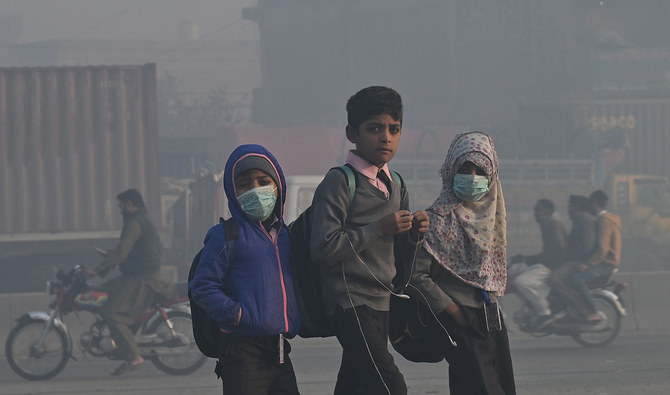

ISLAMABAD: Amid ‘calamitous’ levels of smog in Punjab province, the government has announced the closure of schools three days a week and of private offices two days a week, the provincial administration said in separate notifications on Wednesday.
The latest ranking showed the PM2.5 concentration in Lahore, the capital of Punjab, at 36.9 times the WHO annual air quality guideline value. PM2.5 is lung-damaging particulate matter smaller than 2.5 microns.
Lahore, which is frequently described as the cultural capital of Pakistan, faces heavy smog in the winter months as farmers burn the stubble of harvested crops before planting new ones.
“It is notified that owing to prevailing SMOG condition, all Public & Private Schools in District Lahore shall remain closed on every Friday & Saturday, in addition to the weekly holiday on Sunday till further orders,” a notification released by the provincial education department said.
A separate notification by the Punjab Provincial Disaster Management Authority (PDMA) said private businesses would remain closed two days a week in favor of “work from home.”
The Lahore High Court had on Tuesday ordered the government to notify the closure of schools in the provincial capital for at least three days a week and of private offices two days a week. Justice Shahid Karim of the LHC passed the order while hearing public interest petitions.
Punjab chief minister, Chaudhry Pervez Elahi, has described the smog situation as a “calamity” and instructed the environmental protection department to address its causes. He also announced his administration’s decision to act against farmers who burn crop stubble, which is an illegal practice in the province.
Lahore suffers from high levels of air pollution, with the city regularly ranking at the top of IQAir AirVisual’s live pollution rankings of major global cities. However, pollution only became a public issue in early 2017, when actionable air quality data was published for the first time in Pakistan.
In the absence of publicly available government data, a network of citizen-operated sensors began to monitor PM2.5 and report data in real-time. The data laid bare Lahore’s high levels of air pollution, shocking the public and becoming a media talking point for the first time.
The resulting publicity led to a public interest petition to review the government’s response to the smog crisis, which was heard at the Lahore High Court in November 2017. The court ordered authorities to prepare an updated smog response action plan, and publish daily pollution updates until it was able to publish hourly updates, as the non-government monitors do.
Following the court order, the Punjab Environment Protection Council approved a Smog Action Plan and adopted an Air Quality Index (AQI) classification system in 2017. However, the AQI has been criticized by air quality advocates as being too lax and underreporting the severity of the pollution.
As of November 2019, Pakistani authorities still don’t publish any real-time PM2.5 air quality data. All data come from non-government sensors and the US State Department. The US Embassy in Islamabad, and the three US Consulates in Karachi, Lahore and Peshawar began monitoring and publishing real-time PM2.5 data online in the first half of 2019.
Air quality in Lahore usually worsens during the winter season from October to February when farmers in the wider Punjab province set light to the remnants of crops, producing smoke that adds to smog. At the same time, weather changes mean pollutants remain trapped in the air for longer.
Air pollution in Lahore is also caused by a combination of vehicle and industrial emissions, smoke from brick kilns, the burning of crop residue and general waste, and dust from construction sites. Other factors of air pollution include large scale losses of trees to build new roads and buildings.
Winter air pollution is worse due to temperature inversion, which results in a layer of warm air that is prevented from rising trapping air pollutants.