

Punjab schools get three-day weekend due to smog, private offices to close two days a week

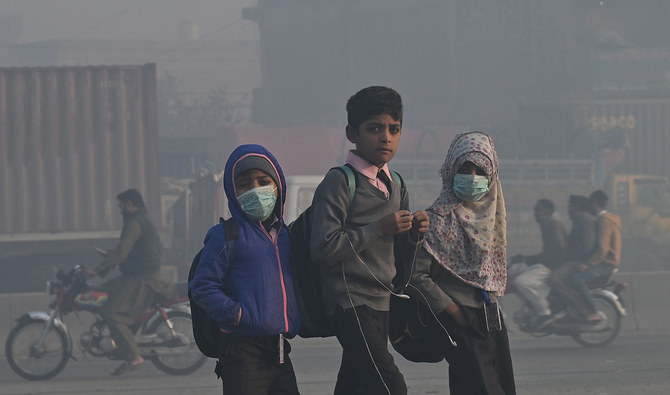
Children walk to school amid heavy smog conditions in Lahore on December 1, 2022. (Photo courtesy: AFP)
Short Url
Updated 07 December 2022
Follow

Punjab schools get three-day weekend due to smog, private offices to close two days a week

  • Lahore regularly ranks at top of IQAir AirVisual’s live pollution rankings of major global cities
  • As of November 2019, Pakistani authorities still don’t publish real-time PM2.5 air quality data

ISLAMABAD: Amid ‘calamitous’ levels of smog in Punjab province, the government has announced the closure of schools three days a week and of private offices two days a week, the provincial administration said in separate notifications on Wednesday.

The latest ranking showed the PM2.5 concentration in Lahore, the capital of Punjab, at 36.9 times the WHO annual air quality guideline value. PM2.5 is lung-damaging particulate matter smaller than 2.5 microns.

Lahore, which is frequently described as the cultural capital of Pakistan, faces heavy smog in the winter months as farmers burn the stubble of harvested crops before planting new ones.

“It is notified that owing to prevailing SMOG condition, all Public & Private Schools in District Lahore shall remain closed on every Friday & Saturday, in addition to the weekly holiday on Sunday till further orders,” a notification released by the provincial education department said.

A separate notification by the Punjab Provincial Disaster Management Authority (PDMA) said private businesses would remain closed two days a week in favor of “work from home.”

The Lahore High Court had on Tuesday ordered the government to notify the closure of schools in the provincial capital for at least three days a week and of private offices two days a week. Justice Shahid Karim of the LHC passed the order while hearing public interest petitions.

Punjab chief minister, Chaudhry Pervez Elahi, has described the smog situation as a “calamity” and instructed the environmental protection department to address its causes. He also announced his administration’s decision to act against farmers who burn crop stubble, which is an illegal practice in the province.

Lahore suffers from high levels of air pollution, with the city regularly ranking at the top of IQAir AirVisual’s live pollution rankings of major global cities. However, pollution only became a public issue in early 2017, when actionable air quality data was published for the first time in Pakistan.

In the absence of publicly available government data, a network of citizen-operated sensors began to monitor PM2.5 and report data in real-time. The data laid bare Lahore’s high levels of air pollution, shocking the public and becoming a media talking point for the first time.

The resulting publicity led to a public interest petition to review the government’s response to the smog crisis, which was heard at the Lahore High Court in November 2017. The court ordered authorities to prepare an updated smog response action plan, and publish daily pollution updates until it was able to publish hourly updates, as the non-government monitors do.

Following the court order, the Punjab Environment Protection Council approved a Smog Action Plan and adopted an Air Quality Index (AQI) classification system in 2017. However, the AQI has been criticized by air quality advocates as being too lax and underreporting the severity of the pollution.

As of November 2019, Pakistani authorities still don’t publish any real-time PM2.5 air quality data. All data come from non-government sensors and the US State Department. The US Embassy in Islamabad, and the three US Consulates in Karachi, Lahore and Peshawar began monitoring and publishing real-time PM2.5 data online in the first half of 2019.

Air quality in Lahore usually worsens during the winter season from October to February when farmers in the wider Punjab province set light to the remnants of crops, producing smoke that adds to smog. At the same time, weather changes mean pollutants remain trapped in the air for longer.

Air pollution in Lahore is also caused by a combination of vehicle and industrial emissions, smoke from brick kilns, the burning of crop residue and general waste, and dust from construction sites. Other factors of air pollution include large scale losses of trees to build new roads and buildings.

Winter air pollution is worse due to temperature inversion, which results in a layer of warm air that is prevented from rising trapping air pollutants.


Pakistan parliament calls for national response against ‘external sponsors’ of terror after Balochistan attacks

Updated 41 min 47 sec ago
Follow

Pakistan parliament calls for national response against ‘external sponsors’ of terror after Balochistan attacks

  • Militants killed 50 people, including 17 law enforcers, in coordinated attacks across Balochistan last week
  • Resolution follows government accusations that India backed the assaults, a charge New Delhi denies

ISLAMABAD: Pakistan’s National Assembly on Tuesday adopted a resolution condemning a wave of militant attacks in the southwestern province of Balochistan and called for an immediate, coordinated national response against what it described as “external sponsors” of terrorism.

The resolution came days after separatist militants carried out coordinated gun and bomb attacks across multiple districts in Balochistan, targeting security installations and government facilities, in one of the deadliest flare-ups of violence in the province in recent months.

Pakistan’s State Minister for Interior Tallal Chaudry said the attacks on Friday and Saturday killed 50 people, including 33 civilians and 17 law enforcement personnel. State media reported on Monday that security forces had killed 177 militants since the assaults began.

Interior Minister Mohsin Naqvi said last week that the attacks, claimed by the separatist Baloch Liberation Army (BLA), were planned from India. New Delhi rejected the allegation as “baseless,” saying Islamabad was attempting to deflect attention from its internal challenges. Pakistan has long accused India of backing militant groups in Balochistan and the northwestern province of Khyber Pakhtunkhwa, charges India has consistently denied.

The parliamentary resolution, tabled by Minister for Parliamentary Affairs Dr. Tariq Fazal Chaudhry, said evidence from several militant incidents had highlighted “external patronage” of armed groups and raised “serious concerns, particularly regarding the role of India.”

“This house demands that an immediate, comprehensive, coordinated and multi-dimensional national response be ensured against these external sponsors and internal facilitators, including funding, smuggling, and propaganda networks, bringing together the political, diplomatic, military, intelligence, legal and narrative fronts,” the resolution stated, according to a copy seen by Arab News.

It said terrorism in Pakistan was being facilitated through logistical and operational support, financial assistance, training, medical treatment, and propaganda networks originating from certain neighboring countries.

The resolution expressed solidarity with victims and their families and praised Pakistan’s security forces for what it described as effective action against militants. It also voiced concern over militant networks increasingly involving women in attacks.

“This house expresses profound grief, sorrow, and concern over the fact that terrorist networks are attempting to exploit women and use them against the state and society through coercion, psychological pressure and blackmail,” it said.

Lawmakers called for national unity and urged political forces to rise above differences, vowing that the state would not compromise on the protection of its citizens or national security.

Balochistan, Pakistan’s largest province by land area, has long faced a separatist insurgency that has intensified in recent years. Militants frequently target security forces, government officials, infrastructure projects, foreigners, and non-local workers.

The province holds vast reserves of minerals and hydrocarbons and is central to the multibillion-dollar China-Pakistan Economic Corridor (CPEC), a flagship component of China’s Belt and Road Initiative.

Separatist groups such as the BLA accuse Islamabad of exploiting Balochistan’s natural resources while denying locals a fair share. Pakistan’s civilian and military leadership reject the claim and say they are investing in the province’s development.

Balochistan is home to vast reserves of minerals and hydrocarbons, and also to the multibillion-dollar China-Pakistan Economic Corridor (CPEC), a flagship component of China’s Belt and Road Initiative.

Separatist militant groups such as the BLA blame Islamabad for exploiting Balochistan’s natural resources and denying locals a share in them. The military and civilian government reject these allegations and say they are investing in the province’s development.