

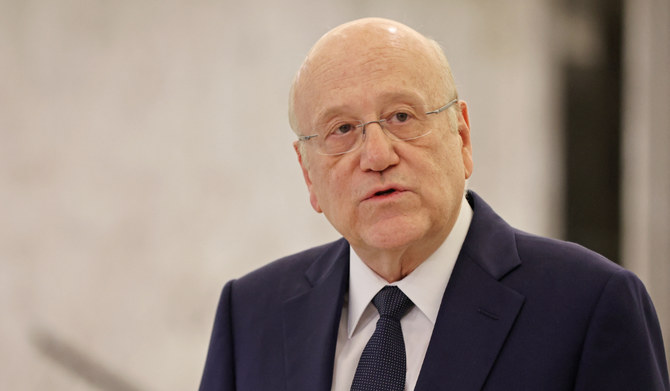

BEIRUT: Lebanese caretaker Prime Minister Najib Mikati has called for a Cabinet meeting on Monday to deal with urgent matters in the country.
He announced the move during a speech at the inauguration of the International Arab Book Fair in Beirut.
The move has outraged Christian blocs in the Lebanese ruling class which consider it an unconstitutional step and an attempt to bypass the priority of electing a new president.
Some eight electoral sessions have failed to procure a new president and the leadership vacuum has entered a second month.
Mikati confirmed that he had called the Cabinet to convene to try and tackle problems which, he said, were deemed important by ministers.
An agenda comprising 65 items has been issued, although Mikati pledged in a parliamentary session held about a month ago not to call a Cabinet session amid the presidential vacuum, unless everyone agreed to the move.
The decision raised concerns among members of the Free Patriotic Movement. The party denounced the invitation, fearing that the resigned government will carry out prerogatives reserved for the president.
In an attempt to reassure those who are skeptical, Mikati said more than 40 items could be excluded from the agenda.
He said: “We will only approve the matters that are deemed important and urgent by ministers.
“It disappoints me when some people consider the meeting a sectarian move or an attempt that targets a specific group.
“Do we discriminate when we provide assistance? What is being said is unacceptable.”
Mikati added: “There’s a file related to cancer and dialysis patients that should be approved.
“What our Cabinet does is perform governmental duties to serve the citizens. Whoever has an alternative can propose it.”
Mikati said he hoped no one would boycott the meeting as ministers had a sense of patriotism. He added he was hopeful of a broad participation on Monday.
He also called on those responsible to accelerate the process of electing a president.
He said: “What is required first and foremost is the political will of the various political forces and blocs to complete the convening of constitutional institutions by electing a new president as soon as possible.”
He added that the adoption of reform laws must take place before the final agreement with the International Monetary Fund, in order to secure the opportunity for the promised economic recovery.
The urgent item that prompted Mikati to call the Cabinet session is related to the settlement of amounts due to hospitals.
It includes the approval of a request to cover the purchase of medicines for incurable and cancerous diseases using $35 million from the Central Bank over three months.
Ministers from the FPM announced that they will boycott Monday’s session.
However, it has been reported that Mikati’s move received the support of Hezbollah and the Amal Movement, despite the strong alliance between Hezbollah and the FPM.
The Syndicate of Hospitals in Lebanon said that using people’s health for political sparring was unacceptable.
It said patients were not responsible for the presidential vacuum, nor for the governmental status and the prerogatives of the caretaker Cabinet.
It has been reported that Foreign Affairs Minister Abdallah Bou Habib, Tourism Minister Walid Nassar, Justice Minister Henri Khoury, Social Affairs Minister Hector Hajjar, Energy Minister Walid Fayad and Defense Minister Maurice Slim will not attend Monday’s meeting.
However, despite the boycott, the quorum will still be met, as two-thirds of the members and Christian ministers from other blocs will attend it.
Meanwhile, Maronite Patriarch Bechara Al-Rahi has criticized the inability of parliament to elect a president after eight electoral sessions.
He described the unsuccessful parliamentary sessions as “comical.”
Addressing the deputies of Hezbollah and the FPM, who keep casting blank votes, he added: “Why don’t you announce your candidate’s name?
“Why would you secure the quorum in the first round, then leave in the second round? Isn’t this disrespectful to the Lebanese people and the presidency?
“Why do you act like this when it comes to the Maronite Christian president, while you elect the parliamentary speaker in one session and the prime minister is designated immediately following parliamentary consultations?
“It is as if you are saying that you can do without a president. If you were keen on respecting the national pact, how is the Christian element represented when you keep missing the chance to elect a president?”


