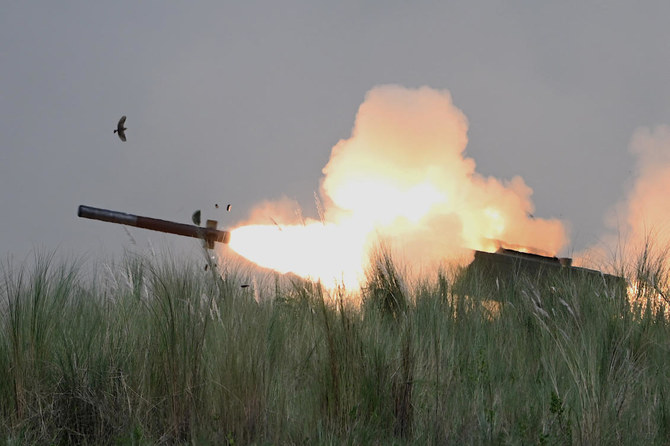
Estonia to buy HIMARS rocket launchers from US

It is the largest arms purchase in the country’s history. (FILE/AFP)
Short Url
Updated 03 December 2022
Follow

Estonia to buy HIMARS rocket launchers from US

  • Estonia, which neighbors Russia, has increased defense spending since Moscow’s invasion of Ukraine
  • The HIMARS systems delivered to Ukraine are widely seen as one of the most effective tools in its arsenal

Tallinn, Estonia: Estonia has agreed to buy six HIMARS rocket systems from the United States worth over $200 million, the state defense investment agency said on Saturday.
It is the largest arms purchase in the country’s history.
Estonia, which neighbors Russia, has increased defense spending since Moscow’s invasion of Ukraine, as has its Baltic neighbors, Latvia and Lithuania.
The HIMARS systems delivered to Ukraine are widely seen as one of the most effective tools in its arsenal, as the pro-Western country fights back against Russian troops.
Magnus-Valdemar Saar, director general of the Estonian Center for Defense Investments (ECDI), signed a contract on Friday with the United States’ Defense Security Cooperation Agency to boost the country’s indirect fire capability, the ECDI said in a statement.
Estonia will also “procure ammunition, communications solutions, as well as training, logistics, and life-cycle solutions,” said armament category manager Ramil Lipp.
The ECDI did not provide details on how many rockets were ordered but said the purchase included those which can strike targets at a distance of 300 kilometers (186 miles), and rockets of shorter range.
The first deliveries will arrive in 2024.
Lithuania last month said it would buy eight HIMARS rocket systems from the United States for $495 million.


Austria turns Hitler’s home into a police station

Updated 1 sec ago
Follow

Austria turns Hitler’s home into a police station

BRAUNAU AM INN: Turning the house where Adolf Hitler was born into a police station has raised mixed emotions in his Austrian hometown.
“It’s a double-edged sword,” said Sibylle Treiblmaier, outside the house in the town of Braunau am Inn on the border with Germany.
While it might discourage far-right extremists from gathering at the site, it could have “been used better or differently,” the 53-year-old office assistant told AFP.
The government wants to “neutralize” the site and passed a law in 2016 to take control of the dilapidated building from its private owner.
Austria — which was annexed by Hitler’s Germany in 1938 — has repeatedly been criticized in the past for not fully acknowledging its responsibility in the Holocaust.
The far-right Freedom Party, founded by former Nazis, is ahead in the polls after getting the most votes in a national election for the first time in 2024, though it failed to form a government.
Last year, two streets in Braunau am Inn commemorating Nazis were renamed after years of complaints by activists.

- ‘Problematic’ -

The house where Hitler was born on April 20, 1889, and lived for a short period of his early life, is right in the center of town on a narrow shop-lined street.
A memorial stone in front reads: “For Peace, Freedom and Democracy. Never Again Fascism. Millions of Dead Warn.”
When AFP visited this week, workers were putting the finishing touches to the renovated facade.
Officers are scheduled to move in during “the second quarter of 2026,” the interior ministry said.
But for author Ludwig Laher, a member of the Mauthausen Committee Austria that represents Holocaust victims, “a police station is problematic, as the police... are obliged, in every political system, to protect what the state wants.”
An earlier idea to turn the house into a place where people would come together to discuss peace-building had “received a lot of support,” he told AFP.
Jasmin Stadler, a 34-year-old shop owner and Braunau native, said it would have been interesting to put Hitler’s birth in the house in a “historic context,” explaining more about the house.
She also slammed the 20-million-euro ($24-million) cost of the rebuild.

- ‘Bit of calm’ -

But others are in favor of the redesign of the house, which many years ago was rented by the interior ministry and housed a center for people with disabilities before it fell into disrepair.
Wolfgang Leithner, a 57-year-old electrical engineer, said turning it into a police station would “hopefully bring a bit of calm,” avoiding it becoming a shrine for far-right extremists.
“It makes sense to use the building and give it to the police, to the public authorities,” he said.
The office of Braunau’s conservative mayor declined an AFP request for comment.
Throughout Austria, debate on how to address the country’s Holocaust history has repeatedly flared.
Some 65,000 Austrian Jews were killed and 130,000 forced into exile during Nazi rule.