

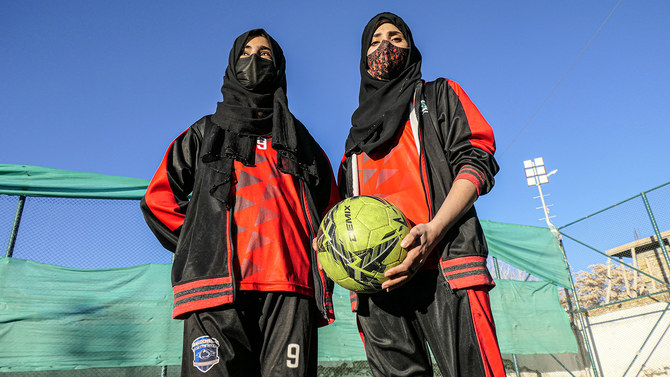
In Pakistan’s southwest, two Pashtun women footballers score against taboos

An undated file photo of footballers Rozi Bakht, right, and Mansoora Kakar. (AN photo)
Short Url
Updated 02 December 2022
Follow

In Pakistan’s southwest, two Pashtun women footballers score against taboos

  • Rozi Bakht and Masnoora Kakar are the first female footballers in Balochistan from ethnic Pashtun families
  • The young sports women want to serve as an inspiration for other girls from their impoverished towns

QUETTA: Two women footballers in Pakistan’s southwestern Balochistan province are shooting for greater inclusion for women from their ethnic Pashtun community, hoping that they can become an example for other girls from their impoverished hometowns who want to pursue sports.

Meet Rozi Bakht, 23, and Mansoora Kakar, 22, who are the only women footballers in Balochistan who hail from the conservative ethnic group, the Pashtuns.

“In my village, there are meager educational facilities for girls, so how can a girl even think about playing football or any other sport?” Bakht, who hails from the remote town of Tuba Kakari in Balochistan’s backward Pishin district told Arab News, outlining her battles against both poverty and the conservative values of her community.


This undated file photo shows Pakistani woman footballer Mansoora Kakar in action. (AN photo)

But the hurdles did not dampen Bakht’s enthusiasm and passion for the sport and she began to regularly attend practice sessions at the Balochistan Women’s Football Academy (BWFA).

For the last three years, she has been the captain of her team, whose coach is a man.

“It was very challenging for me to seek permission from my parents but despite negative criticism, including attacks on my character, my father allowed me to play because he trusted me,” Bakht said during a practice session with more than a dozen other girls at a small futsal ground in Quetta on a chilly evening last week.

Bakht is the only woman from her district who plays football at the provincial level, and hopes to be a source of encouragement for other girls in her village who have a passion for sports.

Just like Bakht, Kakar, another Pashtun girl who belongs to Kuchlak, a town on the outskirts of  Quetta, is also the first women footballer from her home district. She joined the Balochistan Women’s Football Academy two years ago.

Dressed in a black tracksuit that she paired with a red head scarf, Kakar cheered along with her teammates after scoring a goal during a practice match last Saturday. Now a forward player in the team, she too spoke about the hardships she had to face when she initially expressed her desire to join sports.

“I had a passion for football since my childhood, I used to play in my home but when I enrolled myself in college, I started playing there,” Kakar told Arab News. “But when I came to know that there is a football club [for females], I came here. Now it's been two years that I am in this team.”

“When I asked for permission to play football, my family refused because it was very difficult for me to commute for practices as the ground was 30km away from my home,” Kakar added.

“I come for my regular practice matches via a local bus which is the only affordable source of transportation for me because my father and brothers have their own work and can’t provide me pick and drop services.”


This undated file photo shows footballers Rozi Bakht, second left, and Mansoora Kakar, left, during a practice session in Quetta, Pakistan. (AN photo)

Many girls in Kuchlak, Kakar said, had a passion for sports, particularly football, but couldn’t play due to familial and cultural barriers.

But Muhammad Yasir Khan, 22, the head coach at the women's academy, hoped more girls would join the football club.

“The presence of sportswomen from the Pashtun belt,” he said, “is very limited which needs to be increased.”


Qatar, Pakistan resolve to boost strategic, economic cooperation at Doha talks

Updated 24 February 2026
Follow

Qatar, Pakistan resolve to boost strategic, economic cooperation at Doha talks

  • Both countries urge dialogue on Afghanistan amid renewed border tensions between Islamabad and Kabul
  • Discussions focus on bilateral trade and investment, energy, defense, manpower and labor and culture

ISLAMABAD: Pakistan and Qatar on Tuesday agreed to deepen their strategic and economic cooperation during high-level talks between Prime Minister Shehbaz Sharif and his Qatari counterpart Sheikh Mohammed bin Abdulrahman bin Jassim Al Thani, Sharif’s office said.

Sharif visited Qatar along with a high-level delegation on the invitation of Qatari emir Sheikh Tamim bin Hamad Al Thani. The Pakistani premier also held meetings with Qatar’s trade and defense ministers to discuss cooperation in various domains.

The visit came at a time when Pakistan is seeking closer economic engagement with Gulf partners amid its broader push to stabilize the economy and attract investment, while maintaining security and defense cooperation with key regional states.

During their meeting in Doha, PM Sharif and Qatar’s Sheikh Mohammed discussed bilateral relations and exchanged views on regional and international developments, according to the Pakistan prime minister’s office.

“They reaffirmed the strong brotherly relations between Pakistan and Qatar and expressed satisfaction at the growing momentum in political, economic and institutional ties,” Sharif’s office said.

“Discussions focused on enhancing cooperation in the fields of trade and investment, energy, defense, manpower and labor and culture, with both sides stressing the importance of their task force to accelerate cooperation in all these areas.”

Pakistan and Qatar maintain strong trade and investment ties. In 2022, the office of Qatar’s emir said the Qatar Investment Authority planned to invest $3 billion in Pakistan, targeting sectors including transport, aviation, education, health, media, technology and labor.

Nearly 300,000 Pakistanis live and work in Qatar, according to Pakistan’s foreign office, with many employed in health, education, engineering and public services, as well as construction and transport. The two countries engage through forums such as the Bilateral Political Consultations and the Joint Ministerial Commission.

Sharif said he had productive discussions with Qatar’s emir, Sheikh Tamim bin Hamad Al Thani, on how the two sides could transform their brotherly ties into mutually beneficial economic relationships. 

“We also took stock of the regional situation,” he said on X. “Pakistan and Qatar will continue to work together for peace and stability in the region and beyond.”

Prime Minister Shehbaz Sharif (second right) meets the Qatari Emir Qatar’s emir Sheikh Tamim bin Hamad Al Thani (left) in Doha, Qatar, on February 24, 2026. (PID)

DIALOGUE WITH AFGHANISTAN

Earlier, Sharif and Qatar’s Deputy PM Sheikh Saoud Al-Thani discussed the situation in Afghanistan and called for dialogue to support regional stability.

The meeting took place amid renewed tensions after Islamabad carried out airstrikes last week on what it described as Tehreek-e-Taliban Pakistan (TTP) targets inside Afghanistan. Kabul said the strikes killed civilians and vowed to respond to what it called a violation of its sovereignty.

“Regional developments were also discussed, in particular the situation in Iran and Afghanistan,” Sharif’s office said in a statement. “Both sides emphasized the importance of dialogue, de-escalation and collective efforts to promote peace and stability in the region.”

This was the second time in less than six months that Pakistan conducted airstrikes in Afghanistan. The last strikes triggered heavy, weeklong clashes between the neighbors along their border before Qatar and Turkiye mediated a ceasefire between them in Oct. last year.

Separately, Sharif held meetings with Qatar’s State Minister for Trade Dr. Ahmed bin Mohammed Al-Sayed and a delegation of the Qatar Businessmen Association (QBA), highlighting Pakistan’s investment-friendly reforms.

He invited QBA members to explore opportunities in infrastructure, logistics, energy, agriculture, technology and export-oriented manufacturing, his office said.