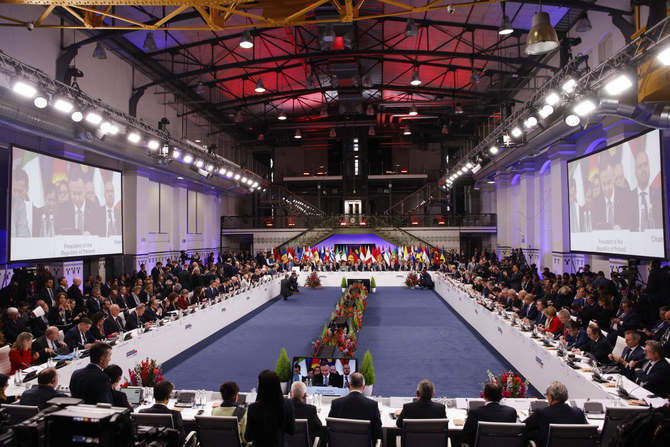
LODZ, Poland: Europe’s largest security organization opened a meeting Thursday with foreign ministers and other representatives strongly denouncing Russia’s war against Ukraine, a conflict that is among the greatest challenges the body has faced in its nearly half-century of existence.
The Organization for Security and Cooperation in Europe, which was founded to maintain peace and stability on the continent, has been a rare international forum — along with the United Nations — where Russia and Western powers have been able meet to discuss security matters. The two-day meeting in Lodz, Poland, is the first such high-level meeting since Russia invaded Ukraine in February.
But since the war began, the 57-nation OSCE has also become another venue where the bitter clash between Russia and the West has played out, exposing the organization’s own inadequacies in helping to resolve the conflict.
Notably absent was Russian Foreign Minister Sergey Lavrov, who was banned by Poland, the current chair of the OSCE, from entering the country. Poland is a member of the 27-member European Union, which has put Lavrov on a sanctions list.
Lavrov denounced the ban and Poland on Thursday.
“I can say responsibly that Poland’s anti-chairmanship of the OSCE will take the most miserable place ever in this organization’s history,” Lavrov said. “Nobody has ever caused such damage to the OSCE while being at its helm.”
“Our Polish neighbors have been digging a grave for the organization by destroying the last remains of the consensus culture,” he said in a video call with reporters.
The Polish chairman in office, Foreign Minister Zbigniew Rau, said he had a responsibility to defend the OSCE’s “fundamental principles,” and argued that it was not Poland but Russia which has hurt the organization by blocking budgets, appointments and other critical aspects of its work. He accused Russia of spreading disinformation against Poland.
“I would say it’s outrageous to hear Russia accusing the chairmanship of pushing the OSCE into the abyss, destroying its foundations and breaking its procedural rules,” Rau said.
Before Russia’s invasion of Ukraine, the OSCE acted as a mediator in Ukraine, negotiating peace deals for eastern Ukraine following a Russian-backed separatist war that began in the Donbas in 2014. In March, the OSCE discontinued its special monitoring mission to Ukraine.
Also missing from the meeting in Lodz was Belarus Foreign Minister Vladimir Makei, who died suddenly last weekend at the age of 64 and was buried earlier this week. Belarusian authorities didn’t give the cause of Makei’s death, and he wasn’t known to suffer from any chronic illness, triggering speculation about possible foul play.
A Belarusian representative, Andrei Dapkiunas, delivered remarks that he said had been prepared by Makei before his death. He deplored the exclusion of Lavrov, saying it “is killing the OSCE,” and accused Western powers of undermining Europe’s security structure with what he described as an unfair isolation of Russia and Belarus.
Peter Szijjarto, the foreign minister of Hungary, which is in the unusual position of being an ally of Poland while maintaining close economic and diplomatic ties with Russia, appeared to fault Poland for excluding Lavrov.
“Channels of communication must be maintained,” Szijjarto said.
Szijjarto told the meeting that Hungary wants peace in Ukraine, but didn’t mention Russia by name.
The OSCE was established in 1975 at a time of Cold War detente. Its approach to security is undergirded by an emphasis on human rights and economic development in conjunction with military security. It is possibly best known for its monitoring of elections but has also carried out conflict prevention and post-conflict peace-building missions in places including Bosnia, Moldova, Georgia and Tajikistan.
The US representative, Under Secretary of State Victoria Nuland said she came away from the gathering in Lodz with a renewed optimism within the OSCE, noting that 55 of its 57 members — Russia and Belarus excluded — were finding new ways to work to defend democratic principles.
Russian President Vladimir Putin “has failed to defeat Ukraine,” Nuland said. “Despite his brutal war of aggression, his war crimes, and now his vicious fight against civilians trying to freeze them in the middle of winter, Putin has also failed in his effort to divide and destroy the OSCE.”


![]()

Security meeting overshadowed by Russia’s war, ban on Lavrov
Short Url
https://arab.news/ndwa3
Security meeting overshadowed by Russia’s war, ban on Lavrov
- The two-day meeting in Lodz, Poland, is the first such high-level meeting since Russia invaded Ukraine in February
- Notably absent was Russian Foreign Minister Sergey Lavrov, who was banned by Poland, the current chair of the OSCE, from entering the country


Latest updates




© 2026 SAUDI RESEARCH & PUBLISHING COMPANY, All Rights Reserved And subject to Terms of Use Agreement.