

Tonga latest nation to back Saudi Arabia’s Expo 2030 bid

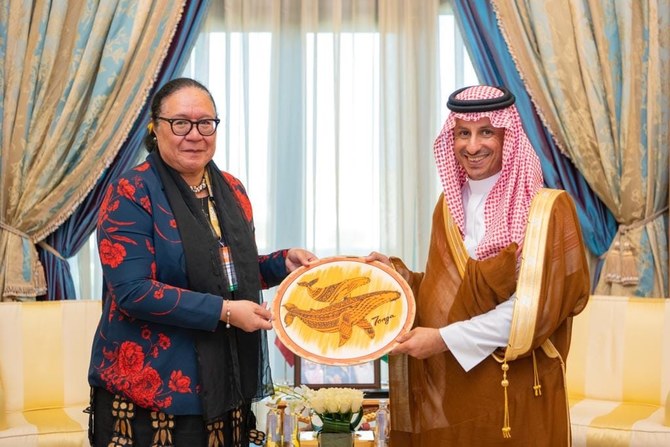
Tonga's Minister for Foreign Affairs Fekitamoeloa ‘Utoikamanu meeting with the Kingdom’s Tourism Minister Ahmed Al Khateeb in Riyadh (Supplied)
Short Url
Updated 01 December 2022
Follow

Tonga latest nation to back Saudi Arabia’s Expo 2030 bid

RIYADH: Tonga has become the latest country to declare its support for Saudi Arabia’s bid to host the World Expo in 2030. 

The Polynesian country’s Minister for Foreign Affairs Fekitamoeloa ‘Utoikamanu made the declaration during a meeting with the Kingdom’s Tourism Minister Ahmed Al Khateeb in Riyadh.

Saudi Arabia submitted its bid for the World Expo 2030 in October last year, in a letter sent by Crown Prince Mohammed bin Salman to the Bureau International des Expositions, the international organizing body for the global event since 1931. 

The Kingdom has already earned significant support for its bid from more than 60 countries and organizations around the world, including China, France, Turkiye, Greece, Armenia, Cuba, dozens of other African nations, and the Organization of Islamic Cooperation. 

If Saudi Arabia is selected to host the event, authorities plan to turn Riyadh and the rest of the country into a world-class venue for global culture, connectivity and climate action.

The Kingdom 's capital is competing against Busan in South Korea, Rome in Italy, and Odesa in Ukraine for Expo 2030, with a ballot to be held by the BIE in November 2023, on the principle of one country, one vote.

In a statement after her meeting, ‘Utoikamanu — also Tonga’s tourism minister — acknowledged the leadership Saudi Arabia has shown over the last few years to boost its tourism industry and the ambitious plan to attract 100 million visitors by 2030. 

“During my visit it is obvious that the Saudi Government is committed to boosting sustainable tourism,” she said, adding: “The investments in smart, environmentally sound infrastructure place Saudi Arabia as a global leader in responsible development and growth.” 

Tonga and Saudi Arabia established diplomatic relations in 2020, and the Kingdom’s tourism minister was one of the first foreign dignitaries to visit the country this year, following two years of border closures. 

Al Khateeb acknowledged that even if the relations between Tonga and Saudi Arabia are recent, the reciprocal high-level visits signal the commitment by both sides to strengthen the friendly relations that have developed between the two Kingdoms. 

‘Utoikamanu used her trip to Saudi Arabia to attend the World Travel and Tourism Council Global Summit which took place in Riyadh. 

The summit welcomed 57 tourism ministers, 250 CEOs, 8,000 registered participants and 3,000 in-person participants.


Kuwait to boost Islamic finance with sukuk regulation

Updated 05 February 2026
Follow

Kuwait to boost Islamic finance with sukuk regulation

  • The move supports sustainable financing and is part of Kuwait’s efforts to diversify its oil-dependent economy

RIYADH: Kuwait is planning to introduce legislation to regulate the issuance of sukuk, or Islamic bonds, both domestically and internationally, as part of efforts to support more sustainable financing for the oil-rich Gulf nation, Prime Minister Sheikh Ahmad Abdullah Al-Ahmad Al-Sabah said on Wednesday.

Speaking at the World Governments Summit in Dubai, Al-Sabah highlighted that Kuwait is exploring a variety of debt instruments to diversify its economy. The country has been implementing fiscal reforms aimed at stimulating growth and controlling its budget deficit amid persistently low oil prices. Hydrocarbons continue to dominate Kuwait’s revenue stream, accounting for nearly 90 percent of government income in 2024.

The Gulf Cooperation Council’s debt capital market is projected to exceed $1.25 trillion by 2026, driven by project funding and government initiatives, representing a 13.6 percent expansion, according to Fitch Ratings.

The region is expected to remain one of the largest sources of US dollar-denominated debt and sukuk issuance among emerging markets. Fitch also noted that cross-sector economic diversification, refinancing needs, and deficit funding are key factors behind this growth.

“We are about to approve the first legislation regulating issuance of government sukuk locally and internationally, in accordance with Islamic laws,” Al-Sabah said.

“This enables us to deal with financial challenges flexibly and responsibly, and to plan for medium and long-term finances.”

Kuwait returned to global debt markets last year with strong results, raising $11.25 billion through a three-part bond sale — the country’s first US dollar issuance since 2017 — drawing substantial investor demand. In March, a new public debt law raised the borrowing ceiling to 30 billion dinars ($98 billion) from 10 billion dinars, enabling longer-term borrowing.

The Gulf’s debt capital markets, which totaled $1.1 trillion at the end of the third quarter of 2025, have evolved from primarily sovereign funding tools into increasingly sophisticated instruments serving governments, banks, and corporates alike. As diversification efforts accelerate and refinancing cycles intensify, regional issuers have become regular participants in global debt markets, reinforcing the GCC’s role in emerging-market capital flows.

In 2025, GCC countries accounted for 35 percent of all emerging-market US dollar debt issuance, excluding China, with growth in US dollar sukuk issuance notably outpacing conventional bonds. The region’s total outstanding debt capital markets grew more than 14 percent year on year, reaching $1.1 trillion.