

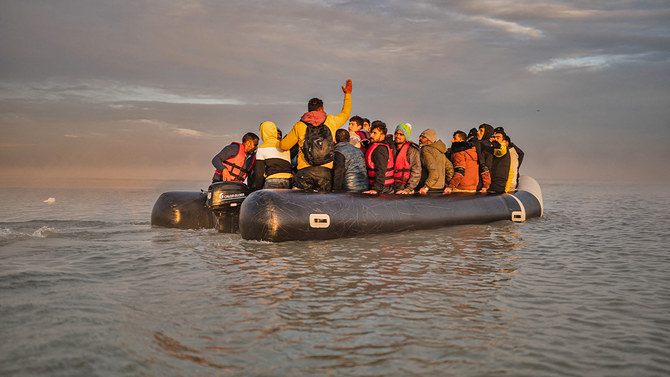
French authorities rescue 61 migrants including Pakistanis in English Channel

Migrants sail after boarding a smuggler's boat on the beach of Gravelines, near Dunkirk, northern France on October 12, 2022, in an attempt to cross the English Channel. (AFP/File)
Short Url
Updated 30 November 2022
Follow

French authorities rescue 61 migrants including Pakistanis in English Channel

  • This was one of the largest emergency operations in recent months 
  • Afghan, Indian, Iranian and Pakistani nationals were aboard the dinghy

BOULOGNE, France: French authorities rescued 61 migrants including small children in the English Channel on Tuesday in one of the largest emergency operations in recent months as calm seas drew a rush of migrants in small boats toward the coast of Britain.

Rescue workers in the port of Boulogne, where the migrants were brought ashore, said about 30 people had to be plucked out of the cold waters as they rushed to climb aboard a French rescue vessel from their rubber dinghy, which had been taking on water.

Officials said the rescue took place about one nautical mile inside British territorial waters.

Afghan, Indian, Iranian and Pakistani nationals were aboard the dinghy, which left the French coast in the small hours of the morning, the refugees said.

At the quayside, the migrants were handed fresh clothing and heat-retaining blankets by emergency workers.

French police earlier on Tuesday had stopped close to 50 migrants from trying to cross the Channel to Britain after mild weather and calm waters led a growing number of people to undertake the dangerous journey in recent days.

Guy Allemand, mayor of the small village of Sangatte near Calais, said some migrants had been forced by police to turn back, but that another 100 had made it to the open waters.

He told Reuters that migrant trafficking networks had recently changed their methods.

“They [traffickers] now arrive with ‘taxi boats’ and the refugees are being asked to run into the water to catch them ... rather than launching their own boats from the beach,” he said.

So far this year more than 40,000 people have crossed the Channel to Britain in small boats, up from 28,526 in 2021. Unusually mild November weather led to a hike in departures.

Earlier this month, Britain and France signed an agreement worth 72.2 million euros ($74.5 million) over the coming year to ramp up joint efforts to prevent illegal migrants making perilous journeys across the Channel.



Backlash as Australia kills dingoes after backpacker death

Updated 3 sec ago
Follow

Backlash as Australia kills dingoes after backpacker death

  • The euthanization program has stirred debate about how to manage the local population of dingoes
  • Wildlife experts said killing the animals was the wrong response and may threaten the island’s dingo population
SYDNEY: Australian authorities have sparked a backlash by killing a group of dingoes linked to the death of a young Canadian woman on an island in the country’s east.
The Queensland government said six animals were put down after 19-year-old backpacker Piper James’s body was found on January 19 at a beach on the World Heritage-listed island of K’gari.
The euthanization program has stirred debate about how to manage the local population of dingoes, a sandy-colored canine believed to have first arrived in Australia 4,000 to 5,000 years ago.
An autopsy conducted on James’ body found evidence “consistent with drowning” but also detected injuries corresponding to dingo bites.
“Pre-mortem dingo bite marks are not likely to have caused immediate death,” said a spokesperson for the Coroners Court of Queensland.
The coroner’s investigation into the cause of death was expected to take several weeks.
In response, the Queensland government said a pack of 10 dingoes involved would be euthanized after rangers had observed some “aggressive behavior.”
Six of the dingoes had already been euthanized, the state’s environment minister, Andrew Powell, told reporters Sunday.
“Obviously, the operation will continue,” he said.
The traditional owners of K’gari, the Butchulla people, said the state’s failure to consult with them before euthanizing the dingoes — or wongari in their language — was “unexpected and disappointing.”
“Once again, it feels as though economic priorities are being placed above the voices of the people and traditional owners, which is frustrating and difficult to accept,” the Butchulla Aboriginal Corporation said in a statement to Australian media this week.
‘You are food’
Wildlife experts said killing the animals was the wrong response and may threaten the island’s dingo population, estimated at just 70-200 animals.
Given their small numbers, killing a pack of 10 animals would harm the population’s genetic diversity, said Mathew Crowther, professor of quantitative conservation biology at the University of Sydney.
“There’s no moral from the dingoes’ point of view. They’re just being wild animals, doing wild things,” Crowther said.
Dingoes tend to lose their fear of people as they interact with tourists, some of whom defy advice against feeding the animals.
“That’s the worst thing you can do to a wild animal,” Crowther said.
“They just relate humans to food, and if you don’t give them food, well, you are food — that’s basically how it is.”
Dingoes are wild, predatory animals and need to be treated with respect, said Bill Bateman, associate professor in the school of molecular and life sciences at Curtin University.
The canines are more likely to attack children or people who are alone, and may be triggered when people turn their backs or run, he said.
“These are important animals, and therefore we need to change the way we deal with them, otherwise we’re just going to keep reacting to these attacks and driving the population of dingoes down,” Bateman said.
Wildlife managers, rangers, Indigenous people and tourism operators need to work together so that humans and dingoes can coexist on the island, he said.
Todd James, the father of Piper, has described on social media how his family’s hearts were “shattered” by her death.
News of the dingoes’ euthanization was “heart-wrenching,” he told Australian media, adding however that he recognized it may be necessary for safety because of the pack’s behavior.