

Big jump in tourism revenue could see Portugal end 2022 on high note

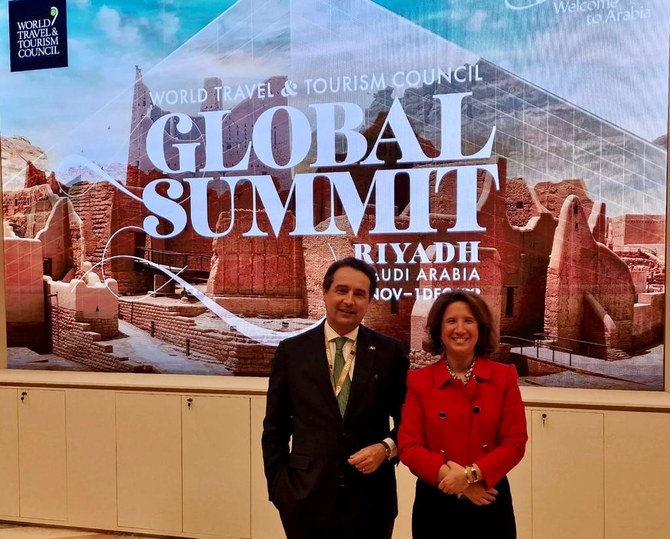
Rita Marques, secretary of state for Tourism of Portugal, said she was optimistic that 2022 would end on a high note for the country. (Supplied)
Short Url
Updated 01 December 2022
Follow

Big jump in tourism revenue could see Portugal end 2022 on high note

RIYADH: Witnessing a strong rebound in tourism, Portugal has had an amazing summer with a quantum leap in revenue, according to the politician responsible for the sector.

Speaking to Arab News ahead of the World Travel & Tourism Council Global Summit in Riyadh, Rita Marques, Portugal's secretary of state for tourism, said she was optimistic that 2022 would end on a high note for the country.

“We expect to end this year with 10-15 percent more revenue than we did back in 2019 and we are very excited about these numbers,” she said. “We are also very happy with the overall resilience that the sector has shown because things had come to a standstill for two years.”

Talking about competition from neighboring countries and beyond, Marques said that, after the pandemic, there was room for everyone. “There is space for everyone to compete in the world of tourism,” she said. “And that’s not just because people are traveling more but because people are more and more curious about exploring new emotions and new experiences. Tourists are also getting more curious about discovering new spots.”

With regard to tourism opportunities in Portugal, she explained that the country offers a lot for tourists to discover.

“A couple of years ago, we were known to be a sunny place with beaches and all of that but now people come to Portugal for our golf courses, for our walking and cycling and more. And this allows us to compete with other destinations, not just with regular ones. We offer authentic and emotional experiences when tourists visit the old parts of Lisbon, for instance.” 

According to Marques, one of the main challenges that the tourism industry around the world is facing today is the shortage of talent because a lot of people left the industry during the pandemic. “In Europe, for instance, we lost pretty much 20 percent of our workforce,” she said. “So we need to create conditions for those people to come back. And how do we do that? Well, we need to open the door to migrants and that’s pretty much what we are doing.”

Marques added: “My message to everyone is to continue to invest in people because we might have nice places to visit, we might have nice cultural heritage sites, but if we don’t have trained people, then it’s going be hard to greet and host everyone. So it is important to pamper those that work in the sector and try to train them.”

Marques said she was glad that Saudi Arabia was taking the lead in this direction. 

“I know that the Kingdom has just launched a massive program to train more than 100,000 people to work in the tourism and sustainability sector. And that’s pretty much what we are doing as well but on a different scale, of course,” she added.  


Arab Energy Fund approved for Panda bonds, first MENA multilateral issuer in China

Updated 5 sec ago
Follow

Arab Energy Fund approved for Panda bonds, first MENA multilateral issuer in China

RIYADH: The Arab Energy Fund has received regulatory approval to issue Panda bonds in China, marking a significant step in linking Middle Eastern and Chinese capital markets.

This decision makes the Riyadh-based institution the first multilateral financial institution from the Middle East and North Africa region to secure such approval, granting it direct access to China’s domestic bond market.

According to a press release, the approval was granted by the Asian country’s National Association of Financial Market Institutional Investors, the regulator overseeing the interbank bond market.

This milestone reflects rapidly deepening ties between the Gulf Cooperation Council, especially Saudi Arabia, and China.

Recent high-level engagements have prioritized strategic investment and technology transfer in Vision 2030 sectors, resulting in dozens of agreements, and in December Foreign Minister Wang Yi described the China-GCC partnership as vital for safeguarding common interests and strengthening Global South resilience.

Under the program, TAEF is authorized to issue up to 10 billion Chinese yuan ($1.4 billion) in Renminbi-denominated bonds. The fund can issue these Panda bonds in multiple tranches over a two-year period, providing flexible, long-term capital for its strategic investments.

Vicky Bhatia, chief financial officer of the Arab Energy Fund, said: “This milestone allows us to further diversify our funding sources by tapping into a deep pool of Chinese investors, while laying a strong foundation for closer collaboration between a highly rated multilateral financial institution from the MENA region and China’s capital markets.”

This access represents a major diversification of TAEF’s funding strategy. Panda bonds provide a stable and direct source of Renminbi financing, strengthening the Fund’s capital planning capabilities as it supports projects across the energy spectrum. 

With a 50-year history, strong governance, and a high international credit rating, TAEF invests in conventional energy, energy infrastructure, and broader energy transition solutions.

By entering the onshore Panda bond market, the Arab Energy Fund reinforces its position as a trusted multilateral partner and an active, innovative participant in global capital markets. 

The move signals China’s growing role as a pivotal source of capital for international energy projects and highlights the increasing financial interconnectivity between the MENA region and Asia.