

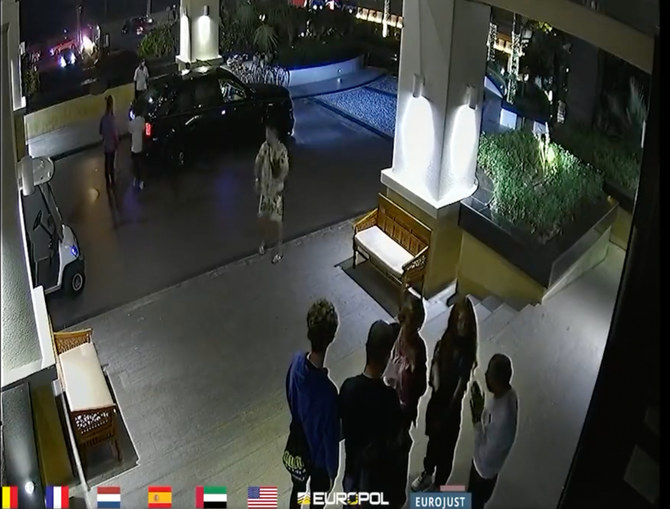
UAE, Europol bust cocaine ‘super-cartel’

Parallel investigations launched in Spain, France, Belgium, the Netherlands and the UAE targeted the activities of the prolific criminal network involved in large-scale drugs trafficking and money laundering. (Twitter: @SaifBZayed)
Short Url
Updated 29 November 2022
Follow

UAE, Europol bust cocaine ‘super-cartel’

  • Dubai police arrest 6 ‘high-value’ suspects linked to Netherlands, Spain, France
  • Emirates committed to joint global security pacts, says deputy PM

DUBAI: The UAE’s Deputy Prime Minister Sheikh Saif bin Zayed Al-Nahyan lauded on Monday the arrest of 49 drug kingpins, including six chief suspects in Dubai, involved in a “super-cartel” that controlled a third of Europe’s cocaine trade network.

The arrests were the result of coordinated efforts between the UAE’s Ministry of Interior, the Dubai Police General Command, the EU Agency for Law Enforcement Cooperation Europol, and several overseas law enforcement agencies.


With the support of Europol, parallel investigations launched in Spain, France, Belgium, the Netherlands and the UAE targeted the activities of the prolific criminal network involved in large-scale drugs trafficking and money laundering.

Over 30 tons of drugs were seized by law enforcement officers during the massive international operation, Europol said.

Dubai had arrested two “high-value” suspects with ties to the Netherlands, two with ties to Spain, and two with ties to France.

“One of the Dutch suspects is an extremely big fish,” a Europol source told AFP.


Another 13 people were arrested in Spain, six in France and 10 in Belgium, while 14 people were nabbed in 2021 in the Netherlands as part of the same operation, Europol said.

Sheikh Saif attributed the success of Operation Desert Light to the cooperation between nations and law enforcement agencies worldwide. Joint agreements remained a key part of the UAE’s commitment to global safety and security, he said.

In September, Europol and the UAE Ministry of Interior signed a Liaison Officer Agreement, as part of this commitment to tackle transnational crime, Europol said. The agreement ensures the deployment of UAE law enforcement liaison officers to Europol’s headquarters in the Netherlands.

A UAE official has already joined the network of over 250 liaison officers from more than 50 countries and organizations with permanent representation at Europol.


Algeria inaugurates strategic railway to giant Sahara mine

President Tebboune attended an inauguration ceremony in Bechar. (AFP file photo)
Updated 02 February 2026
Follow

Algeria inaugurates strategic railway to giant Sahara mine

  • The mine is expected to produce 4 million tons per year during the initial phase, with production projected to triple to 12 million tons per year by 2030
  • The project is financed by the Algerian state and partly built by a Chinese consortium

ALGEIRS: Algerian President Abdelmadjid Tebboune on Sunday inaugurated a nearly 1,000-kilometer (621-mile) desert railway to transport iron ore from a giant mine, a project he called one of the biggest in the country’s history.
The line will bring iron ore from the Gara Djebilet deposit in the south to the city of Bechar located 950 kilometers north, to be taken to a steel production plant near Oran further north.
The project is financed by the Algerian state and partly built by a Chinese consortium.
During the inauguration, Tebboune described it as “one of the largest strategic projects in the history of independent Algeria.”
This project aims to increase Algeria’s iron ore extraction capacity, as the country aspires to become one of Africa’s leading steel producers.
The iron ore deposit is also seen as a key driver of Algeria’s economic diversification as it seeks to reduce its reliance on hydrocarbons, according to experts.
President Tebboune attended an inauguration ceremony in Bechar, welcoming the first passenger train from Tindouf in southern Algeria and sending toward the north a first charge of iron ore, according to footage broadcast on national television.
The mine is expected to produce 4 million tons per year during the initial phase, with production projected to triple to 12 million tons per year by 2030, according to estimates by the state-owned Feraal Group, which manages the site.
It is then expected to reach 50 million tons per year in the long term, it said.
The start of operations at the mine will allow Algeria to drastically reduce its iron ore imports and save $1.2 billion per year, according to Algerian media.