

Brothers among 5 Palestinians killed in West Bank

1 / 2
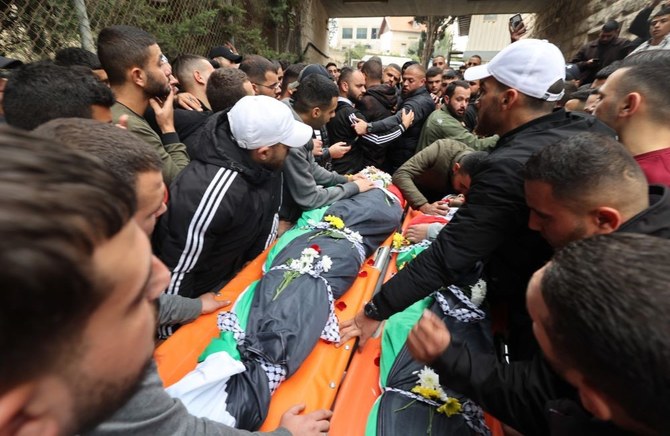
Mourners gather around the bodies of Palestinians killed during clashes with Israeli army forces, outside a morgue, Ramallah, occupied West Bank, Nov. 29, 2022. (AFP)
2 / 2
Mourners gather around the bodies of Palestinians killed during clashes with Israeli army forces, Ramallah, occupied West Bank, Nov. 29, 2022. (AFP)
Short Url
Updated 29 November 2022
Follow

Brothers among 5 Palestinians killed in West Bank

  • Jawad Abd Al-Rahman Rimawi, 22,  was shot dead in Kufr Ein, near Ramallah; his brother, Thafer, 21, was shot and critically injured, and later died
  • Mohammad Shtayyeh, Palestinian prime minister, said that the deaths of the two brothers was a “heinous crime”

RAMALLAH: Five Palestinians, including two brothers, were killed and 21 injured in the occupied West Bank on Tuesday.

Mufid Mahmoud Ekhlil, 44, was shot dead in the town of Beit Ummar, northern Hebron.

Nine Palestinians were injured by bullets during the confrontations and taken to nearby hospitals, the Palestinian Ministry of Health said.

The Israel Defense Forces said that “rioters” attacked soldiers with rocks and explosive devices after two IDF vehicles got stuck during an operational patrol near Beit Ummar.

It added: “The rioters also shot at the soldiers, who responded with riot dispersal means and live fire.”

Jawad Abd Al-Rahman Rimawi, 22,  was shot dead in Kufr Ein, near Ramallah. His brother, Thafer, 21, was shot and critically injured, and later died.

Rami Abu Ali, 45, from Betunia, west of Ramallah, was killed following a car accident involving a 20-year-old Israeli soldier, who was wounded.

Raed Na’asan, another Palestinian, was killed by Israeli fire when the troops stormed his Al-Mughair village in north-eastern Ramallah.

The latest bloodshed took place amid a mounting surge of Israeli-Palestinian violence in the wake of a Jerusalem bombing last week that killed two Israelis.

A general strike in Ramallah and some surrounding towns was called to mourn the deaths of the two brothers.

Ghassan Al-Khatib, a Palestinian political analyst and vice president of Birzeit University, told Arab News that there is a clear indication of an Israeli policy of escalation.

He added that he believes the soldiers’ incursions into Palestinian cities and villages will increase in the light of the ultra right-wing Israeli government being formed under Likud leader Benjamin Netanyahu and including Itamar Ben-Gvir and Bezalel Smotrich.

He said: “We are facing a revolt and an escalation of violence because a popular Palestinian reaction will meet every attack of the Israeli army.”

Nabil Abu Rudeineh, Palestinian presidential spokesperson, said the Israeli government “bears full responsibility for these crimes and must be held accountable for them,” noting that successive right-wing governments have declared daily war on the Palestinian people.

He added: “The American administration also bears a great responsibility for the occupation and authorities’ continuous crimes against our people, as it is the only sponsor of the occupying state in the world, in arms and financing and at international forums.

Abu Rudeineh said the US administration needed to take action to deter Israel from carrying out crimes that destabilized the region.

Mohammad Shtayyeh, Palestinian prime minister, said that the deaths of the two brothers was a “heinous crime.”

He added: “With the continued declaration of war on our people, and the new Israeli government, we call on the world’s countries to intervene urgently to stop the Israeli killing machine and to hold the perpetrators accountable.”

Hundreds of Palestinians attended the funerals of the victims in Ramallah and Hebron, and chanted slogans condemning the crimes of the Israeli occupation, and calling for their cessation.

Hussein Al-Sheikh, from the Palestine Liberation Organization, tweeted that the deaths of the brothers was an “awful crime committed by the occupation forces.” He added that execution in cold blood is “fascist behavior.”

Hamas spokesman Hazem Qassem said: “The Israeli occupation is trying desperately to stop the legitimate struggle of the Palestinian people, through killings and assassinations, but this blood will be fuel for our people’s revolution and continuous uprising.”

Meanwhile, Benny Gantz, outgoing Israeli defense minister, said he had approved the construction of 10,000 units in the West Bank and East Jerusalem, and that settlements, especially in the Jordan Valley, must be strengthened.

In addition, Yair Lapid, the outgoing Israeli prime minister, has sent more than 50 world leaders a letter calling on them to exert their influence on the Palestinian Authority to prevent the General Assembly vote on an advisory opinion from the International Court of Justice on the Israeli-Palestinian conflict.

“This resolution is the outcome of a concerted effort to single out Israel, to discredit our legitimate security concerns, and to delegitimize our very existence,” Lapid said in the letter.


Lebanese man flees hometown, months after repairing home damaged in last war

Updated 3 sec ago
Follow

Lebanese man flees hometown, months after repairing home damaged in last war

  • Lebanese man rebuilt home four times but fled new war
  • Many in Lebanon ‌were still recovering from 2024 conflict
HAZMIEH: Just days ago, Hussain Khrais was proudly showing off his newly restored home in south Lebanon, fixed up after ​being badly damaged in 2024 clashes between Israel and Hezbollah. But a new war has since erupted and his home is in the line of fire again.
Khrais fled his hometown of Khiyam, about five km (three miles) from the border with Israel, as Israel pounded Lebanon with heavy airstrikes last week in retaliation for Iran-backed group Hezbollah’s rocket and drone fire into Israel.
“Is the house I worked so hard to build, or the business I started, still there? Or is it all gone?” Khrais told Reuters from a relative’s home near the capital Beirut where he and his family are now staying.
“The feeling is ‌very, very upsetting, ‌because we still don’t know if we’ll go back or not.”
’WHAT ​KIND ‌OF ⁠LIFE IS ​THAT?’
It ⁠wasn’t Khrais’ first time — or even his second. The 66-year-old has been displaced at least four times in the last four decades by Israeli incursions and airstrikes, each time returning to a town in ruins and rebuilding patiently.
Last year, he spent months and around $25,000 repairing the damage from the last war between Hezbollah and Israel, which ended 15 months ago. Hezbollah started firing at Israel after the United States and Israel launched airstrikes against Iran on February 28.
“It really bothers me to think this is the life I’ve lived,” Khrais told Reuters. “Once ⁠again, displacement, return, rebuilding, restoration — then again displacement, return, rebuilding. What kind of life ‌is that?“
With no support from the Lebanese state and ‌little coming from Hezbollah’s social welfare program, most Lebanese whose homes were ​damaged or destroyed in the 2024 war have ‌used their own private funds to rebuild.
Reconstruction has placed a huge burden on affected Lebanese families, still ‌struggling to access their savings in commercial banks after a financial collapse in 2019.
Two weeks ago, Khrais had told Reuters he was scared that a new war would start. “I’m at an age where I can’t start all over again. That’s it,” he said.
’WORTH THE WORLD’S TREASURES’
The new war has dealt Lebanese another blow. About 300,000 people have ‌been displaced over the last week by Israel’s strikes and by the Israeli military’s evacuation orders, which encompass around 8 percent of Lebanese territory.
Khrais is staying ⁠with around 20 other ⁠displaced relatives, some displaced from Khiyam and others from Beirut’s southern suburbs, which have been hit hard by Israeli strikes.
He is glued to the television, where news bulletins have reported on Israeli troops and tanks pushing deeper into his hometown.
“I’ve been in Beirut for four days now, and these four days feel like 400 years,” Khrais said.
He misses his house dearly.
“Maybe the thing I’m most attached to, is when I open the door to my children’s bedrooms and see the pictures of their children hanging on the walls,” he said.
“That sight is worth the world’s treasures — to see my grandchildren’s pictures in Khiyam.”
Khrais has no news on the state of his home. He said he remains hopeful but that if it has been destroyed, he’ll still do what he’s always done.
“The big shock would be if I ​came back and didn’t find it. But my ​feeling says no, God willing, it will remain. And like I said, even if we don’t find the house, we’ll go back and rebuild,” he said.