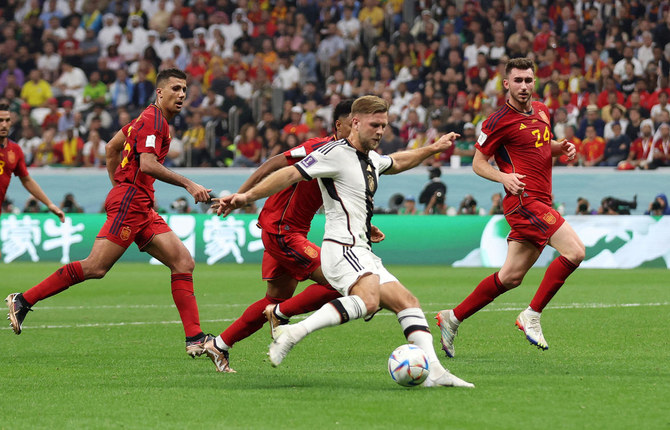
AL KHOR; Qatar: Niclas Fullkrug’s late equalizer snatched Germany a morale-boosting 1-1 draw with Spain in a heavyweight World Cup clash on Sunday, leaving both sides’ hopes of qualifying for the last 16 still in the balance.
Alvaro Morata’s flicked finish had Spain on course to secure qualification from Group E, but the electric Jamal Musiala and Fullkrug combined to foil La Roja and restore some German pride.
Costa Rica’s surprise win over Japan earlier eased some pressure on Germany after their shock loss to the Asian side, but they were unable to capitalize for large periods in a battle for the ball against Spain.
The four-time world champions suffered a humiliating group-stage exit in Russia four years ago, and Morata’s strike at Al Bayt Stadium had them on the ropes, but Werder Bremen striker Fullkrug finished brilliantly to divide the points.
Spain lead Group E on four points, from Japan and Costa Rica on three each, while Germany have one, with a final round of matches to come.
The only World Cup group-stage clash to pit two former champions against each other lived up to its top billing in intensity and tactical intrigue, with both sides set on trying to dominate possession and press extremely high.
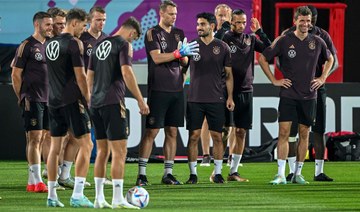
Germany coach Hansi Flick rejected suggestions his side had been distracted in their shock opening defeat by Japan because of their pre-game protest against FIFA “silencing teams” and the taut opening exchanges quickly ensured all focus was on the football.
Flick cut Kai Havertz from his line-up and deployed Thomas Mueller up front after their shocking opening-day capitulation, hoping for a quick reaction.
However, Spain almost took the lead in the seventh minute when Manuel Neuer palmed Dani Olmo’s powerful drive from range onto the woodwork.
It seemed like they were picking up where they left off after their 7-0 demolition of Costa Rica, but Germany steeled themselves, keeping Luis Enrique’s side at bay.
Spain goalkeeper Unai Simon relied on his footwork under pressure as La Roja sought to dominate possession.
One mistake handed Serge Gnabry an opportunity, but he fired wide.
Neuer erred with the ball at his feet too, with Germany similarly looking to build from the back, but Ferran Torres could not capitalize.
Antonio Ruediger powered home a header from a free-kick, but his celebration was cut short after VAR caught him half a step ahead of the Spanish defense, leaving the teams tied at the break.
Germany nearly struck after Joshua Kimmich won the ball back pressing extremely high, but Simon produced a fine save to deny him.
Just when Luis Enrique’s side seemed to have lost their grip on the game, they broke the deadlock.
Morata, on for Torres, finished clinically at the near post from an inviting low cross from Jordi Alba after 62 minutes.
It looked like it was enough for the 2010 champions, but Fullkrug — on only his third international appearance — decided otherwise, sneaking in behind substitute Alejandro Balde and lashing past Simon with seven minutes remaining.
Leroy Sane, on as a substitute after injury, might have won it late on for Germany but was forced extremely wide as he rounded Simon and could not find a finish or produce a cutback.
Spain face Japan on Thursday, while Germany play Costa Rica, needing to win and hoping La Roja do not lose.

Fullkrug strikes late to salvage Germany World Cup draw with Spain
https://arab.news/g9kzt
Fullkrug strikes late to salvage Germany World Cup draw with Spain
- Niclas Fullkrug — on only his third international appearance — lashed home an 83rd-minute equalizer
- Alvaro Morata’s deft touch from Jordi Alba’s cross had put Spain ahead
Australia depth shows up England’s Ashes ‘failures’
SYDNEY: A well-drilled Australia are on the cusp of retaining the Ashes after just six days of cricket — not bad for a team lambasted by England great Stuart Broad before the series began as its weakest since 2010.
The hosts take a 2-0 lead into the third Test at Adelaide on December 17 needing only a draw to keep the famous urn and pile more humiliation on Ben Stokes’s tourists.
Australia have put themselves on the brink despite missing injured pace spearheads Pat Cummins and Josh Hazlewood, with the performances of stand-ins Michael Neser and Brendan Doggett a reflection of their depth.
“The great and the healthiest thing for Australian cricket right now is that they’ve got almost a second XI or an Australia ‘A’ side that could come in and play some outstanding cricket too,” said former Australia Test quick Brett Lee.
“The guys who have had their opportunity, the Doggetts and the Nesers, have stood up. They’ve taken their opportunity and taken it with both hands, which is brilliant.”
The strength of the country’s talent pool was driven home by Australia ‘A’ crushing England’s second-tier side by an innings and 127 runs at Allan Border Field while Stokes’s men were being thrashed down the road in the second Test at the Gabba.
Young prospects Fergus O’Neill, Cooper Connolly and Campbell Kellaway stood out, while discarded Test batsman Nathan McSweeney fired a double-century reminder to selectors.
It is a far cry from the pre-Ashes war-of-words where England were hyped as having their best chance in a generation to win a series in Australia, with seamer Broad’s comments coming back to haunt him.
“It’s probably the worst Australian team since 2010 when England last won and it’s the best English team since 2010,” said Broad, who retired in 2023 and is now working as a pundit.
“It’s actually not an opinion, it’s fact.”
At the time, he pointed to questions over the make-up of Australia’s batting line-up and a perceived lack of bowling depth.
Both have been blown out of the water.
On the go
Australia went into the first Test in Perth dogged by uncertainty, with the uncapped Jake Weatherald as Usman Khawaja’s sixth opening partner since David Warner retired nearly two years ago.
In a quirk of fate, Khawaja was unable to bat in the first innings because of back spasms with Marnus Labuschagne replacing him.
But it was when he pulled out again in the second innings and Travis Head stepped up that the tide turned on England with his stunning 69-ball match-winning century.
“Ever since Travis Head stuck his hand up to open when Khawaja got hurt in Perth, Australia have looked like a different team,” said Australian legend Glenn McGrath.
Labuschagne said Head and Weatherald’s confidence trickled down to the lower order in Brisbane, where himself, Steve Smith and Alex Carey all blasted quick-fire half centuries.
It leaves selectors with a dilemma for the third Test: recall now-fit 85-Test veteran Khawaja or persist with Weatherald and Head, whose home ground is Adelaide.
Smith, who stood in for Cummins as skipper in the first two Tests, attributed Australia’s success so far to being able to adapt “in real time.”
“We play ‘live’. We adapt on the go, instead of getting back in the sheds and going, ‘We should have done this’,” he said.
“Sometimes it’s just playing the long game. I think we’ve just adapted so well the last couple of years, and played in real time, I suppose.”
For former Australia captain Greg Chappell, Australia’s success has been as much about England’s failures.
While their aggressive “Bazball” approach might be suited to flat English pitches and small grounds, it has been brutally exposed by the bigger boundaries and demanding conditions in Australia.
“The failure that has ensued across the first two Tests is a whole-of-system one, a catastrophic breakdown of both the game plan and its execution,” he wrote in a column.
“While the players have been the immediate culprits, the off-field leaders — Brendon McCullum and Ben Stokes — are equally responsible for not recognizing the different challenges presented by Test cricket in Australia.”