

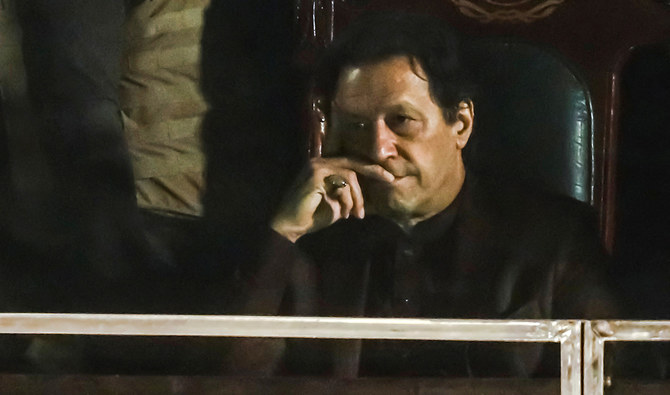

ISLAMABAD: Pakistan’s former prime minister Imran Khan is trying to create more pressure on the government, experts said on Sunday, as he announced that his party was quitting all assemblies while addressing a mammoth public rally in Rawalpindi a day before.
Khan, who was removed in a parliamentary vote of no-confidence in April, has since held several anti-government rallies while demanding early elections. He has frequently maintained that his ouster was part of a US-backed “foreign conspiracy,” a claim denied by Washington and Khan’s opponents who are now in power.
The leader of the Pakistan Tehreek-e-Insaf (PTI) party made his first public appearance on Saturday since being wounded in a gun attack earlier this month, when he called off a protest march that began from the eastern city of Lahore and was set to culminate in Islamabad.
He announced at the recent rally that his party was going to resign from all assemblies, telling tens of thousands of his cheering supporters that PTI was getting out of this “corrupt system.”
The announcement was a new move taken after months of calling for early elections, said political analyst Dr. Huma Baqai, which saw Khan’s narrative “getting weaker due to repetition.”
“Economy is the main concern of all, and after mass resignations by the PTI, the situation will further deteriorate and put the government on the back foot and can force them to announce early elections,” she added.
Pakistan, faced with high inflation and dwindling foreign reserves, has been battling an economic crisis exacerbated by devastating floods that killed over 1,700 people.
Former attorney-general of Pakistan, Anwar Mansoor Khan, also said the latest political development “can build pressure” on the current government.
“But they [the PTI] tried it [the resignation move] in the national assembly but did not succeed. It is a matter of wits and how long the government can sustain pressure,” Khan told Arab News.
PTI lawmakers resigned from the national assembly en masse in April, ahead of a vote to elect a new premier after Khan was removed from office.
Khan’s decision could “create a lot of problems” for the federal government, said senior journalist Arifa Noor, and was taken because of the recent change in military leadership.
“[He] wants to increase the pressure on the new army chief to make some decision in favor of his demand of calling early elections,” Noor told Arab News.
Pakistan named Lieutenant-General Asim Munir on Thursday as chief of its army, a major power center that plays a vital and influential role in the governance of the nuclear-armed nation. The appointment coincided with a dispute between Khan and the military, who the former premier blamed for playing a part in his ouster.
PTI’s mass resignation was intended to “create the possibility of political disruption,” said Ahmed Bilal Mehboob, president of Pakistan Institute of Legislative Development and Transparency.
“By doing this he maintains pressure on the government and sends a message to the army as well that they should use their influence to prevent the possible disruption,” he continued.
Khan, who said he canceled his protest march because he feared it would cause havoc in the country, was “running out of options,” Mehboob added.
“Threat to resign from provincial assemblies is all he could do at this time to keep the momentum of his campaign.”
But there remain uncertainties with Khan's announcement, with political analyst Mosharraf Zaidi saying that “resignations from the assemblies would not have the same effect as a dissolution.”
“PTI’s threat of the dissolution of the KP and Punjab assemblies would need to actually happen for it to actually challenge the federal government,” he told Arab News, alluding to PTI’s stronghold in the northwest province of Khyber Pakhtunkhwa and the coalition government Khan has in Punjab with ally PML-Q.
Former secretary of Pakistan’s election commission Kanwar Dilshad highlighted that Khan’s announcement was incomplete, as he did not clarify whether “he will dissolve assemblies or will just resign,” also noting that each would have different consequences.
“Dissolution of assemblies can bring a real constitutional crisis and force the federal government to call early elections,” he said.


