

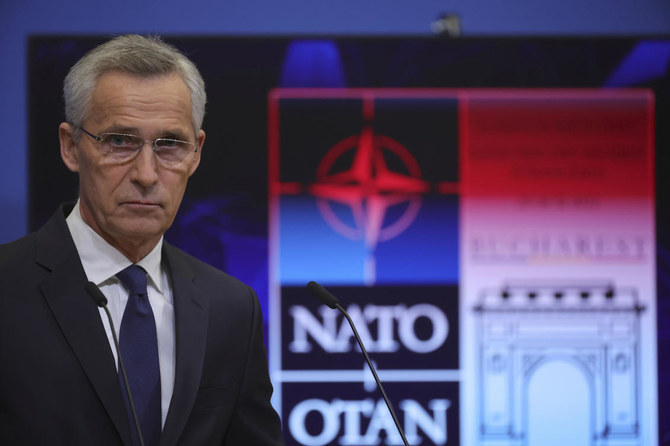

BRUSSELS: NATO is determined to help Ukraine defend itself against Russia for “as long as it takes” and will help the war-wracked country transform its armed forces into a modern army up to Western standards, the alliance’s Secretary-General Jens Stoltenberg vowed on Friday.
Speaking to reporters ahead of a meeting of NATO foreign ministers in Romania next week, Stoltenberg urged countries that want to, either individually or in groups, to keep providing air defense systems and other weapons to Ukraine. NATO as an organization does not supply weapons.
“NATO will continue to stand with Ukraine for as long as it takes. We will not back down,” the former Norwegian prime minister said. “Allies are providing unprecedented military support, and I expect foreign ministers will also agree to step up non-lethal support.”
Germany said on Friday it was discussing with allies Poland’s request that German Patriot air defense units be sent to Ukraine, after NATO’s chief suggested the military alliance might not oppose such a move.
“We are talking with our allies about how to handle Poland’s ... suggestion,” a German government spokesperson said in Berlin.
Berlin offered Warsaw the Patriot system to help secure its airspace after a stray missile crashed and killed two people in Poland last week. Polish Defense Minister Mariusz Blaszczak later asked Germany to send the fire units to Ukraine instead.
NATO Secretary-General Jens Stoltenberg said such deployments should be decisions for individual nations, taking into account rules around final users. “The specific decisions on specific systems are national decisions,” he said in Brussels.
“Sometimes there are end users agreements and other things so they need to consult with other allies. But at the end of the day, it (the decision) has to be taken by the national governments,” he added.
Stoltenberg’s comments came after German Defense Minister Christine Lambrecht on Thursday said sharing Germany’s Patriot units outside NATO territory would require prior discussions with NATO and the allies.
Patriots are produced by the US company Raytheon. On Friday, the Polish president said it was Germany’s decision where its Patriot air defense units are stationed, adding that it would be better for Poland’s security if they were on Ukrainian territory near the border.
“From a military point of view, it would be best if they were located in Ukraine to also protect Polish territory, then they would protect both Ukraine and Poland most effectively,” Andrzej Duda told a news conference in Kaunas, Lithuania. “But the decision rests with the German side.”
Duda later said that Germany could send the Patriot units to Ukraine without NATO troops to operate them, something he says Kyiv has been asking for a while. “But if there is no consent to this, let them be here (in Poland) and protect us,” Duda wrote on Twitter.
On the sidelines of NATO drills in northeastern Poland, Blaszczak took a swipe at Berlin by saying he was surprised by the idea that the German Patriots might be too advanced to be transferred to Ukraine.
Russian shelling on the southern Ukrainian city of Kherson killed 15 civilians on Friday, said an official in the recently recaptured city.
“Today, 15 Kherson city residents were killed and 35 injured, including one child, as a result of enemy shelling,” Galyna Lugova said on social media. “Several private houses and high-rise buildings were damaged” in the attacks,” she added.
Stoltenberg said that members of the 30-nation security organization have been delivering fuel, generators, medical supplies, winter equipment and drone jamming devices, but that more will be needed as winter closes in, particularly as Russia attacks Ukraine’s energy infrastructure.
“At our meeting in Bucharest, I will call for more,” he said. “Over the longer term we will help Ukraine transition from Soviet era equipment to modern NATO standards, doctrine and training.”
Stoltenberg said Ukrainian Foreign Minister Dmytro Kuleba would join the ministers to discuss his country’s most pressing needs but also what kind of long-term support that NATO can provide. NATO’s top civilian official said the support will help Ukraine move toward joining the alliance one day.
The Nov 29-30 meeting in Bucharest is being held almost 15 years after NATO promised that Ukraine and Georgia would one day become members of the organization, a pledge that deeply angered Russia.
Also attending the meeting will be the foreign ministers of Bosnia, Georgia and Moldova – three partners that NATO says are coming under increasing Russian pressure. Stoltenberg said the meeting would see NATO “take further steps to help them protect their independence, and strengthen their ability to defend themselves.”
Since President Vladimir Putin ordered the invasion 10 months ago, NATO has bolstered the defenses of allies neighboring Ukraine and Russia but has carefully sought to avoid being dragged into a wider war with a major nuclear power.
But Stoltenberg put no pressure on Ukraine to enter peace talks with Russia, and indeed NATO and European diplomats have said that Putin does not appear willing to come to the table.
“Most wars end with negotiations,” he said. “But what happens at the negotiating table depends on what happens on the battlefield. Therefore, the best way to increase the chances for a peaceful solution is to support Ukraine.”


