

Pakistani exporters hope to retain Middle East market despite flood damages to rice crop

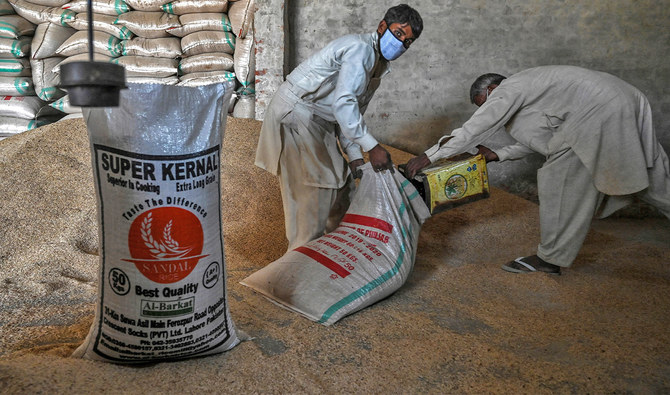
In this picture taken on March 31, 2021 workers fill a sack with rice at the Al-Barkat Rice Mills on the outskirts of Lahore. (AFP/File)
Short Url
Updated 24 November 2022
Follow

Pakistani exporters hope to retain Middle East market despite flood damages to rice crop

  • Traders estimate rice exports to decline by over a million-ton rice after 40% drop in rice production
  • Pakistan exports around 500,000 tons of rice mainly to Saudi Arabia, UAE, Oman, other Gulf nations

KARACHI: Pakistani rice exporters are hopeful they can retain their markets in Saudi Arabia, the United Arab Emirates (UAE) and other Gulf countries despite an up to 40% estimated drop in rice production following catastrophic floods that damaged vast swaths of farmland around the country this summer, the national rice exporters’ body has said. 

The south Asian nation is still reeling from the deadly impact of monsoon rains and floods that started in mid-June this year and destroyed homes, infrastructure and agriculture, impacting over 33 million people. According to government figures, the estimated economic losses from the deluge are around $30 billion. 

The floods have hit Pakistan’s two agriculture centers, Sindh and some parts of Punjab province, where rice, a major staple food in the country, is sown. 

Despite that, exporters are optimistic about retaining the Middle Eastern market on the back of normal crop production in Punjab.

“Pakistan exports around 500,000 tons of rice mainly to Saudi Arabia, United Arab Emirates, Oman, and other Gulf countries,” Chela Ram Kewlani, Chairman of the Rice Exporters Association of Pakistan (REAP), a representative body of rice exporters, told Arab News this week.

“We have enough stocks to meet the requirements of Pakistan’s Middle Eastern market.”


Chela Ram Kewlani, Chairman of Rice Exporters Association of Pakistan, speaks to Arab News on November 23, 2022 about Pakistan's sufficient rice stocks for middle Eastern market. (AN photo)

However, Pakistani exporters also fear a million-ton drop in rice exports in the wake of flood damages, which will also hurt the value of the commodity. 

“Last year, Pakistan’s rice production was 8 million tons, out of which we exported 4.88 million tons and the rest was left for local consumption, mostly basmati rice,” Kewlani said.

Pakistan last year earned $2.5 billion through the export of rice mainly to far eastern, European and Middle Eastern countries. 

“We estimated that exports of rice would be around 3.5 million tons, so the value would suffer by over $500 million,” Kewlani said, adding it would be hard to meet the $2 billion mark this year.  

Pakistan yearly produces around four million tons of basmati rice, mostly in Punjab, out of which three million tons is locally consumed and only 800,000 tons is exported. Rice produced in the Sindh province is mainly exported to far eastern countries. 

Exporters said their market could now fall into the hands of Pakistan’s arch-foe and neighbor, India.

“Sindh exports around 70 percent of rice, mostly to the far eastern destination including China,” Kewlani said.

Pakistani rice exporters have called for persistent policies, including exchange rate stability, to minimize export losses. 

Pakistan’s exports have suffered by 11.5 percent in terms of quantity and 8.2 percent in terms of value by October 2022 since the start of the fiscal year in July 2022. The country has earned $545.7 million as compared to $594.6 million earned the previous year, according to the Pakistan Bureau of Statistics.


Pakistan okays Bangladesh’s Biman to begin Dhaka-Karachi flights as ties warm up

Updated 9 sec ago
Follow

Pakistan okays Bangladesh’s Biman to begin Dhaka-Karachi flights as ties warm up

  • Pakistan and Bangladesh were once one nation, but they split in 1971 as a result of a bloody civil war
  • Ties between both nations have warmed up since ouster of PM Sheikh Hasina, viewed as an India ally

ISLAMABAD: Pakistan has granted Bangladesh’s national carrier, Biman Bangladesh Airlines, permission to begin flight operations between Dhaka and Karachi, the Pakistan Civil Aviation Authority (PCAA) said on Friday, amid strengthening ties between the two countries. 

Pakistan and Bangladesh used to be one nation, but they split in 1971 as a result of a bloody civil war, which saw the part previously referred to as East Pakistan seceding to form the independent nation of Bangladesh.

Ties between Pakistan and Bangladesh have warmed up since the fall of former Bangladeshi prime minister Sheikh Hasina, who was widely viewed as close to India and critical of Pakistan, following a student-led uprising in August 2024.

Islamabad has attempted to forge closer ties with Dhaka in recent months after the two South Asian nations began sea trade in late 2024, which were followed by efforts to expand government-to-government commerce.

“Pakistan has granted Biman, the national flag carrier of Bangladesh, initial permission for three months up to March 26 to operate flights between Dhaka and Karachi,” a PCAA spokesperson told Arab News, adding that the duration could be extended. 

The approval marks a significant step in restoring direct air connectivity between the two nations.

In Nov. last year, the now-privatized Pakistan International Airlines (PIA) said it had signed a cargo agreement with Biman, aimed at streamlining air freight operations and boosting bilateral trade. 

A PIA spokesperson said the agreement was part of PIA’s strategy to expand its cargo business and offer more competitive services to customers. 

Pakistan has stepped up efforts to rebuild relations with Bangladesh as ties between Dhaka and New Delhi remain strained over India’s decision to grant asylum to Hasina after she fled the country. 

In Feb. 2025, a cargo vessel sailed directly from Pakistan to Bangladesh for the first time in decades and successfully unloaded containers, port officials said.

The two countries signed six agreements last August, covering areas such as visa exemptions for diplomatic and official passport holders, trade cooperation, media collaboration and cultural exchanges, officials said.

Separately, Islamabad allowed Britain’s Norse Atlantic to operate flights to the South Asian country, the Pakistani defense minister announced late Thursday. The airline will operate direct flights from London, Manchester and Birmingham to the Pakistani capital of Islamabad.

“The increase in operations of international airlines to Pakistan will promote a competitive environment leading to world class service and balance in fares,” Defense Minister Khawaja Asif said on X.