

Pakistani exporters hope to retain Middle East market despite flood damages to rice crop

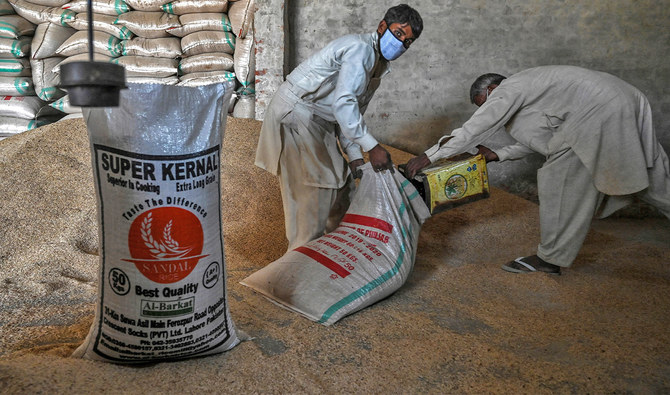
In this picture taken on March 31, 2021 workers fill a sack with rice at the Al-Barkat Rice Mills on the outskirts of Lahore. (AFP/File)
Short Url
Updated 24 November 2022
Follow

Pakistani exporters hope to retain Middle East market despite flood damages to rice crop

  • Traders estimate rice exports to decline by over a million-ton rice after 40% drop in rice production
  • Pakistan exports around 500,000 tons of rice mainly to Saudi Arabia, UAE, Oman, other Gulf nations

KARACHI: Pakistani rice exporters are hopeful they can retain their markets in Saudi Arabia, the United Arab Emirates (UAE) and other Gulf countries despite an up to 40% estimated drop in rice production following catastrophic floods that damaged vast swaths of farmland around the country this summer, the national rice exporters’ body has said. 

The south Asian nation is still reeling from the deadly impact of monsoon rains and floods that started in mid-June this year and destroyed homes, infrastructure and agriculture, impacting over 33 million people. According to government figures, the estimated economic losses from the deluge are around $30 billion. 

The floods have hit Pakistan’s two agriculture centers, Sindh and some parts of Punjab province, where rice, a major staple food in the country, is sown. 

Despite that, exporters are optimistic about retaining the Middle Eastern market on the back of normal crop production in Punjab.

“Pakistan exports around 500,000 tons of rice mainly to Saudi Arabia, United Arab Emirates, Oman, and other Gulf countries,” Chela Ram Kewlani, Chairman of the Rice Exporters Association of Pakistan (REAP), a representative body of rice exporters, told Arab News this week.

“We have enough stocks to meet the requirements of Pakistan’s Middle Eastern market.”


Chela Ram Kewlani, Chairman of Rice Exporters Association of Pakistan, speaks to Arab News on November 23, 2022 about Pakistan's sufficient rice stocks for middle Eastern market. (AN photo)

However, Pakistani exporters also fear a million-ton drop in rice exports in the wake of flood damages, which will also hurt the value of the commodity. 

“Last year, Pakistan’s rice production was 8 million tons, out of which we exported 4.88 million tons and the rest was left for local consumption, mostly basmati rice,” Kewlani said.

Pakistan last year earned $2.5 billion through the export of rice mainly to far eastern, European and Middle Eastern countries. 

“We estimated that exports of rice would be around 3.5 million tons, so the value would suffer by over $500 million,” Kewlani said, adding it would be hard to meet the $2 billion mark this year.  

Pakistan yearly produces around four million tons of basmati rice, mostly in Punjab, out of which three million tons is locally consumed and only 800,000 tons is exported. Rice produced in the Sindh province is mainly exported to far eastern countries. 

Exporters said their market could now fall into the hands of Pakistan’s arch-foe and neighbor, India.

“Sindh exports around 70 percent of rice, mostly to the far eastern destination including China,” Kewlani said.

Pakistani rice exporters have called for persistent policies, including exchange rate stability, to minimize export losses. 

Pakistan’s exports have suffered by 11.5 percent in terms of quantity and 8.2 percent in terms of value by October 2022 since the start of the fiscal year in July 2022. The country has earned $545.7 million as compared to $594.6 million earned the previous year, according to the Pakistan Bureau of Statistics.



Pakistan to promote mineral sector at Saudi forum this month with 13 companies

Updated 02 January 2026
Follow

Pakistan to promote mineral sector at Saudi forum this month with 13 companies

  • Delegation will take part in the Future Minerals Forum in Riyadh from Jan. 13-15
  • Petroleum minister will lead Pakistan, participate in a 90-minute country session

ISLAMABAD: Around 13 Pakistani state-owned and private companies will attend the Future Minerals Forum (FMF) in Saudi Arabia from Jan. 13 to 15, an official statement said on Friday, as the country seeks to ramp up global engagement to develop its mineral resources.

The FMF is an international conference and investment platform for the mining sector, hosted by mineral-rich countries to attract global investors, companies and governments.

Petroleum Minister Ali Pervaiz Malik confirmed Pakistan’s participation in a meeting with the Saudi envoy, Nawaf bin Said Al-Malki.

Pakistan hosts one of the world’s largest copper-gold zones. The Reko Diq mine in southwestern Balochistan, with an estimated 5.9 billion tons of ore, is partly owned by Barrick Gold, which calls it one of the world’s largest underdeveloped copper-gold deposits. Its development is expected to boost Pakistan’s struggling economy.

“Upon an invitation of the Government of the Kingdom of Saudi Arabia, the Federal Minister informed the Ambassador that Pakistan will fully participate in the upcoming Future Minerals Forum (FMF), scheduled to be held in Riyadh later this month,” Pakistan’s Press Information Department (PID) said in an official statement.

The Pakistani minister will lead his country’s delegation at the FMF and take part in a 90-minute country showcase session titled “Unleashing Potential: Accelerating Pakistan’s Mineral Revolution” along with local and foreign investors.

Pakistan will also establish a dedicated pavilion to highlight the vast potential of its rich geological landscape to the global mineral community.

The Saudi envoy welcomed Pakistan’s decision to participate in the forum and discussed enhancing bilateral cooperation in the minerals and energy sectors during the meeting.

According to the statement, he highlighted the potential for cooperation between Saudi Arabia and Pakistan in the minerals and energy sectors, expressing confidence that the FMF would provide a platform to expand collaboration.
Pakistan’s mineral sector, despite its rich reserves of salt, copper, gold and coal, contributes only 3.2 percent to the country’s GDP and just 0.1 percent to global mineral exports.

However, many countries, including the United States, have shown interest in Pakistan’s underdeveloped mineral sector, particularly in copper, gold and other critical resources.

In October, Pakistan dispatched its first-ever shipment of rare earth and critical minerals to the United States, according to a Chicago-based US public relations firm’s report.