

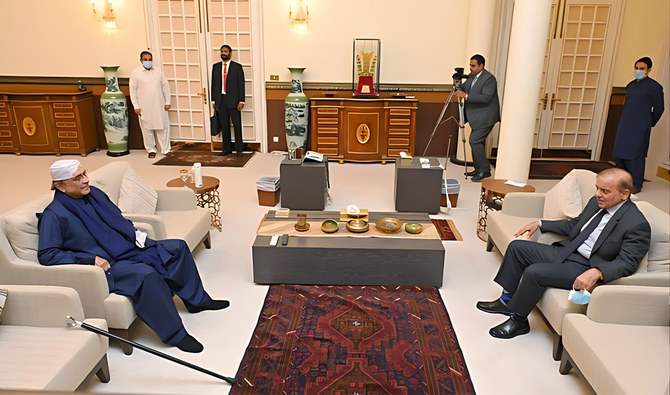

ISLAMABAD: Federal Minister for Defense Khawaja Asif said on Wednesday the government was consulting its allies regarding the much-awaited appointment of the army chief and the suggestions put forward by former president Asif Ali Zardari, the co-chairman of the Pakistan Peoples Party (PPP), would be considered on priority.
Asif’s remarks came after a meeting between Zardari and Prime Minister Shehbaz Sharif on Wednesday.
The army chief is arguably the most powerful man in the country and his appointment will have a crucial bearing on the future of the South Asian nation’s burgeoning democracy. It will also set the tone for relations with India, Afghanistan, China, and the United States.
The current chief, General Qamar Javed Bajwa, has been the head of the army since 2016 and received an extension in service in 2019. He will retire on November 29.
“Zardari’s opinion was very loaded and he came up with a good suggestion. Therefore, we have included his advice in the updated summary regarding the appointment of the new army chief,” Asif said while speaking to Geo News.
The defense minister said the government was also consulting other allied parties regarding the matter. He reiterated that the legal procedure for the appointment would be concluded today, Thursday, as PM Shehbaz was leaving on a visit to Turkiye on Friday.
Commenting on Gen. Bajwa’s farewell address on Wednesday, in which he admitted that recent criticism of the army was due to its history of interfering in politics, Asif described the speech as “straightforward and candid.”
“It’s a new beginning as the military has acknowledged and admitted that it had been interfering in political matters for the last 75 years. We should respect that the army now wants to disassociate itself from [political matters], and support Bajwa’s statement so that the institution becomes successful in its pledge,” the defense minister said.
When questioned about remarks by former prime minister Imran Khan about using the president to “drag out” the appointment process, the minister said the government was prepared for the worst.
Since his ouster from power in April via a parliamentary vote of no-confidence, Khan has been demanding fresh elections and has accused the government of wanting to pick an army chief of its choice instead of considering merit.
On Wednesday, Khan said President Arif Alvi, a close aide and member of Khan’s PTI party, was in contact with him and would consult him on the appointment of the top slots in the military.
As per the rules, Sharif will pick a candidate from among the six names suggested by the army in its summary, and will subsequently advice the president to appoint him as army chief.
According to Article 48 of the Pakistani constitution, the president is bound to follow the advice of the prime minister. However, the president also has the right to return the summary to the premier for reconsideration within 15 days of its issuance. After that, the premier will have another 10 days to incorporate changes to the summary for the army chief’s appointment, but if he takes no action, the summary would automatically be executed and come into effect.
Asif said it would throw the country into a “spin” if the president followed Khan’s advice and tried to stretch out approving the summary.
“If they say they will play with the decision along constitutional and legal lines, it would be the worse that could be done to the country under the present circumstances,” Asif said. “Such a move will definitely be a shock for the government and the country will be going into a spin, but Imran Khan will be the ultimate loser”.
“We hope that such a situation does not arise in the first place but we are, nonetheless, prepared for the worst as we don’t expect anything good from Khan.”
Among the main contenders for the army chief’s post are Lieutenants-Generals Asim Munir, the army’s quartermaster general, Azhar Abbas, the chief of general staff, Nauman Mahmood, president of the National Defense University, and Faiz Hameed, the former chief of Pakistan’s premier Inter-Services Intelligence agency and currently the commander of the army’s Bahawalpur Corps.


