PM Sharif consults allies on appointment of new chief of Pakistan army

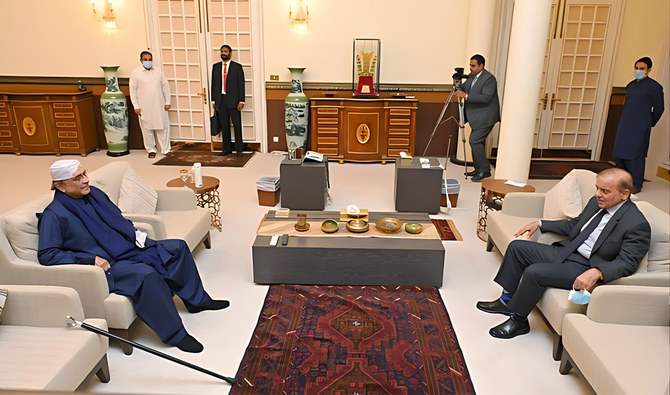
Pakistan Prime Minister Shehbaz Sharif (right) meets former president and PPP's chairman Asif Ali Zardari in Islamabad, Pakistan, on November 22, 2022. (@FarhatullahB/Twitter)
Short Url
Updated 24 November 2022
Follow

PM Sharif consults allies on appointment of new chief of Pakistan army

  • Asif’s remarks came after meeting between ex-president Zardari and PM Sharif
  • General Bajwa, has been the head of the army since 2016, will retire on November 29

ISLAMABAD: Federal Minister for Defense Khawaja Asif said on Wednesday the government was consulting its allies regarding the much-awaited appointment of the army chief and the suggestions put forward by former president Asif Ali Zardari, the co-chairman of the Pakistan Peoples Party (PPP), would be considered on priority.

Asif’s remarks came after a meeting between Zardari and Prime Minister Shehbaz Sharif on Wednesday. 

The army chief is arguably the most powerful man in the country and his appointment will have a crucial bearing on the future of the South Asian nation’s burgeoning democracy. It will also set the tone for relations with India, Afghanistan, China, and the United States. 

The current chief, General Qamar Javed Bajwa, has been the head of the army since 2016 and received an extension in service in 2019. He will retire on November 29.

“Zardari’s opinion was very loaded and he came up with a good suggestion. Therefore, we have included his advice in the updated summary regarding the appointment of the new army chief,” Asif said while speaking to Geo News.

The defense minister said the government was also consulting other allied parties regarding the matter. He reiterated that the legal procedure for the appointment would be concluded today, Thursday, as PM Shehbaz was leaving on a visit to Turkiye on Friday.

Commenting on Gen. Bajwa’s farewell address on Wednesday, in which he admitted that recent criticism of the army was due to its history of interfering in politics, Asif described the speech as “straightforward and candid.”

“It’s a new beginning as the military has acknowledged and admitted that it had been interfering in political matters for the last 75 years. We should respect that the army now wants to disassociate itself from [political matters], and support Bajwa’s statement so that the institution becomes successful in its pledge,” the defense minister said. 

When questioned about remarks by former prime minister Imran Khan about using the president to “drag out” the appointment process, the minister said the government was prepared for the worst.

Since his ouster from power in April via a parliamentary vote of no-confidence, Khan has been demanding fresh elections and has accused the government of wanting to pick an army chief of its choice instead of considering merit.

On Wednesday, Khan said President Arif Alvi, a close aide and member of Khan’s PTI party, was in contact with him and would consult him on the appointment of the top slots in the military.

As per the rules, Sharif will pick a candidate from among the six names suggested by the army in its summary, and will subsequently advice the president to appoint him as army chief. 

According to Article 48 of the Pakistani constitution, the president is bound to follow the advice of the prime minister. However, the president also has the right to return the summary to the premier for reconsideration within 15 days of its issuance. After that, the premier will have another 10 days to incorporate changes to the summary for the army chief’s appointment, but if he takes no action, the summary would automatically be executed and come into effect.

Asif said it would throw the country into a “spin” if the president followed Khan’s advice and tried to stretch out approving the summary.

“If they say they will play with the decision along constitutional and legal lines, it would be the worse that could be done to the country under the present circumstances,” Asif said. “Such a move will definitely be a shock for the government and the country will be going into a spin, but Imran Khan will be the ultimate loser”.

“We hope that such a situation does not arise in the first place but we are, nonetheless, prepared for the worst as we don’t expect anything good from Khan.”

Among the main contenders for the army chief’s post are Lieutenants-Generals Asim Munir, the army’s quartermaster general, Azhar Abbas, the chief of general staff, Nauman Mahmood, president of the National Defense University, and Faiz Hameed, the former chief of Pakistan’s premier Inter-Services Intelligence agency and currently the commander of the army’s Bahawalpur Corps.


Islamabad dismisses claims about paying up to 8 percent interest on foreign loans as ‘misleading’

Updated 22 February 2026
Follow

Islamabad dismisses claims about paying up to 8 percent interest on foreign loans as ‘misleading’

  • Pakistan has long relied on external loans to help bridge persistent gaps in public finances and foreign exchange reserves
  • Pakistan’s total external debt, liabilities stand at $138 billion at an overall average cost of around 4 percent, ministry says

KARACHI: Pakistan’s finance ministry on Sunday dismissed as “misleading” claims that the country is paying up to 8 percent interest on external loans, saying the overall average cost of external public debt is approximately 4 percent.

Pakistan has long relied on external loans to help bridge persistent gaps in public finances and foreign exchange reserves, driven largely by a narrow tax base, chronic trade deficits, rising debt-servicing costs and repeated balance-of-payments pressures.

Over the decades, successive governments have turned to multilateral and bilateral lenders, including the International Monetary Fund, the World Bank and the Asian Development Bank, to support budgetary needs and shore up foreign exchange reserves.

The finance ministry on Sunday issued a clarification in response to a “recent press commentary” regarding the country’s external debt position and associated interest payments, and said the figures required contextual explanation to ensure accurate understanding of Pakistan’s external debt profile.

“Pakistan’s total external debt and liabilities currently stand at $138 billion. This figure, however, encompasses a broad range of obligations, including public and publicly guaranteed debt, debt of Public Sector Enterprises (both guaranteed and non-guaranteed), bank borrowings, private-sector external debt, and intercompany liabilities to direct investors. It is therefore important to distinguish this aggregate figure from External Public (Government) Debt, which amounts to approximately $92 billion,” it said.

“Of the total External Public Debt, nearly 75 percent comprises concessional and long-term financing obtained from multilateral institutions (excluding the IMF) and bilateral development partners. Only about 7 percent of this debt consists of commercial loans, while another 7 percent relates to long-term Eurobonds. In light of this composition, the claim that Pakistan is paying interest on external loans ‘up to 8 percent’ is misleading.

The overall average cost of External Public Debt is approximately 4 percent, reflecting the predominantly concessional nature of the borrowing portfolio.”

With respect to interest payments, public external debt interest outflows increased from $1.99 billion in Fiscal Year (FY) 2022 to $3.59 billion in FY2025, representing an increase of 80.4 percent, not 84 percent as reported. In absolute terms, interest payments rose by $1.60 billion over this period, not $1.67 billion, it said.

According to the State Bank of Pakistan’s records, Pakistan’s total debt servicing payments to specific creditors during the period under reference were as follows: the IMF received $1.50 billion, of which $580 million constituted interest; Naya Pakistan Certificates payments totaled $1.56 billion, including $94 million in interest; the Asian Development Bank received $1.54 billion, including $615 million in interest; the World Bank received $1.25 billion, including $419 million in interest; and external commercial loans amounted to nearly $3 billion, of which $327 million represented interest payments.

“While interest payments have increased in absolute terms, this rise cannot be attributed solely to an expansion in the debt stock,” the ministry said. “Although the overall debt stock has increased slightly since FY2022, the additional inflows have primarily originated from concessional multilateral sources and the IMF’s Extended Fund Facility (EFF) under the ongoing IMF-supported program.”

Pakistan secured a $7 billion IMF bailout in Sept. 2024 as part of Prime Minister Shehbaz Sharif’s efforts to stabilize the South Asian economy that narrowly averted a default in 2023. The government has since been making efforts to boost trade and bring in foreign investment to consolidate recovery.

“It is also important to note that the increase in interest payments reflects prevailing global interest rate dynamics. In response to the inflation surge of 2021–22, the US Federal Reserve raised the federal funds rate from 0.75-1.00 percent in May 2022 to 5.25–5.50 percent by July 2023. Although rates have since moderated to around 3.75 percent, they remain significantly higher than 2022 levels,” the finance ministry said.

“The government remains committed to prudent debt management, transparency, and the continued strengthening of Pakistan’s macroeconomic stability,” it added.