

IMF says finalizing flood recovery plan by Pakistan essential for continued financial support

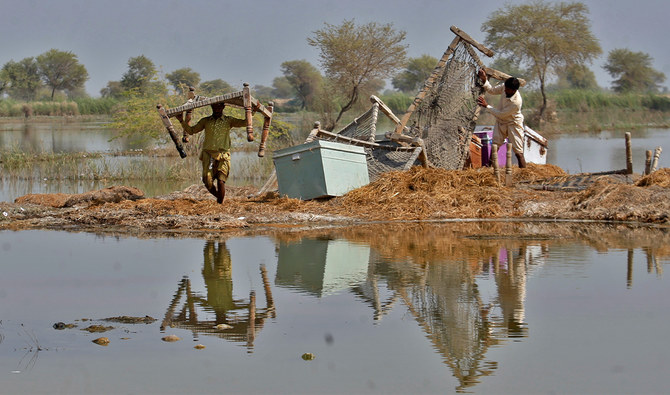
Villagers retrieve belongings they kept on the higher ground still surrounded by floodwaters in a village in Sohbat Pur, a flood-hit district of Balochistan province, Pakistan, onOctober 25, 2022. (AP)
Short Url
Updated 23 November 2022
Follow

IMF says finalizing flood recovery plan by Pakistan essential for continued financial support

  • The fund’s resident representative in Pakistan says IMF seeks to better target support toward rehabilitation needs
  • Esther Perez Ruiz points out the fund wants to accelerate economic reform efforts while helping survivors of the floods

ISLAMABAD: The International Monetary Fund (IMF) said on Wednesday a swift finalization of plan to recover from the impact of the recent floods in Pakistan was necessary for the country to get continued financial support from bilateral and multilateral partners, reported Reuters.

More than 1,700 people in Pakistan were killed by extreme weather during the monsoon season this year. The unprecedented rains and floods also affected the lives of over 33 million people while destroying houses, farmlands and other public infrastructure.

While it is difficult to estimate the economic cost of the climate-induced catastrophe, it is said to have cost over $30 billion to the country.

“The timely finalization of the recovery plan is essential to support the discussions, along with continuing financial support from multilateral and bilateral partners,” the fund’s resident representative Esther Perez Ruiz told Reuters in a message.

“IMF staff continue discussions with the Pakistani authorities over policies to reprioritize and better target support toward humanitarian and rehabilitation needs, while also accelerating reform efforts,” she added.

Last week, Pakistan’s finance minister Ishaq Dar held an online meeting with the IMF mission chief for Pakistan, Nathan Porter, in which he focused on the impact of floods on macroeconomic framework and targets for the current fiscal year.

According to a statement issued by the country’s finance division, the IMF official indicated willingness to “sympathetically view the targeted assistance for poor and vulnerable” segment of society, particularly those affected by the floods.

“It was agreed that expenditure estimates for flood related humanitarian assistance during the current year will be firmed up along with estimates of priority rehabilitation expenditure,” the statement added. “In this regard engagement at the technical level shall be expeditiously concluded for proceeding with the 9th Review.”

The country has undergone eight reviews of its economic progress after securing a bailout package from the international lending agency in 2019.

The IMF delegation was expected to visit Pakistan in the ongoing month, though it did not happen and the review has now been delayed.


At UNSC, Pakistan warns competition for critical minerals could fuel global conflict

Updated 6 sec ago
Follow

At UNSC, Pakistan warns competition for critical minerals could fuel global conflict

  • The demand for critical minerals has surged worldwide due to rapid expansion of electric vehicles, advanced electronics and clean energy technologies
  • Pakistan’s representative says all partnerships in critical minerals sector must be ‘cooperative and not exploitative’ and respect national ownership

ISLAMABAD: Ambassador Asim Iftikhar Ahmad, Pakistan’s permanent representative to the United Nations (UN), has warned that intensifying global competition over critical minerals could become a new driver of global conflict, urging stronger international cooperation and equitable access to resources vital for the world’s energy transition.

The warning comes as demand for critical minerals and rare earth elements surges worldwide due to the rapid expansion of electric vehicles, advanced electronics and clean energy technologies, with governments and companies increasingly competing to secure supply chains while raising concerns that this may lead to geopolitical rivalries in the coming years.

Speaking at a Security Council briefing on ‘Energy, Critical Minerals, and Security,’ Ahmad said experience showed that the risks of instability increased where mineral wealth intersected with weak governance, entrenched poverty and external interference.

“Access to affordable, reliable and sustainable energy is essential for development, stability and prosperity. The global transition toward renewable energy, electric mobility, battery storage and digital infrastructure has sharply increased the demand for critical minerals,” he said.

“This upsurge has generated new geopolitical and geo-economic pressures. If not managed responsibly, competition over natural resources can affect supply chains, aggravate tensions, undermine sovereignty and contribute to instability.”

In several conflict-affected settings, he noted, illicit extraction, trafficking networks and opaque financial flows have fueled armed conflict and violence, weakened state institutions and deprived populations of legitimate revenues.

“The scramble for natural resources and its linkage to conflict and instability is therefore not new,” Ahmad told UNSC members at the briefing. “Pakistan believes that natural resources must serve as instruments of economic development and shared prosperity, and not coercion or conflict.”

He urged the world to reaffirm the right of peoples to permanent sovereignty over their natural resources, saying all partnerships in the critical minerals sector must be cooperative and not exploitative, respect national ownership, ensure transparent contractual arrangements and align with host countries’ development strategies.

“In order to prevent the exploitation of mineral-producing countries and regions, particularly in fragile and conflict-affected settings, support their capacity-building for strengthening domestic regulatory institutions, combating illicit financial flows, ensuring environmental safeguards, and promoting equitable benefit-sharing with local communities,” he asked member states.

“Promote equitable participation in global value chains. Developing countries must be enabled to move beyond extraction toward processing, refining and downstream manufacturing. Technology transfer, skills development and responsible investment are essential to avoid perpetuating structural imbalances.”