

Hate speech emerges on Malaysian TikTok as political uncertainty drags out

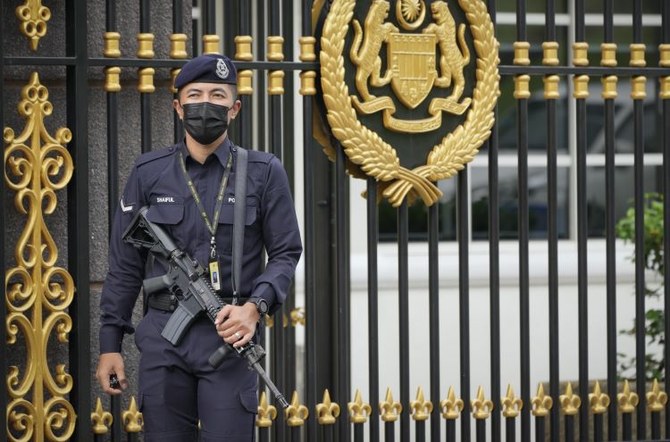
An armed policeman stands guard at the National Palace in Kuala Lumpur, Malaysia, Wednesday, Nov. 23, 2022. (AP Photo)
Short Url
Updated 23 November 2022
Follow

Hate speech emerges on Malaysian TikTok as political uncertainty drags out

  • Malaysia still has no new government, 4 days since voters cast ballots
  • TikTok on ‘high alert’ after slew of posts about 1969 deadly race riot emerged

KUALA LUMPUR: Hate speech has been dominating Malaysia’s corner of TikTok, experts said on Wednesday, as political uncertainty continued after a general election ended in a hung parliament.

After divisive polls on Saturday failed to produce a clear winner, Malaysians throughout the country have been glued to their screens for the latest updates on the formation of their next government, an issue still to be decided four days after 14.7 million Malaysians cast their ballots.

Nearly 6 million Malaysians were eligible to vote for the first time in the election, the first since a constitutional amendment lowered the voting age from 21 to 18.

The campaign period saw politicians taking to social media in efforts to woo youth votes, with video-sharing platform TikTok emerging as the most popular.

“Many political campaigns target these youth,” Faisal Aziz, president of the Malaysian Islamic Youth Movement (ABIM), told Arab News. “However, the videos lacked any constructive conversations and instead fan sentiments of hatred and divisiveness.”

As Malaysia’s election crisis drags on, TikTok has turned into a hotbed for hate speech and disinformation.

Malaysia ranked the sixth highest for TikTok's penetration rate globally, with most of its 4 million users aged under 30, according to 2022 research by Digital Business Lab.

In a statement on Wednesday, TikTok said it was on “high alert” and would “aggressively remove any violative content.”

Social media users in Malaysia have been reporting a slew of posts mentioning a deadly race riot in Kuala Lumpur on May 13, 1969, which left around 200 people dead days after opposition parties supported by the ethnic Chinese community made inroads in an election. Around 40 percent of Malaysia’s 32 million population are minorities.

The company, which is owned by China-based firm ByteDance, said it had removed videos with May 13-related content that violated its community guidelines, adding that the company had “zero tolerance” against any form of hate speech and violent extremism.

Dr. Ryan Chua, program director of human rights non-governmental organization Pusat Komas, told Arab News that narratives of racial and religious politics were “amplified” by social media, which had led to the results of the elections.

Opposition leader Anwar Ibrahim’s reformist, multi-ethnic alliance, Pakatan Harapan, had topped the race with 82 out of 222 parliamentary seats, while the Malay-centric Perikatan Nasional led by former Prime Minister Muhyiddin Yassin had unexpectedly won 73 seats. Both groups were short of the 112 seats needed for a simple majority to form a government.

“Race and religious rhetoric have created a split amongst the voters,” Chua said.

The social media narrative has also led to police setting up 24-hour checkpoints on roads throughout the country to ensure public safety and security.

“This is the first phenomena in Malaysia where such narratives are elevated even further through TikTok,” Hisham Muhaimi, project officer at the Initiative to Promote Tolerance and Prevent Violence, told Arab News.

“The authorities should do more than just asking users to prevent provocative content,” he said. “I believe the damage is done and this reflects the poor and ineffective content moderations by TikTok.”


To infinity and beyond: Grendizer’s 50 years of inspiring Arabs

Updated 27 December 2025
Follow

To infinity and beyond: Grendizer’s 50 years of inspiring Arabs

  • ⁠ ⁠50 years after its creation, the Grendizer anime series continues to capture Arab imagination
  • ⁠ ⁠⁠Arab News Japan speaks to creator Go Nagai, Middle Eastern fans and retells the story behind the UFO Robot tasked with protecting our planet

LONDON: Few cultural imports have crossed borders as unexpectedly, or as powerfully, as Grendizer, the Japanese giant robot that half a century ago became a childhood hero across the Arab world, nowhere more so than in Saudi Arabia.

Created in Japan in the mid-1970s by manga artist Go Nagai, Grendizer was part of the “mecha” tradition of giant robots. The genre was shaped by Japan’s experience during the Second World War, and explored themes of invasion, resistance and loss through the medium of science fiction.

But while the series enjoyed moderate success in Japan, its true legacy was established thousands of kilometers away in the Middle East.

By the early 1980s, “Grendizer” had spread across the Middle East, inspiring fandoms in Saudi Arabia, Kuwait, Iraq and beyond. (Supplied)

The anime “UFO Robot Grendizer” arrived on television in the region in 1979, dubbed into Arabic and initially broadcast in Lebanon during the Lebanese civil war. The story it told of the heroic Duke Fleed, a displaced prince whose planet had been destroyed by alien invaders, struck a chord with children growing up amid regional conflict and occupation by Israel.

Its themes of defending one’s homeland, standing up to aggression and protecting the innocent were painfully relevant in the region, transforming the series from mere entertainment into a kind of emotional refuge.

Much of the show’s impact came from its successful Arabization. The powerful Arabic dubbing and emotionally charged voice-acting, especially by Lebanese actor Jihad El-Atrash as Duke Fleed, lent the show a moral gravity unmatched by other cartoons of the era.

While the series enjoyed moderate success in Japan, its true legacy was established thousands of kilometers away in the Middle East. (Supplied)

The theme song for the series, performed by Sami Clark, became an anthem that the Lebanese singer continued to perform at concerts and festivals right up until his death in 2022.

By the early 1980s, “Grendizer” had spread across the Middle East, inspiring fandoms in Saudi Arabia, Kuwait, Iraq and beyond. For many, it was not only their first exposure to anime, it also delivered lessons on values such as justice and honor.

Grendizer was so influential in the region that it became the subject of scholarly research, which in addition to recognizing the ways in which the plight of the show’s characters resonated with the audience in the Middle East, also linked the show’s popularity to generational memories of displacement, particularly the Palestinian Nakba.

By the early 1980s, “Grendizer” had spread across the Middle East, inspiring fandoms in Saudi Arabia, Kuwait, Iraq and beyond. (Supplied)

Half a century later, “Grendizer” remains culturally alive and relevant in the region. In Saudi Arabia, which embraced the original version of the show wholeheartedly, Manga Productions is now introducing a new generation of fans to a modernized version of the character, through a video game, The Feast of The Wolves, which is available in Arabic and eight other languages on platforms including PlayStation, Xbox and Nintendo Switch, and a new Arabic-language anime series, “Grendizer U,” which was broadcast last year.

Fifty years after the debut of the show, “Grendizer” is back — although to a generation of fans of the original series, their shelves still full of merchandise and memorabilia, it never really went away.


Grendizer at 50
The anime that conquered Arab hearts and minds
Enter
keywords