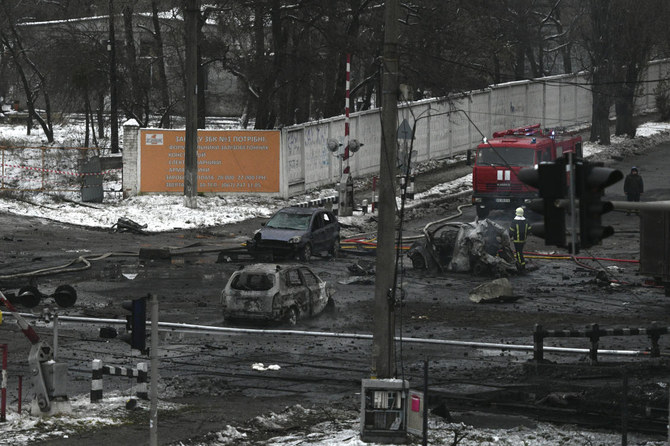
KYIV: Russia unleashed a missile barrage across Ukraine on Wednesday, forcing shutdowns of nuclear power plants and killing at least six civilians as Moscow pursued a campaign to pitch Ukrainian cities into darkness and cold as winter sets in.
All of the Kyiv capital region, where over three million people live, lost electricity and running water, Kyiv’s governor said, as were many other regions where emergency blackouts were necessary to help conserve energy and carry out repairs.
Ukrainian President Volodymyr Zelensky was expected to brief a special session of the UN Security Council shortly by video link about Russia’s assault on civilian infrastructure.
“The murder of civilians and the destruction of civilian infrastructure are acts of terror,” Zelensky said in a tweet. “Ukraine will continue to demand a decisive response from the world to these crimes.”
Officials across the border in Moldova said electricity was also lost to more than half of their country, the first time a neighboring state has reported such extensive damage from the war in Ukraine triggered by Russia’s invasion nine months ago.
Blackouts forced the shutdown of reactors at Ukraine’s Pivdennoukrainsk nuclear power plant in the south and the Rivne and Khmelnitskyi plants in the west, all in government-held territory, the state-run nuclear energy firm Energoatom said.
“Currently, they (power units) work in project mode, without generation into the domestic energy system,” Energoatom said.
Ukraine’s largest nuclear complex, at Zaporizhzhia near the front lines in the south, is Russian-controlled and was previously switched off because of shelling that both sides blame on each other.
SIRENS, EXPLOSIONS, DARKNESS
Air raid sirens blared across Ukraine in a nationwide alert.
Explosions reverberated throughout Kyiv on Wednesday afternoon as Russian missiles bore down and Ukrainian air defense rockets were fired in efforts to intercept them.
Four civilians had been killed and 34 injured, five of them children, in Kyiv, regional governor Oleksiy Kuleba said in a statement posted on Telegram. Ukraine’s defense ministry said two people were killed by missile strikes elsewhere.
“Our little one was sleeping. Two years old. She was sleeping, she got covered. She is alive, thanks be to God,” said Fyodr, a Kyiv resident walking away from a smoldering apartment building that was hit in Kyiv, dragging a suitcase.
Mayor Vitali Klitschko said on Wednesday evening at least 80 percent of people in the capital remained without power and water, but Kuleba said repair crews were working hard and “electricity will begin to appear in the coming hours. Don’t panic!“
By 6 p.m., electricity in half of the western city of Lviv had been restored following repairs, its mayor said.
Most thermal and hydro-electric power plants were forced to shut down as well, Ukraine’s energy ministry said earlier. As a result, it said, the great majority of electricity consumers in areas of the country under Ukrainian control were cut off.
Earlier, Russian missiles hit a maternity hospital in the Zaporizhzhia region overnight, killing a baby, the regional governor said on the Telegram messaging service.
Blasts were also reported in other cities, where further information about casualties was not immediately available.
Ukraine’s top military commander, General Valeriy Zaluzhniy, said air defenses had shot down 51 of 67 Russian cruise missiles launched, including 20 of the 30 that targeted Kyiv.
Since October, Russia has acknowledged targeting Ukraine’s civilian energy grid far from front lines with long-range missiles and drones as a Ukrainian counter-offensive has wrested back territory from Russian occupiers in the east and south.
Moscow says the aim of its missile strikes is to weaken Kyiv’s ability to fight and push it to negotiate; Ukraine says the attacks on infrastructure amount to war crimes, deliberately intended to harm civilians to break the national will.
That will not happen, Zelensky vowed in an earlier video address posted on the Telegram messaging app.
“We’ll renew everything and get through all of this because we are an unbreakable people,” he said.
SPILLOVER BLACKOUT IN MOLDOVA
Moldova, like Ukraine a former Soviet republic once dominated by Moscow but now pro-Western, has long worried about the prospect of fighting spreading across its borders.
“Massive blackout in Moldova after today’s Russian attack on Ukraine’s energy infrastructure,” Deputy Prime Minister Andrei Spinu said on Twitter, adding the grid operator was trying to reconnect “more than 50 percent of the country to electricity.”
With the first snow of Ukraine’s generally frigid winter falling, authorities worry about the impact of power cuts affecting millions of people.
Zelensky on Tuesday announced special “invincibility centers” would be set up around Ukraine to provide electricity, heat, water, Internet, mobile phone links and a pharmacy, free of charge and around the clock.
In addition, Europe’s biggest cities will donate power generators and transformers to help Ukrainians get through the harsh winter ahead.
A series of Russian battlefield setbacks in the east and south included a Russian retreat earlier this month from the key southern city of Kherson to the east bank of the Dnipro River that bisects the country.
Ground battles continue to rage in the east, where Russia is pressing an offensive along a stretch of front line west of the city of Donetsk, which has been held by its proxies since 2014.
For their part, Ukrainian forces killed about 50 Russian soldiers in an attack on an ammunition depot in the eastern Luhansk region, and up to 15 Russians in a separate attack in the Zaporizhzhia region, Kyiv’s military said on Wednesday.
No further details were given and Reuters was unable to independently verify the reports.
Moscow says it is carrying out a “special military operation” to protect Russian speakers in what President Vladimir Putin calls an artificial state carved from Russia. Ukraine and the West call the invasion an unprovoked land grab.
Western responses have included billions of dollars worth of financial aid and state-of-the-art military hardware for Kyiv and waves of punitive sanctions on Russia.


![]()

Russian missile barrage forces Ukraine to shut nuclear power plants
Short Url
https://arab.news/nbk5q
Russian missile barrage forces Ukraine to shut nuclear power plants
- All of the Kyiv capital region, where over three million people live, lost electricity and running water
- “The murder of civilians and the destruction of civilian infrastructure are acts of terror,” Zelensky said in a tweet


Latest updates





© 2026 SAUDI RESEARCH & PUBLISHING COMPANY, All Rights Reserved And subject to Terms of Use Agreement.