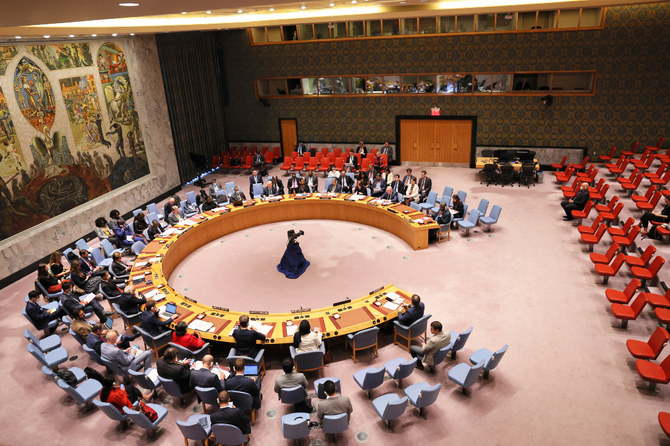

NEW YORK: Saudi Arabia on Tuesday called on the UN Security Council to designate the Houthis in Yemen a terrorist group, warning that the recent escalation in conflict by the Iran-backed militia was “extremely serious,” likely to cause the country to “collapse at any time,” and result in devastating security consequences for the entire region.
“Classifying the Houthi militias as a terrorist group is today extremely urgent and paramount,” Abdulaziz Alwasil, Saudi Arabia’s permanent representative to the UN, told a Security Council meeting to discuss the latest developments in Yemen. He said all attempts to resolve the conflict have failed because of the Houthis’ continued violations, resulting in only one option left for the world body.
Alwasil called on the UNSC to discuss the situation in Yemen “in all its dimensions and in full transparency and objectivity.” The meeting, he added, comes against the backdrop of “serious political and security developments threatening Yemen and the region with more instability and insecurity.”
Lamenting the lack of an international vision capable of ensuring the Houthis lay down their arms and engage in peace talks, Alwasil told the council: “A question should be asked here … Does the international silence towards these violations serve the Yemeni people?”
Since the UNSC’s last meeting on the war-torn nation in October, the Houthis have launched several drone attacks that have targeted Yemeni government ports, including one that hit a Greek oil tanker near the Al-Dubba oil terminal in Hadramawt governorate.
The Houthis said they had launched the attack as a warning to the Yemeni government not to use the terminal to export oil. The UNSC subsequently condemned the attacks.
Similar drone attacks later targeted the Rudum oil terminal, and then the southern Qena port in Shabwah governorate. This resulted in further condemnation from the UNSC, which called on the group to renew the truce it had abandoned.
Alwasil called on the international community to take “a clear stance against (the) Houthis’ terrorist activities, who are using ballistic missiles and drones to target Yemenis, neighboring states and commercial and oil vessels.”
He said the Kingdom would not hesitate to defend itself and respond firmly to any threat to its national security. Saudi Arabia would also defend all the Gulf countries and those nations who are part of the coalition.
The UNSC meeting comes seven weeks after the UN-brokered truce — which came into effect on April 2 and was renewed twice — had expired on Oct. 2. The two-month truce had been hailed for the drastic reduction in hostilities and civilian casualties, along with the resumption of commercial flights from Sanaa airport. The UNSC members had said that the truce, if fully implemented and expanded, would eventually lead to a comprehensive settlement of the country’s war.
But the deadline passed without a word on its renewal, until the Houthis, after meeting with the UN’s Special Envoy for Yemen Hans Grundberg, declared the ceasefire to be “at a dead end,” because of what they perceived as a lack of willingness to prioritize humanitarian issues.
Alwasil told the council members that the Houthi militia was imposing further conditions before they agreed to extend the truce. “First, that the coalition should pay the salaries of their outlawed fighters who are committing humanitarian crimes against the Yemenis. Second, that these salaries should be paid in US dollars and not in the local currency.”
He said the Houthis still refuse to deposit the revenues from Hodeidah port in Yemen’s central bank, “in a blatant violation of the truce agreement,” and instead are using the resources to fund their military operations. They were controlling the port, he said.
“The port is plagued with sea mines and used for warfare. It has been turned into a hub to smuggle weapons and internationally prohibited material and to smuggle terrorists in the absence of any international inspection mechanisms,” he added.
Alwasil said attacks on the legitimate government-held ports are “a criminal act aiming at impoverishing and starving the Yemeni people.” Through these activities, they were taking the people hostage, “controlling their destiny, and exposing (several) Yemeni generations to the threats of wars and armed conflicts, (while) putting their extremist ideologies above any other consideration.”
Alwasil said the Houthis were also continuing to blockade Taiz, “which is witnessing a dire humanitarian situation.” They were depriving regions not under their control of much-needed funds by exploiting natural resources, which should go toward paying the salaries of teachers and public sector workers.
The Saudi envoy said the Kingdom remained committed to supporting the long-suffering Yemeni people, being one of world’s largest donors to the country. However, aid efforts were increasingly being hampered by the actions of the Houthis, he said.
“The Houthi militias should be prevented from controlling humanitarian assistance, deviating it, and depriving those in need.”
Alwasil thanked Grundberg and Reena Ghelani, the operations director for the UN Office for the Coordination of Humanitarian Affairs, for their efforts to promote peace and security in Yemen, and to alleviate the plight of its people.
He reiterated the Kingdom’s “steadfast support” for the UN’s political and humanitarian efforts aimed at ending the crisis.