

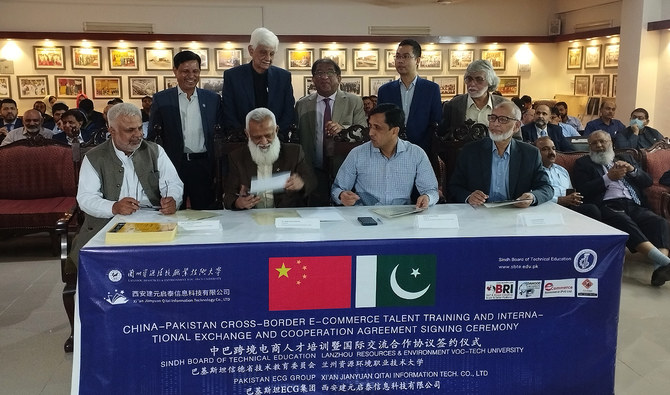

KARACHI: Technical and vocational institutions from Pakistan and China on Monday signed agreements to train more than 100,000 young Pakistani students proficient in the English language and prepare them to work in China as well as for self-employment through e-commerce platforms.
The agreements were signed as part of the Belt and Road Initiative (BRI), China’s signature investment scheme under which it has pledged over $60 billion in infrastructure, energy, agriculture, industrial and IT projects, among others, in Pakistan.
The agreement for the project, entitled ‘China-Pakistan Cross-border E-commerce Talent Training Program,’ was signed between Lanzhou Resources and Environment Vocational and Technical University, the Sindh Board of Technical Education (SBTE), Dawood University of Engineering and Technology (DUET), and a Pakistani consortium.
Under the program, 10,000 students will be trained for employment at Chinese business houses over two years, while another 100,000 will undergo training in the next five years.
“All the students are not going to China, they will be staying in Pakistan, working from their home, studying from their home and running their own companies on Chinese e-commerce portals and marketing Chinese products,” Abdullah Butt, the chief executive officer of Educast, a member of the Pakistani consortium, told Arab News.
Pakistani government officials said the program would enable students to learn about Chinese businesses and play a “greater role” in the promotion of bilateral trade and self-employment.
“Initially, the purpose of this program was to develop the workforce, create self-employment opportunities for the youth, and strengthen economic ties between Pakistan and China. But now it is also focused on teaching students to conduct better businesses with the people of China,” said Dr. Sheikh Masroor Ahmed, the chairman of SBTE.
“In particular, this program is designed to develop two-way businesses to help promote Pakistani exports. The other objective is to create a link between China and Western countries.”
Chinese officials, who joined the agreement-signing ceremony through video links, said BRI-related initiatives had made “positive contributions” in promoting connectivity through people-to-people exchanges.
“The signing of joint training agreement plays a positive role in continuously expanding and enriching the channels and contents of the universities’ foreign cooperation and exchanges, and further consolidating the foundation and ability of the schools’ foreign cooperation and exchanges,” Yu Xiaodong, first-class inspector at the Gansu Provincial Department of Education, said.
“It will play an irreplaceable role in further strengthening educational cooperation and exchanges between the Gansu Province of China and Sindh Province of Pakistan in the future.”
As a first step in setting up the program, a pilot project was launched in October 2022 between DUET and the Hunan Vocational and Chemical Technical College, China, under which 40 e-commerce entrepreneurs were trained.
“We have produced 40 entrepreneurs and they will develop trade between Pakistan and China under the BRI,” said Dr. Abdul Sami Rajput, the program in charge at DUET.
Students who participated in the pilot program said they had learnt data mining skills and event management through the project.
“In this course, we have learned about data mining and we have carried out data mining of almost 100 Chinese companies,” a student named Shahirose told Arab News.
“Along with that we participated in ITCN Asia [Information Technology & Telecom Show] exhibition and conference. After participating in these exhibitions and conferences our confidence has built up and we have come to know how to manage events.”


