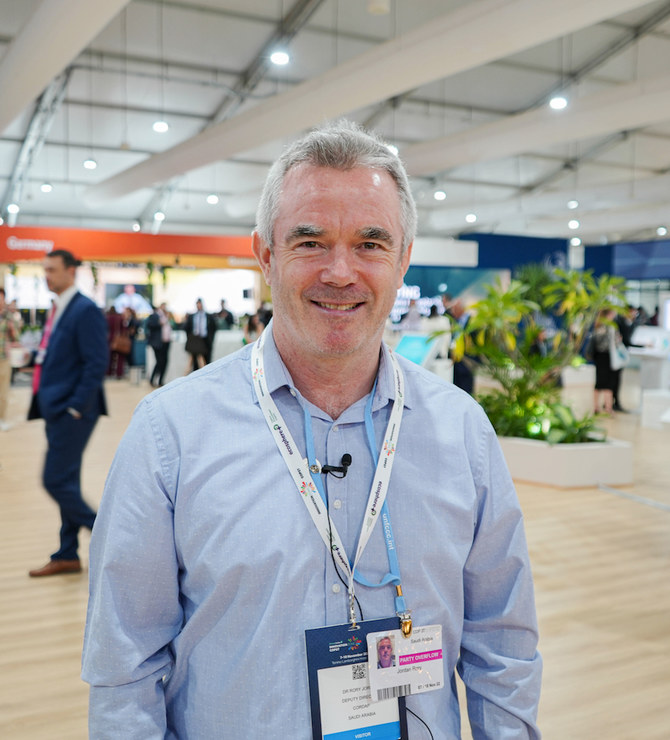

SHARM EL-SHEIKH: Progress made since the Saudi Arabia G20 presidency in raising awareness and filling in a “knowledge gap” surrounding coral reef studies has been vital in developing research in the sector, experts have said.
Speaking to Arab News on the sidelines of the UN Climate Change Conference (COP27) in the Egyptian Red Sea resort town of Sharm El-Sheikh, Dr. Rory Jordan said a global initiative launched off the back of the G20 environmental ministers meeting two years ago was key to pushing the agenda forward and fast-tracking solutions to save the world’s coral.
“We’re here to raise the profile and get visibility of what CORDAP (Coral Research and Development Accelerator Platform) is there to do, which is to fill a knowledge gap in the global research and development space for coral research, both tropical corals which take up an awful lot of the developing world, but also deepwater corals,” said the deputy director of CORDAP at the King Abdullah University of Science and Technology.

Coral reefs are an essential part of the marine ecosystem and exist in more than 100 countries and territories around the world. (AN Photo)
Jordan, who is also a senior research adviser to Coral Reef Restoration Strategies, said: “A founding committee was formed with 17 countries from the G20 and they developed the consensus.”
He added: “Saudi Arabia agreed to put in $100 million as a founding commitment for this, with a view to raising about $300 million over the next 10 years,” and called on other G20 nations and wealthy countries to step up their donations and contribute on a multiannual basis.
CORDAP launched its first $18 million funding call in September and received $112 million in requests from 89 different countries by the deadline on Nov. 1, with over $56 million coming from developing countries.

According to CORDAP, 90 percent of the world’s remaining coral reefs are threatened and may disappear completely by 2050. (AN Photo)
“That just goes to show that the demand is there for development in those areas, where they depend on them for the livelihoods and they’re really keen to get those restored and conserve them as well.”
Jordan, who was part of a delegation participating in a number of panel discussions at COP27, said he hopes this sort of investment will reverse years of coral degradation across the planet, and help put reefs front and center of conservation projects, including in areas closer to home, such as the Red Sea.
“We want to develop scalable, affordable and translatable solutions,” he said. “Solutions to scale up restoration (of) the area of coral reef which is degraded, or dead, or bleached at the moment is reaching gargantuan proportions.”
Coral reefs, which are an essential part of the marine ecosystem, exist in more than 100 countries and territories, and 90 percent of the world’s remaining coral reefs are threatened and may disappear completely by 2050, according to CORDAP
“Most coral restoration activities at the moment are very small. They have been smaller, but they’re gaining more ambition now,” Rory said, noting that they are using science and innovation to develop more affordable and precise technologies and methods to increase the survival rates of coral restoration projects.
And backing from the Saudi government and KAUST has played a big role in making sure more is done to protect coral reefs.

Funding and investment will reverse years of coral degradation across the planet, and help put reefs front and center of conservation projects, experts say. (AN Photo)
“The Red Sea is an area of particular importance to ourselves as well, being at KAUST and being in CORDAP, with the G20 being hosted by the Saudi presidency in 2020,” he said.
“It has built a huge amount of momentum, and actually that’s a lot in thanks to KAUST, who have agreed to put up their hand to host the initiative, its management hub, pay staff full time, and run its funding programs.
“So that’s to the tune of about maybe $2 million per year. So with that full-time ability and with those resources behind us, we’ve been able to move forward very quickly,” he added.
Looking toward COP28, being hosted by the UAE next year, Jordan hopes the momentum will continue and they would be able to bolster the funding available to mobilize resources for R&D programs around the world, and “If possible, by that stage,” they would like to see the Kingdom double its funding commitment.
“Coral reefs need action right now. They need resourcing both for the restoration activities around the world, but also for the new solutions that we need to develop now for even in ten, 20 years time when, hopefully, we can adapt the corals to a warming world, because we have to understand ... the ocean is going to be warmer and we’re just going to have to adapt the corals and the natural ecosystem to that,” Jordan said.