Coral reef progress from Saudi G20 presidency must continue, says CORDAP chief

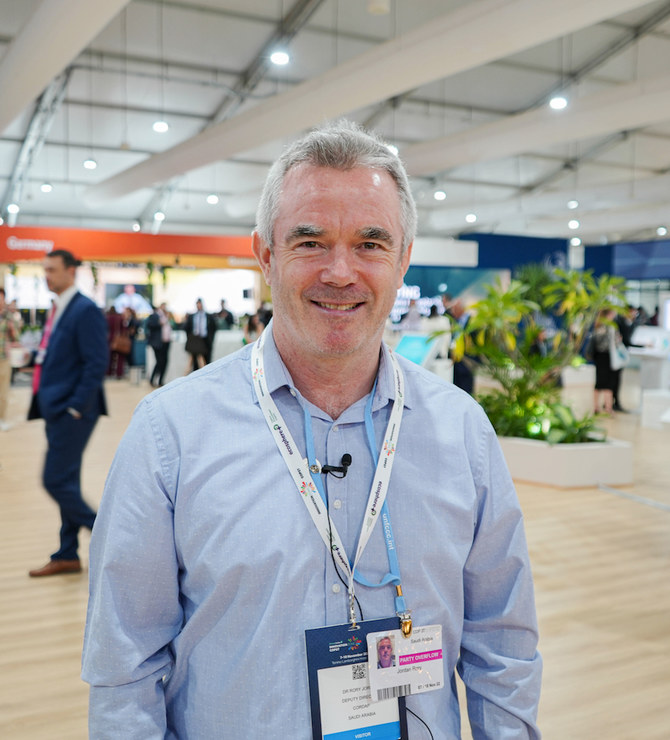
Dr. Rory Jordan, the deputy director of CORDAP at KAUST, speaking to Arab News at COP27. (AN Photo)
Short Url
Updated 30 January 2024
Follow

Coral reef progress from Saudi G20 presidency must continue, says CORDAP chief

  • Backing from Saudi government and KAUST has played big role in making sure more is done to protect coral reefs
  • CORDAP calls on other G20 nations and wealthy countries to step up donations on a multiannual basis

SHARM EL-SHEIKH: Progress made since the Saudi Arabia G20 presidency in raising awareness and filling in a “knowledge gap” surrounding coral reef studies has been vital in developing research in the sector, experts have said.

Speaking to Arab News on the sidelines of the UN Climate Change Conference (COP27) in the Egyptian Red Sea resort town of Sharm El-Sheikh, Dr. Rory Jordan said a global initiative launched off the back of the G20 environmental ministers meeting two years ago was key to pushing the agenda forward and fast-tracking solutions to save the world’s coral.

“We’re here to raise the profile and get visibility of what CORDAP (Coral Research and Development Accelerator Platform) is there to do, which is to fill a knowledge gap in the global research and development space for coral research, both tropical corals which take up an awful lot of the developing world, but also deepwater corals,” said the deputy director of CORDAP at the King Abdullah University of Science and Technology.


Coral reefs are an essential part of the marine ecosystem and exist in more than 100 countries and territories around the world. (AN Photo)

Jordan, who is also a senior research adviser to Coral Reef Restoration Strategies, said: “A founding committee was formed with 17 countries from the G20 and they developed the consensus.”

He added: “Saudi Arabia agreed to put in $100 million as a founding commitment for this, with a view to raising about $300 million over the next 10 years,” and called on other G20 nations and wealthy countries to step up their donations and contribute on a multiannual basis.

CORDAP launched its first $18 million funding call in September and received $112 million in requests from 89 different countries by the deadline on Nov. 1, with over $56 million coming from developing countries.


According to CORDAP, 90 percent of the world’s remaining coral reefs are threatened and may disappear completely by 2050. (AN Photo)

“That just goes to show that the demand is there for development in those areas, where they depend on them for the livelihoods and they’re really keen to get those restored and conserve them as well.”

Jordan, who was part of a delegation participating in a number of panel discussions at COP27, said he hopes this sort of investment will reverse years of coral degradation across the planet, and help put reefs front and center of conservation projects, including in areas closer to home, such as the Red Sea.

“We want to develop scalable, affordable and translatable solutions,” he said. “Solutions to scale up restoration (of) the area of coral reef which is degraded, or dead, or bleached at the moment is reaching gargantuan proportions.”


Coral reefs, which are an essential part of the marine ecosystem, exist in more than 100 countries and territories, and 90 percent of the world’s remaining coral reefs are threatened and may disappear completely by 2050, according to CORDAP

“Most coral restoration activities at the moment are very small. They have been smaller, but they’re gaining more ambition now,” Rory said, noting that they are using science and innovation to develop more affordable and precise technologies and methods to increase the survival rates of coral restoration projects.

And backing from the Saudi government and KAUST has played a big role in making sure more is done to protect coral reefs.


Funding and investment will reverse years of coral degradation across the planet, and help put reefs front and center of conservation projects, experts say. (AN Photo)

“The Red Sea is an area of particular importance to ourselves as well, being at KAUST and being in CORDAP, with the G20 being hosted by the Saudi presidency in 2020,” he said.

“It has built a huge amount of momentum, and actually that’s a lot in thanks to KAUST, who have agreed to put up their hand to host the initiative, its management hub, pay staff full time, and run its funding programs.

“So that’s to the tune of about maybe $2 million per year. So with that full-time ability and with those resources behind us, we’ve been able to move forward very quickly,” he added.


Looking toward COP28, being hosted by the UAE next year, Jordan hopes the momentum will continue and they would be able to bolster the funding available to mobilize resources for R&D programs around the world, and “If possible, by that stage,” they would like to see the Kingdom double its funding commitment.

“Coral reefs need action right now. They need resourcing both for the restoration activities around the world, but also for the new solutions that we need to develop now for even in ten, 20 years time when, hopefully, we can adapt the corals to a warming world, because we have to understand ... the ocean is going to be warmer and we’re just going to have to adapt the corals and the natural ecosystem to that,” Jordan said.


World must prioritize resilience over disruption, economic experts warn

Saudi Arabia’s Finance Minister Mohammed Al-Jadaan urged policymakers and investors to “mute the noise” and focus on resilience.
Updated 23 January 2026
Follow

World must prioritize resilience over disruption, economic experts warn

  • Al-Jadaan said that much of the anxiety dominating markets reflected a world that had already been shifting for years
  • Pointing to Asia and the Gulf, Al-Jadaan said that some countries had already built models based on diversification and resilience

DAVOS: Saudi Arabia’s Finance Minister Mohammed Al-Jadaan urged policymakers and investors to “mute the noise” and focus on resilience, as global leaders gathered in Davos on Friday against a backdrop of trade tensions, geopolitical uncertainty and rapid technological change.

Speaking on the final day of the World Economic Forum in Davos, Al-Jadaan said that much of the anxiety dominating markets reflected a world that had already been shifting for years.

“We need to define who ‘we’ are in this so-called new world order,” he said, arguing that many emerging economies had been adapting to a more fragmented global system for decades.

Pointing to Asia and the Gulf, Al-Jadaan said that some countries had already built models based on diversification and resilience. In energy markets, he pointed out that the focus should remain on balancing supply and demand in a way that incentivized investment without harming the global economy.

“Our role in OPEC is to stabilize the market,” he said.

His remarks were echoed by Saudi Arabia’s Minister of Economy and Planning Faisal Alibrahim, who said that uncertainty had weighed heavily on growth, investment and geopolitical risk, but that reality had proven more resilient.

“The economy has adjusted and continues to move forward,” Alibrahim said.

Alibrahim warned that pragmatism had become scarce, trust increasingly transactional, and collaboration more fragile. “Stability cannot be quickly built or bought,” he said.

Alibrahim called for a shift away from preserving the status quo towards the practical ingredients that made cooperation work, stressing discipline and long-term thinking even when views diverged.

Quoting Saudi Arabia’s founding King Abdulaziz Al-Saud, he added: “Facing challenges requires strength and confidence, there is no virtue in weakness. We cannot sit idle.”

President of the European Central Bank Christine Lagarde stressed the importance of distinguishing meaningful data from headline noise, saying: “Our duty as central bankers is to separate the signal from the noise. The real numbers are growth numbers not nominal ones.”

Managing Director of the IMF Kristalina Georgieva echoed Lagarde’s sentiments, saying that the world had entered a more “shock prone” environment shaped by technology and geopolitics.

Director General of the World Trade Organization Ngozi Okonjo-Iweala said that the global trade systems currently in place were remarkably resilient, pointing out that 72 percent of global trade continued despite disruptions.

She urged governments and businesses, however, to avoid overreacting.

Okonjo Iweala said that a return to the old order was unlikely, but trade would remain essential. Georgieva agreed, saying global trade would continue, albeit in a different form.

Georgieva warned that AI would accelerate economic transformation at an unprecedented speed. The IMF expects 60 percent of jobs to be affected by AI, either enhanced or displaced, with entry-level roles and middle-class workers facing the greatest pressure.

Lagarde warned that without cooperation, capital and data flows would suffer, undermining productivity and growth.

Al-Jadaan said that power dynamics had always shaped global relations, but dialogue remained essential. “The fact that thousands of leaders came here says something,” he said. “Some things cannot be done alone.”

In another session titled Geopolitical Risks Outlook for 2026, former US Democratic representative Jane Harman said that because of AI, the world was safer in some ways but worse off in others.

“I think AI can make the world riskier if it gets in the wrong hands and is used without guardrails to kill all of us. But AI also has enormous promise. AI may be a development tool that moves the third world ahead faster than our world, which has pretty messy politics,” she said.

American economist Eswar Prasad said that currently the world was in a “doom loop.”

Prasad said that the global economy was stuck in a negative-feedback loop and economics, domestic politics and geopolitics were only bringing out the worst in each other.

“Technology could lead to shared prosperity but what we are seeing is much more concentration of economic and financial power within and between countries, potentially making it a destabilizing force,” he said.

Prasad predicted that AI and tech development would impact growing economies the most. But he said that there was uncertainty about whether these developments would create job opportunities and growth in developing countries.

Professor of international political economy at the University of New South Wales in Australia, Elizabeth Thurbon, said that China was driving a Green Energy transition in a way that should be modeled by the rest of the world.

“The Chinese government is using the Green Energy Transition to boost energy security and is manufacturing its own energy to reduce reliance on fossil fuel imports,” she explained.

Thurbon said that China was using this transition to boost economic security, social security and geostrategic security. She viewed this as a huge security-enhancing opportunity and every country had the ability to use the energy transition as a national security multiplier. 

“We are seeing an enormous dynamism across emerging market economies driven by China. This boom loop is being driven by enormous investments in green energy. Two-thirds of global investment flowing into renewable energy is driven largely by China,” she said.

Thurbon said that China was taking an interesting approach to building relationships with countries by putting economic engagement on the forefront of what they had to offer.

“China is doing all it can to ensure economic partnership with emerging economies are productive. It’s important to approach alliances as not just political alliances but investment in economy, future and the flourishment of a state,” she said.

The panel criticized global economic treaties and laws, and expressed the need for immediate reforms in economic governing bodies.

“If you are a developing economy, the rules of the WTO, for example, are not helpful for you to develop. A lot of the rules make it difficult to pursue an economic development agenda. These regulations are not allowing the economies to grow,” Thurbon said.

“Serious reform must be made in international trade agreements, economic bodies and rules and guidelines,” she added.

Prasad echoed this sentiment and said there was a need for national and international reform in global economic institutions.

“These institutions are not working very well so we can reconfigure them or rebuild them from scratch. But unfortunately the task of rebuilding falls into the hands of those who are shredding them,” he said.

WEF attendees were invited to join the Global Collaboration and Growth meeting to be held in Saudi Arabia in April 2026 to continue addressing the complex global challenges and engage in dialogue.