

Saudi Arabia ‘taking the lead’ in nature-based climate solutions, says KAPSARC

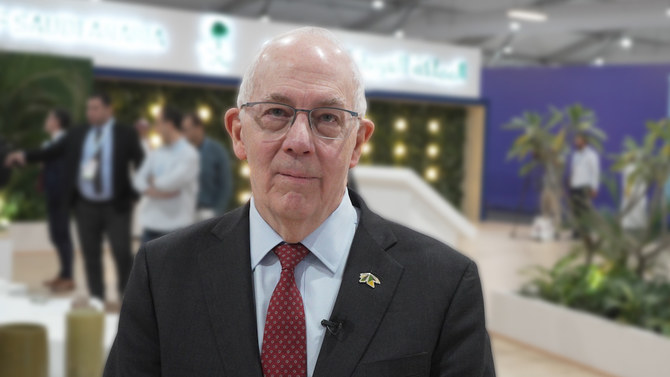
Adam Sieminski, senior adviser to the board of trustees at KAPSARC, speaking to Arab News at COP27. (AN Photo)
Short Url
Updated 21 November 2022
Follow

Saudi Arabia ‘taking the lead’ in nature-based climate solutions, says KAPSARC

  • Mangrove restoration among critical plans
  • Kingdom’s carbon storage hub key to change

SHARM EL-SHEIKH, Egypt: Nature-based solutions to climate challenges are important and somewhat overlooked globally, particularly remedies that Saudi Arabia have been championing, say experts.

The Riyadh-based King Abdullah Petroleum Studies and Research Center, in cooperation with the King Abdullah University for Science and Technology, released two reports last week on the matter at the UN Climate Change Conference, COP27, in Egypt. The solutions focused on the 4Rs of the circular carbon economy which are reduce, reuse, recycle and remove.

“Most people know about the technological type of solutions, carbon capture and storage, putting it into underground aquifers, using it for enhanced oil recovery, direct air capture, and so on,” Adam Sieminski, senior adviser to the board of trustees at KAPSARC, told Arab News.

“But nature-based solutions also fall under this ‘remove’ category, and they’re very, very important, and they are going to be part of everything that Saudi Arabia is doing to put as many opportunities on the table to deal with greenhouse gas emissions as can be done,” he added

Sieminski said the announcements that Saudi Arabia made during COP27 and the Saudi Green Initiative Forum were critical for the future, which included mangrove restoration. He highlighted the plans by Aramco and the Ministry of Energy to build a carbon capture and storage hub in the Eastern Province, and the Public Investment Fund’s initiative to establish a carbon trading platform. “All of these things are going to add very much to the ‘lead by example’ credibility that the Kingdom has been showing.”

KAPSARC, an energy and sustainability think tank, offers research, analysis, consulting and modeling on topics such as oil and gas, utilities, urban transportation, environment, and climate, with a focus on the circular carbon economy.

The think tank also released the second version of its Circular Carbon Economy Index, which was launched during the second edition of the SGI Forum that was held on the sidelines of COP 27. It measures the performance of countries around the world on how they are reducing, reusing, recycling and removing carbon dioxide and other greenhouse gas emissions from the environment. The first version was launched at the previous COP26 in Glasgow last year.

“KAPSARC hopes to continue to play a role in providing good, non-biased, fact-based research and analysis on climate challenges ... that will help to provide a good basis for policymakers and the policies that are debated and put in place at the COP meetings,” he said.

Sieminski also noted the importance of Vision 2030 for the Kingdom. “KAPSARC is trying to provide sort of the fact-based underlying work to show how Vision 2030 can be accomplished in a positive way for both energy sustainability and the economy, and this is ultimately, I think, going to be a good thing, not just for Saudi Arabia, but for the world.”


Closing Bell: Saudi main market ends week in red at 11,189

Updated 05 February 2026
Follow

Closing Bell: Saudi main market ends week in red at 11,189

RIYADH: Saudi Arabia’s Tadawul All Share Index closed lower at the end of the trading week on Thursday, falling 1.34 percent, or 152.54 points, to finish at 11,188.73. 

The benchmark index opened at 11,320.52 and trended lower throughout the session, finishing well below its previous close of 11,341.27.  

Market breadth was sharply negative, with only 28 gainers compared with 236 decliners. Trading activity saw a volume of 239 million shares exchanged, with total turnover reaching SR5.5 billion ($1.47 billion). 

In the parallel market, Nomu closed higher, rising 0.23 percent to 23,865.95, although decliners continued to outnumber advancers. The MT30 index closed at 1,508.60, down 1.46 percent, shedding 22.38 points by the end of the session. 

Among the session’s top gainers, Dar Al Majed Real Estate Co. led advances, rising 5.43 percent to close at SR9.91. 

Al Aziziah REIT Fund added 4.67 percent to SR4.48, while Al Majed Oud Co. gained 2.81 percent to SR161.20. AFG International Co. advanced 2.45 percent to SR17.17, and Al Mawarid Manpower Co. rose 1.37 percent to SR125.70.

On the losing side, Saudi Research and Media Group posted the steepest decline, falling 6.88 percent to SR107. Cherry Trading Co. dropped 6.23 percent to SR28.88, while Saudi Arabian Mining Co. slipped 5.41 percent to SR72.55.  

Almasane Alkobra Mining Co. declined 5.38 percent to SR102, and Power and Water Utility Co. for Jubail and Yanbu ended 4.56 percent lower at SR31.36. 

On the announcements front, Saudi Industrial Investment Group released its interim financial results for the twelve-month period ended Dec. 31, 2025, reporting a return to profitability on an annual basis despite posting a quarterly loss.  

The company recorded a net loss of SR104 million in the fourth quarter, compared with a net profit of SR201 million in the same quarter of the previous year, which it attributed mainly to lower selling prices, higher operating costs, and increased general and administrative expenses.  

For the full year, however, the group posted a net profit attributable to shareholders of SR197 million, compared with SR161 million a year earlier, supported by higher sales volumes and improved operational performance at several subsidiaries. The stock last traded at SR14.77, down 3.59 percent. 

Separately, Saudi Exchange Co. announced the approval of a request by Merrill Lynch Kingdom of Saudi Arabia to terminate its market-making activities for Saudi Arabian Oil Co., effective Feb. 8.

The exchange said the termination relates specifically to the market-making agreement for Saudi Aramco shares and was approved in line with applicable market-making regulations.