NEW YORK: The majority of veto appliance cases at the UN Security Council in the past three decades have been related to causes in the Arab region, a Kuwaiti diplomat has said.
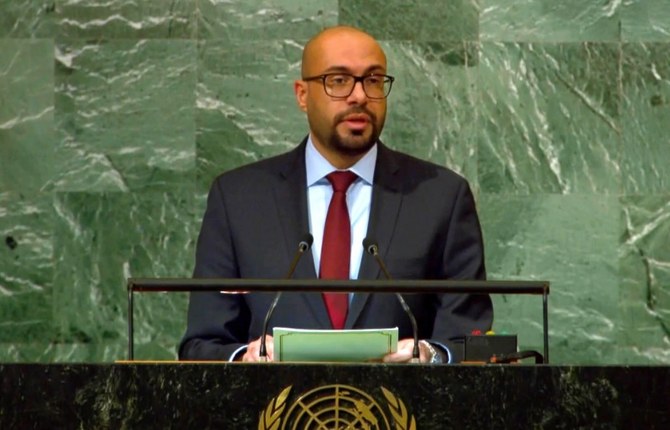
Fahad Mohammad Al-Hajji, the first secretary in Kuwait’s mission, was addressing the UN General Assembly during a debate on just representation in the UNSC and prospects of increasing its members, reported Kuwait’s News Agency on Saturday.
Al-Hajji said he deeply regretted that the majority of veto cases involved the Arab region.
He said his country has brought to the spotlight reforming the UNSC, affirming that “arbitrary usage of the veto right” has compromised its credibility in some cases.
He added: “The usage of the veto led in some cases to preventing the council from shouldering responsibilities and taking the necessary precautions to preserve international peace and security.
“There is also another challenge. That is, setting the just and adequate representation of the geographic and regional groups, in addition to improving the task methods where it has become necessary to make actions more effective and transparent.”
Al-Hajji welcomed the appointment of Ambassador Tareq Al-Bannai, as Kuwait’s permanent delegate at the UN, and Ambassador Michal Mlynar, Slovakia’s permanent envoy, as chief personnel in the government-level negotiations on reforming the UNSC.
He expressed gratitude to Qatar’s peer, Ambassador Alya Al-Thani, and the Danish counterpart, Ambassador Martin Hermann, for their leading roles in the negotiations.
The senior diplomat said world events “should prompt us to exert more efforts to push forward the government-level negotiations on fixing the Security Council.”
However, Al-Hajji said efforts to reform the council had foundered due to the lack of “the required political will on the part of the member states, including the five permanent members.”
Noting Kuwait’s unwavering stance for reforming the UNSC, the first secretary pointed out that the council should be transformed to become more representative and mirror the “status that has changed a lot since the establishment of the United Nations in 1945.”
He renewed the call for granting Arab states the right to occupy permanent seats in the UNSC, in addition to increasing the number of their non-permanent seats.
The Arab Group in the UNSC represents more than 400 million people and comprises 22 states, nearly 12 percent of UN memberships.


![]()

Kuwaiti diplomat says arbitrary usage of veto compromises UN Security Council credibility
Short Url
https://arab.news/4p75j
Kuwaiti diplomat says arbitrary usage of veto compromises UN Security Council credibility
- Regrets over Arab region involving majority of cases
- First secretary addresses General Assembly


Latest updates





© 2026 SAUDI RESEARCH & PUBLISHING COMPANY, All Rights Reserved And subject to Terms of Use Agreement.