

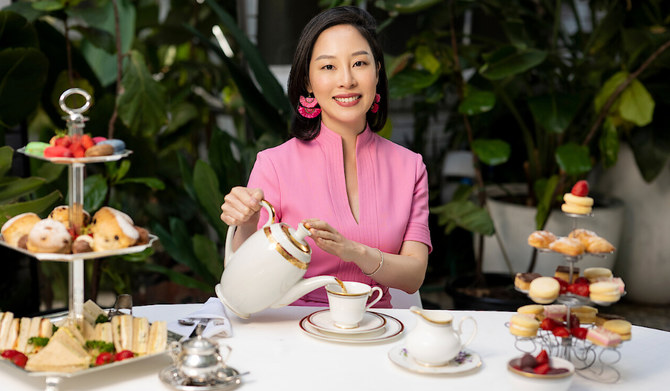
What We Are Watching Today: Netflix’s Mind Your Manners

Sara Jane Ho
Short Url
Updated 19 November 2022
Follow

What We Are Watching Today: Netflix’s Mind Your Manners

  • Sara Jane Ho serves up lessons in etiquette and style, as guests spill the tea

There’s a new Asian woman on Netflix who wants to help you live your best life, and she’s doing it by elevating your sloppy lifestyle — and your mindset.

Like a feistier version of Japan’s Marie Kondo, Sara Jane Ho is a Hong Kong Chinese entrepreneur who founded Institute Sarita, China’s first etiquette school, in 2013. The following year it was named one of the World’s 50 Most Innovative Companies by Fast Company magazine.

Ho is also the author of the bestselling Chinese-language book “Finishing Touch: Good Manners for the Debutante.” A graduate of the Harvard Business School, she is well versed in all things refined. Her focus isn’t on simply tidying up or sparking joy in people, but on elevating their whole life by getting rid of insecurities, inappropriate clothing and bad manners.

The series feels like it’s part self-help, part group therapy and part makeover — or makeunder.

Ho is adamant on bringing refinement into people’s lives. Her first step is to offer clients a cup of hot tea, so they might figuratively spill the tea on their own lives. Guests are invited to dig deep and reveal their deepest shame or grief in the hope of slapping on a layer of makeup or crisp new outfit to help them emerge with a better attitude.

Ho is quick on her feet with sly innuendos and slightly pretentious scolding of people’s life choices. At times, she comes across as a bit judgmental and slightly stoic but then softens to share a tender personal story or a warm hug.

Nearly every client comes out with a flash of refinement and a seemingly genuine smile at the end. All seem calmer too. They all learn how to use cutlery properly and how to act elegantly while in a Western fine dining establishment. She also emphasizes feng shui and Eastern teas.

Perhaps the only thing she has in common with fellow author and Netflix star Kondo is the use of non-English dialogue within the show. In this series, she outlines the etiquette principles for a group of older Chinese students who comically learn how to correctly pronounce the names of luxury brands, among other lessons. Those parts are perhaps the most endearing and where Ho seems more at ease.

It’s a binge-worthy season with six episodes, each about half an hour long. They can also be enjoyed in smaller bites, perhaps the way Ho would want you to.

The show is available to stream on Netflix MENA.


BMW Art Cars mark 50 years at inaugural Art Basel Qatar

Updated 09 February 2026
Follow

BMW Art Cars mark 50 years at inaugural Art Basel Qatar

DOHA: BMW’s long-running Art Car initiative took center stage at the inaugural Art Basel Qatar, with Thomas Girst, BMW Group’s head of cultural engagement, reflecting on five decades of collaboration between artists, engineers and the automobile.

Speaking at the fair, Girst situated the Art Car program within BMW’s broader cultural engagement, which he said spanned “over 50 years and hundreds of initiatives,” ranging from museums and orchestras to long-term partnerships with major art platforms.

“Every time Art Basel moves — from Miami to Hong Kong to Qatar — we move along with them,” he said. “That’s why we’re here.”


A post shared by Art Basel (@artbasel)

The occasion also marked the 50th anniversary of the BMW Art Car series, which began in 1975 with Alexander Calder’s painted BMW 3.0 CSL. Since then, the project has grown into a global collection that brings together motorsport, engineering, design and contemporary art. “Those Art Cars speak to a lot of people at the intersection of motorsports, technology, racing engineering, arts, lifestyle and design,” Girst said.

For Girst, the relationship between art and the automobile has deep historical roots. He pointed to early modernist fascination with cars, noting that “since the inception of the automobile,” artists have seen it as both a subject and a symbol of modernity. “There’s a reason for arts and culture and cars to mix and mingle,” he said.

At Art Basel Qatar, visitors were invited to view David Hockney’s BMW Art Car — Art Car No. 14 — displayed nearby. Girst described the work as emblematic of the program’s ethos, highlighting how Hockney painted not just the exterior of the vehicle but also visualized its inner life. The result, he suggested, is a car that reflects both movement and perception, turning the act of driving into an artistic experience.

Central to BMW’s approach, Girst stressed, is the principle of absolute artistic freedom. “Whenever we work with artists, it’s so important that they have absolute creative freedom to do whatever it is they want to do,” he said. That freedom, he added, mirrors the conditions BMW’s own engineers and designers need “to come up with the greatest answers of mobility for today and tomorrow.”

The Art Car World Tour, which accompanies the anniversary celebrations, has already traveled to 40 countries, underscoring the project’s global reach. For Girst, however, the enduring value of the initiative lies less in scale than in its spirit of collaboration. Art, design and technology, he said, offer a way to connect across disciplines and borders.

“That’s what makes us human. We can do better things than just bash our heads in — we can create great things together,” he said.