NEW YORK: Shaina Taub was in the audience at “Suffs,” her buzzy and timely new musical about women’s suffrage, when she spied something that delighted her.
It was intermission, and Taub, both creator and star, had been watching her understudy perform at a matinee preview last week. Suddenly, she saw audience members searching the Wikipedia pages of key figures portrayed in the show: women like Ida B. Wells, Inez Milholland and Alice Paul, who not only spearheaded the suffrage fight but also wrote the Equal Rights Amendment ( still not law, but that’s a whole other story).
“I was like, that’s my goal, exactly that!” Taub, who plays Paul, said from her dressing room later. “Do everything I can to make you fall in love with these women, root for them, care about them. So that was a really satisfying moment to witness.”
Satisfying but sobering, too. Fact is, few audience members know much about the American suffrage movement. So the all-female creative team behind “Suffs,” which had a high-profile off-Broadway run and opens Thursday on Broadway with extensive revisions, knows they’re starting from zero.
It’s an opportunity, says Taub, who studied social movements — but not suffrage — at New York University. But it’s also a huge challenge: How do you educate but also entertain?
One member of the “Suffs” team has an especially poignant connection to the material. That would be producer Hillary Clinton.
She was, of course, the first woman to win the US presidential nomination of a major party, and the first to win the popular vote. But Clinton says she never studied the suffrage movement in school, even at Wellesley. Only later in life did she fill in the gap, including a visit as first lady to Seneca Falls, home to the first American women’s rights convention some 70 years before the 19th Amendment gave women the vote.
“I became very interested in women’s history through my own work, and writing and reading,” Clinton told The Associated Press. And so, seeing “Suffs” off-Broadway, “I was thrilled because it just helps to fill a big gap in our awareness of the long, many-decades struggle for suffrage.”
It was Taub who wrote Clinton, asking her to come on board. “I thought about it for a nanosecond,” Clinton says, “and decided absolutely, I wanted to help lift up this production.” A known theater lover, Clinton describes traveling often to New York as a college student and angling for discounts, often seeing only the second act, when she could get in for free. “For years, I’d only seen the second act of ‘Hair,’” she quips.
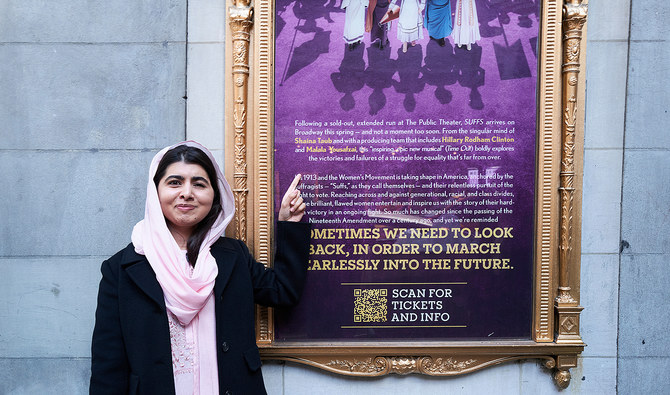
Clinton then reached out to Malala Yousafzai, whom Taub also hoped to engage as a producer. As secretary of state, Clinton had gotten to know the Pakistani education activist who was shot by a Taliban gunman at age 15. Clinton wanted Yousafzai to know she was involved and hoped the Nobel Peace Prize winner would be, too.
“I’m thrilled,” Clinton says of Yousafzai’s involvement, “because yes, this is an American story, but the pushback against women’s rights going on at this moment in history is global.”
Yousafzai had also seen the show, directed by Leigh Silverman, and loved it. She, too, has been a longtime fan of musicals, though she notes her own acting career began and ended with a school skit in Pakistan, playing a not-very-nice male boss. Her own education about suffrage was limited to “one or two pages in a history book that talked about the suffrage movement in the UK,” where she’d moved for medical treatment.
“I still had no idea about the US side of the story,” Yousafzai told the AP. It was a struggle among conflicting personalities, and a clash over priorities between older and younger activists but also between white suffragists and those of color — something the show addresses with the searing “Wait My Turn,” sung by Nikki M. James as Wells, the Black activist and journalist.
“This musical has really helped me see activism from a different lens,” says Yousafzai. “I was able to take a deep breath and realize that yes, we’re all humans and it requires resilience and determination, conversation, open-mindedness … and along the way you need to show you’re listening to the right perspectives and including everyone in your activism.”
When asked for feedback by the “Suffs” team, Yousafzai says she replied that she loved the show just as it was. (She recently paid a visit to the cast, and toured backstage.) Clinton, who has attended rehearsals, quips: “I sent notes, because I was told that’s what producers do.”
Clinton adds: “I love the changes. It takes a lot of work to get the storytelling right — to decide what should be sung versus spoken, how to make sure it’s not just telling a piece of history, but is entertaining.”
Indeed, the off-Broadway version was criticized by some as feeling too much like a history lesson. The new version feels faster and lighter, with a greater emphasis on humor — even in a show that details hunger strikes and forced feedings.
One moment where the humor shines through: a new song titled “Great American Bitch” that begins with a suffragist noting a man had called her, well, a bitch. The song reclaims the word with joy and laughter. Taub says this moment — and another where an effigy of President Woodrow Wilson (played by Grace McLean, in a cast that’s all female or nonbinary) is burned — has been a hit with audiences.
“As much as the show has changed,” she says, “the spine of it is the same. A lot of what I got rid of was just like clearing brush.”
Most of the original cast has returned. Jenn Colella plays Carrie Chapman Catt, an old-guard suffragist who clashed with the younger Paul over tactics and timing. James returns as Wells, while Milholland, played by Phillipa Soo off-Broadway, is now played by Hannah Cruz.
Given its parallels to a certain Lin-Manuel Miranda blockbuster about the Founding Fathers, it’s perhaps not a surprise that the show has been dubbed “Hermilton” by some.
“I have to say,” Clinton says of Taub, “I think she’s doing for this part of American history what Lin did for our founders — making it alive, approachable, understandable. I’m hoping ‘Suffs’ has the same impact ‘Hamilton’ had.”
That may seem a tall order, but producers have been buoyed by audience reaction. “They’re laughing even more than we thought they would at the parts we think are funny, and cheering at other parts,” Clinton says.
A particular cheer comes at the end, when Paul proposes the ERA.
“A cast member said, ‘Who’d have ever thought the Equal Rights Amendment would get cheers in a Broadway theater?’” Clinton recalls.
One clear advantage the show surely has: timeliness. During the off-Broadway run, news emerged the Supreme Court was preparing to overturn Roe vs. Wade, fueling a palpable sense of urgency in the audience. The Broadway run begins as abortion rights are again in the news — and a key issue in the presidential election only months away.
Taub takes the long view. She’s been working on the show for a decade, and says something’s always happening to make it timely.
“I think,” she muses, “it just shows the time is always right to learn about women’s history.”