

More Twitter workers flee after Musk’s ‘hardcore’ ultimatum

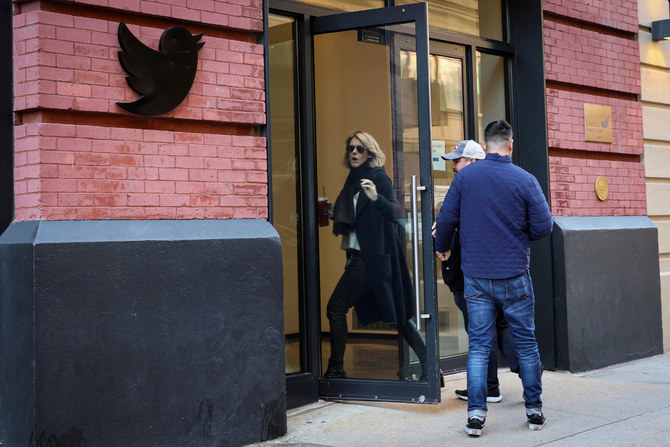
Twitter employees are seen entering the offices in New York City on November 9, 2022. (REUTERS/File Photo)
Short Url
Updated 18 November 2022
Follow

More Twitter workers flee after Musk’s ‘hardcore’ ultimatum

  • Musk has booted half of the company’s full-time staff of 7,500 and an untold number of contractors since taking over Twitter less than three weeks ago

Twitter continued to bleed engineers and other workers on Thursday, after new owner Elon Musk gave them a choice to pledge to “hardcore” work or resign with severance pay.
Some took to Twitter to announce they were signing off after Musk’s deadline to make the pledge. A number of employees took to a private forum outside of the company’s messaging board to discuss their planned departure, asking questions about how it might jeopardize their US visas or if they would get the promised severance pay, according to an employee fired earlier this week who spoke on condition of anonymity for fear of retaliation.
While it’s not clear how many of Twitter’s already-decimated staff took Musk up on his offer, the newest round of departures means the platform is continuing to lose workers just at it is gearing up for the 2022 FIFA World Cup. one of the busiest events on Twitter that can overwhelm its systems if things go haywire.
“To all the Tweeps who decided to make today your last day: thanks for being incredible teammates through the ups and downs. I can’t wait to see what you do next,” tweeted one employee, Esther Crawford, who is remaining at the company and has been working on the overhaul of the platform’s verification system.
Since taking over Twitter less than three weeks ago, Musk has booted half of the company’s full-time staff of 7,500 and an untold number of contractors responsible for content moderation and other crucial efforts. He fired top executives on his first day as Twitter’s owner, while others left voluntarily in the ensuing days. Earlier this week, he began firing a small group of engineers who took issue with him publicly or in the company’s internal Slack messaging system. 
Then overnight on Wednesday, Musk sent an email to the remaining staff at Twitter, saying that it is a software and servers company at its heart and he asked employees to decide by Thursday evening if they want to remain a part of the business.
Musk wrote that employees “will need to be extremely hardcore” to build “a breakthrough Twitter 2.0” and that long hours at high intensity will be needed for success.
But in a Thursday email, Musk backpedaled on his insistence that everyone work from the office. His initial rejection of remote work had alienated many employees who survived the layoffs.
He softened his earlier tone in an email to employees, writing that “all that is required for approval is that your manager takes responsibility for ensuring you are making an excellent contribution.” Workers would also be expected to have “in-person meetings with your colleagues on a reasonable cadence, ideally weekly, but not less than once per month.”


As of 7 p.m. Pacific Time, the No. 1 topic trending in the United States was “RIPTwitter” followed by the names of other social media platforms: “Tumblr,” “Mastodon” and “MySpace.”
Twitter did not respond to a message seeking comment.


Mark Zuckerberg set to testify in watershed social media trial

Updated 18 February 2026
Follow

Mark Zuckerberg set to testify in watershed social media trial

  • The plaintiff, a now 20-year-old woman, is seeking to hold social media companies responsible for harms to children who use their platforms
  • Zuckerberg’s testimony comes a week after the testimony of Adam Mosseri, the head of Meta’s Instagram

LOS ANGELES: Mark Zuckerberg will testify in an unprecedented social media trial that questions whether Meta’s platforms deliberately addict and harm children.
Meta’s CEO is expected to answer tough questions on Wednesday from attorneys representing a now 20-year-old woman identified by the initials KGM, who claims her early use of social media addicted her to the technology and exacerbated depression and suicidal thoughts. Meta Platforms and Google’s YouTube are the two remaining defendants in the case, which TikTok and Snap have settled.
Zuckerberg has testified in other trials and answered questions from Congress about youth safety on Meta’s platforms, and he apologized to families at that hearing whose lives had been upended by tragedies they believed were because of social media. This trial, though, marks the first time Zuckerberg will answer similar questions in front of a jury. and, again, bereaved parents are expected to be in the limited courtroom seats available to the public.
The case, along with two others, has been selected as a bellwether trial, meaning its outcome could impact how thousands of similar lawsuits against social media companies would play out.
A Meta spokesperson said the company strongly disagrees with the allegations in the lawsuit and said they are “confident the evidence will show our longstanding commitment to supporting young people.”
One of Meta’s attorneys, Paul Schmidt, said in his opening statement that the company is not disputing that KGM experienced mental health struggles, but rather that Instagram played a substantial factor in those struggles. He pointed to medical records that showed a turbulent home life, and both he and an attorney representing YouTube argue she turned to their platforms as a coping mechanism or a means of escaping her mental health struggles.
Zuckerberg’s testimony comes a week after that of Adam Mosseri, the head of Meta’s Instagram, who said in the courtroom that he disagrees with the idea that people can be clinically addicted to social media platforms. Mosseri maintained that Instagram works hard to protect young people using the service, and said it’s “not good for the company, over the long run, to make decisions that profit for us but are poor for people’s well-being.”
Much of Mosseri’s questioning from the plaintiff’s lawyer, Mark Lanier, centered on cosmetic filters on Instagram that changed people’s appearance — a topic that Lanier is sure to revisit with Zuckerberg. He is also expected to face questions about Instagram’s algorithm, the infinite nature of Meta’ feeds and other features the plaintiffs argue are designed to get users hooked.
Meta is also facing a separate trial in New Mexico that began last week.