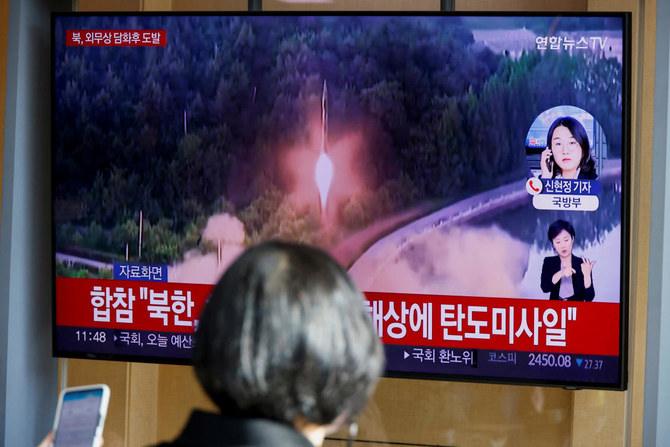
SEOUL: North Korea fired a short-range ballistic missile Thursday, Seoul’s military said, the latest in a record-breaking blitz of launches as Pyongyang warned of a “fiercer” military response to the US and its regional allies.
South Korea’s Joint Chiefs of Staff said that the military had “detected around 10:48 am (0148 GMT) one short-range ballistic missile fired from the Wonsan area in Kangwon province.”
“The military has stepped up monitoring and guard and are maintaining utmost readiness in close coordination with the US,” it added.
Earlier this week, US President Joe Biden discussed North Korea’s spate of recent missile tests with Chinese counterpart Xi Jinping on the sidelines of the G20 summit in Bali, Indonesia.
The US leader pushed China to use its influence to rein in North Korea after the wave of missile launches raised fears the reclusive regime would soon carry out its seventh nuclear test.
Biden also held talks with his South Korean counterpart Yoon Suk-yeol and Japanese Prime Minister Fumio Kishida on Sunday to discuss ways to address the threat posed by the North’s “unlawful weapons of mass destruction and ballistic missile programs,” the White House said.
On Thursday, North Korea’s minister of foreign affairs, Choe Son Hui, slammed those discussions, saying they were “bringing the situation on the Korean peninsula to an unpredictable phase.”
“The US ‘bolstered offer of extended deterrence’ and the daily-increasing military activities of the allied forces around the Korean peninsula are foolish acts,” Choe said in a statement carried by state news agency KCNA.
The more Washington works to strengthen its security alliance with Tokyo and Seoul, “the fiercer the DPRK’s military counteraction will be,” Choe said, referring to the North by its official name.
Experts said the Thursday missile launch was timed to coincide with the statement from Pyongyang’s foreign minister.
The North “fired the missile after releasing the statement hours earlier in an attempt to justify the launch to send its message to the US and Japan,” Cheong Seong-chang, a researcher at the Sejong Institute told AFP.
Earlier this month, North Korea conducted a flurry of launches, including a November 2 barrage in which Pyongyang fired 23 missiles — more than during the whole of 2017, the year of “fire and fury” when Kim traded barbs with then US president Donald Trump.
The blitz came as hundreds of US and South Korean warplanes — including B-1B heavy bombers — participated in joint air drills, which have long sparked strong reactions from North Korea, which sees them as rehearsals for an invasion.
Experts say North Korea is seizing the opportunity to conduct banned missile tests, confident of escaping further UN sanctions due to Ukraine-linked gridlock at the United Nations.
China, Pyongyang’s main diplomatic and economic ally, joined Russia in May in vetoing a US-led bid at the UN Security Council to tighten sanctions on North Korea.
Washington has responded to North Korea’s sanctions-busting missile tests by extending exercises with the South and deploying a strategic bomber.
Pyongyang has also been under a self-imposed coronavirus blockage since early 2020, which experts say would limit the impact of any additional external sanctions.
“Choe Son Hui’s threatening statement and North Korea’s most recent missile launch are attempts to signal that Pyongyang won’t back down under international pressure,” said Leif-Eric Easley, a professor at Ewha University in Seoul.
But he said it was clear that Biden, Yoon and Kishida’s summit had taken “substantive steps on trilateral coordination,” even as China’s Xi ended his Covid-linked isolation with a “relative charm offensive” at the recent G20 summit.
“At some point, Chinese interests will prefer exerting pressure on Pyongyang rather than face a more strategically united US, South Korea and Japan,” Eastley added.


![]()

North Korea fires missile hours after warning of ‘fiercer’ military response
Short Url
https://arab.news/97a4h
North Korea fires missile hours after warning of ‘fiercer’ military response
- US President Joe Biden earlier discussed North Korea’s spate of recent missile tests with Chinese counterpart Xi Jinping


Latest updates


© 2026 SAUDI RESEARCH & PUBLISHING COMPANY, All Rights Reserved And subject to Terms of Use Agreement.