

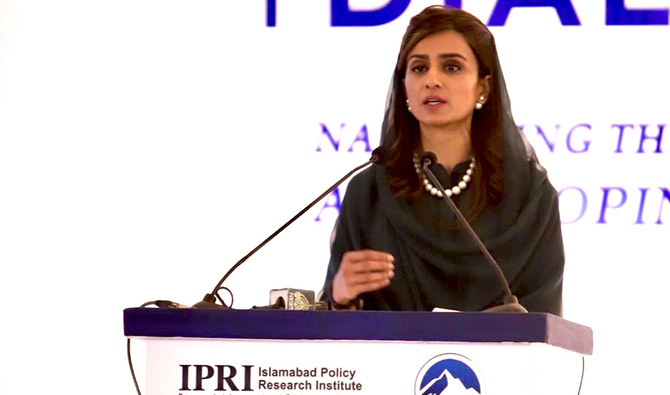

ISLAMABAD: Pakistan’s state minister for foreign affairs Hina Rabbani Khar said on Wednesday her country did not want to get entangled in bloc politics, adding its objective was to create trade and investment opportunities to ensure greater economic prosperity.
Khar expressed these views while addressing the inaugural session of Margalla Dialogue 2022 which has been organized by the Islamabad Policy Research Institute (IPRI) to project Pakistan’s narrative on key national and global issues.
“Pakistan seeks to open the doors and windows of opportunity for trade, investment and people-to-people contact with all as we believe in Pakistan first, bloc politics later,” she said. “We shall align with whosoever we feel is a mutually beneficial ally.”
She maintained Pakistan was not interested in selective engagement or lack of pragmatism, adding that Islamabad wanted to forge new alliances and cement old ones.
“Pakistan is very keen to seek the opening of investment and trade. We need to have ties with both China and the United States and our relations with Saudi Arabia, Gulf states, and Turkiye are also based on a solid footing,” she added.
Khar noted the world order was in danger since certain states refused to accept choices made by other countries that were based on geography, history and national interests.
She pointed out that labeling different nations as good or evil was a threat to the spirit of multinationalism.
The minister said Pakistan needed new markets and greater investment for the prosperity of its people, adding that the China-Pakistan Economic Corridor (CPEC) would not only benefit her country but the entire region.
“When Pakistan ventured into CPEC, we thought it was a giveaway for the region,” she continued. “The view of China in the West is very different than the view of China in the East.”
Addressing the ceremony during the second session, state minister for finance and revenue, Dr. Aisha Ghaus Pasha, endorsed Khar’s emphasis on geoeconomics.
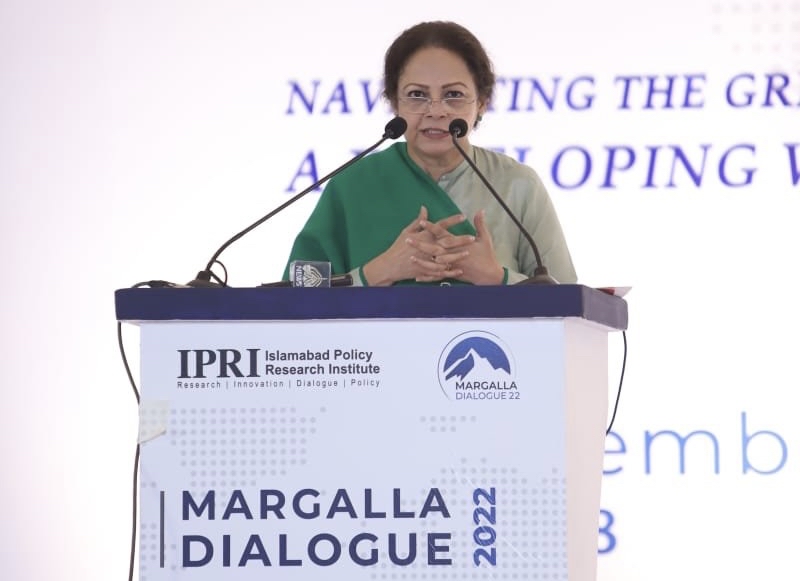
Pakistan’s minister of state for finance and revenue Dr. Aisha Ghaus Pasha addresses Margalla Dialogue in Islamabad, Pakistan, on November 16, 2022. (AN photo)
“Pakistan’s average growth rate has come down in the past few years and public sector investment is just three percent of the gross domestic product,” she said. “It is for its own benefit that Pakistan is committed to the IMF’s structural adjustments program.”
Pasha said Pakistan needed to build climate-resilient infrastructure while pointing out that millions of people had dropped below the poverty line due to the devastation caused by recent floods.
“World needs to do climate justice and help Pakistan rebuild its infrastructure,” she added.
The policy dialogue was also attended by several international experts.
According to Hans Timmer, the chief economist for South Asia at the World Bank, the regional economies were going through an existential balance of payment crisis at a time when the international community was unprepared to deal with climate-induced financial shocks.
“Pakistan played a leadership role at COP-27 [in Egypt],” he maintained. “It is important that funds are raised for developing countries [to deal with climate catastrophes] and emissions are mitigated.”
British High Commissioner to Pakistan Christian Turner said counter-terrorism was no longer an important topic for discussion with Pakistan for his country.
“Development is the focal point of diplomatic ties between the two states,” he continued, adding that inclusive economic growth, investment in human capital and regional connectivity were three propositions for the UK-Pakistan relationship.
“Opening of trade with India is vital for the economic growth of Pakistan, with evolving shifts from geopolitics to geoeconomics,” he added.


