

Pakistan’s Sindh province establishes commission for protection of journalists

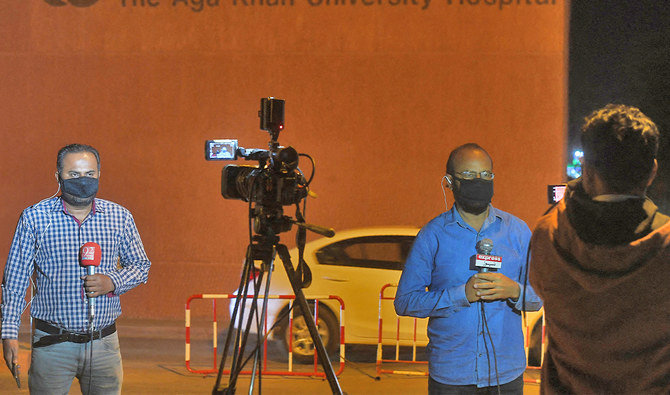
Pakistani journalists report from outside the hospital in Karachi, Pakistan, on February 26, 2020. (AFP/File)
Short Url
Updated 16 November 2022
Follow

Pakistan’s Sindh province establishes commission for protection of journalists

  • Sindh Protection of Journalists and Other Media Practitioners Bill 2021 became law in July 31, 2021
  • Journalists’ bodies welcome commission which is to be headed by a former judge as its chairman

KARACHI: Over 15 months after Pakistan’s Sindh province passed a landmark law for the protection of journalists, the provincial government on Wednesday approved setting up a high-powered commission that will serve as a court to receive complaints and also proactively pursue cases of attacks on media workers.

The Sindh Protection of Journalists and Other Media Practitioners Bill 2021 became law in July 31, 2021. Among its provisions, the bill calls for the establishment of a “Commission for Protection of Journalists and Other Media Workers.’

The commission is to be headed by a former judge as its chairman and will comprise officials from the provincial information, home, law and human rights departments as well as representative of journalists, editors and employers’ unions, lawyers and the Human Rights Commission of Pakistan. Two members of the provincial assembly will also be part of the body.

Pakistan, where journalists face frequent attacks, acts of intimidation and harassment from both state and non-state actors and political groups, registered a steep decline of 12 points in the World Press Freedom Index 2022, dropping to 157 from 145 out of 180 nations in 2021. According to a report by the Freedom Network of Pakistan, 86 attacks were carried out against journalists across the country in the last one year.

“Sindh Cabinet has approved the establishment of the Commission for the Protection of Journalists & Other Media Practitioners. Justice Rasheed Rizvi will serve as its 1st Chairperson,” Sindh government spokesperson Murtaza Wahab said on Twitter.

According to the law, the commission will look into complaints filed “in respect of acts of harassment, sexual harassment, violence, and threats of violence is committed against a journalist or media practitioner”, whether perpetrated by “any person or groups of persons or public or private institution or authority.”

The commission, which will exercise the powers of a civil court, will also be able to take suo moto notice of attacks on journalists and media practitioners, recommend appropriate action to the government, direct an immediate and expeditious investigation and ensure speedy trials.

“The establishment of journalist protection commission and making Justice (R) Rasheed Rizvi as chairman is a welcome decision,” Fazil Jamili, present of the Karachi Press Club, said.

Aamir Latif, assistant secretary general of the Pakistan Federal Union of Journalists (PFUJ), said journalists in Pakistan faced threats both to their lives and their jobs. 

“In Sindh also, dozens of journalists have been booked in fake cases just for performing their duties. We hope the commission will change the course of life for journalists currently working under many threats,” Latif told Arab News, saying owners of media houses needed to comply with the provisions of the new law, which calls for training and job security for journalists.


Pakistan terms climate change, demographic pressures as ‘pressing existential risks’

Updated 06 December 2025
Follow

Pakistan terms climate change, demographic pressures as ‘pressing existential risks’

  • Pakistan has suffered frequent climate change-induced disasters, including floods this year that killed over 1,000
  • Pakistan finmin highlights stabilization measures at Doha Forum, discusses economic cooperation with Qatar 

ISLAMABAD: Pakistan’s Finance Minister Muhammad Aurangzeb on Saturday described climate change and demographic pressures as “pressing existential risks” facing the country, calling for urgent climate financing. 

The finance minister was speaking as a member of a high-level panel at the 23rd edition of the Doha Forum, which is being held from Dec. 6–7 in the Qatari capital. Aurangzeb was invited as a speaker on the discussion titled: ‘Global Trade Tensions: Economic Impact and Policy Responses in MENA.’

“He reaffirmed that while Pakistan remained vigilant in the face of geopolitical uncertainty, the more pressing existential risks were climate change and demographic pressures,” the Finance Division said. 

Pakistan has suffered repeated climate disasters in recent years, most notably the 2022 super-floods that submerged one-third of the country, displaced millions and caused an estimated $30 billion in losses. 

This year’s floods killed over 1,000 people and caused at least $2.9 billion in damages to agriculture and infrastructure. Scientists say Pakistan remains among the world’s most climate-vulnerable nations despite contributing less than 1 percent of global greenhouse-gas emissions.

Aurangzeb has previously said climate change and Pakistan’s fast-rising population are the only two factors that can hinder the South Asian country’s efforts to become a $3 trillion economy in the future. 

The finance minister noted that this year’s floods in Pakistan had shaved at least 0.5 percent off GDP growth, calling for urgent climate financing and investment in resilient infrastructure. 

When asked about Pakistan’s fiscal resilience and capability to absorb external shocks, Aurangzeb said Islamabad had rebuilt fiscal buffers. He pointed out that both the primary fiscal balance and current account had returned to surplus, supported significantly by strong remittance inflows of $18–20 billion annually from the Middle East and North Africa (MENA) and Gulf Cooperation Council (GCC) regions. 

Separately, Aurangzeb met his Qatari counterpart Ali Bin Ahmed Al Kuwari to discuss bilateral cooperation. 

“Both sides reaffirmed their commitment to strengthening economic ties, particularly by maximizing opportunities created through the newly concluded GCC–Pakistan Free Trade Agreement, expanding trade flows, and deepening energy cooperation, including long-term LNG collaboration,” the finance ministry said. 

The two also discussed collaboration on digital infrastructure, skills development and regulatory reform. They agreed to establish structured mechanisms to continue joint work in trade diversification, technology, climate resilience, and investment facilitation, the finance ministry said.