

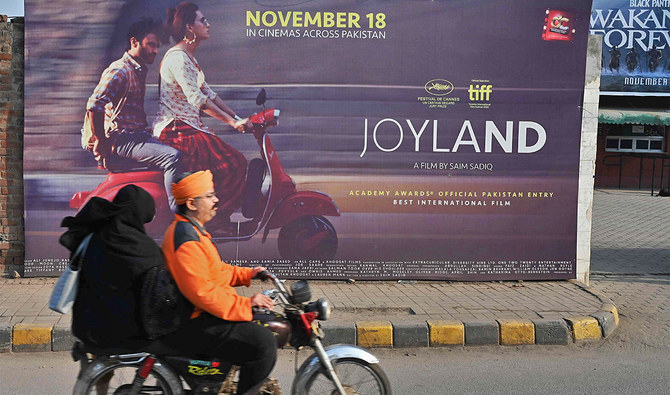

KARACHI: A government committee formed by Prime Minister Shehbaz Sharif to consider complaints against the Pakistani film Joyland on Tuesday tasked the country’s censor board to review whether the movie is suitable for screening or not.
Last week, the information ministry declared Joyland “repugnant to the norms of decency and morality” and ruled that it was an “uncertified film” for release in cinemas. Joyland celebrates “transgender culture” in Pakistan, with the film’s plot revolving around a family torn between modernity and tradition in contemporary Lahore.
Transgender people are considered outcasts by many in Pakistan, despite some progress with a law that protects their rights and a landmark Supreme Court ruling designating them as a third gender.
It has won the Cannes “Queer Palm” prize for the best feminist-themed movie as well as the Jury Prize in the “Un Certain Regard” competition, a segment focusing on young, innovative cinema talent. Joyland is Pakistan’s entry for next year’s Academy Awards.
The committee, headed by federal minister Sardar Ayaz Sadiq, held a meeting to review complaints against the film on Tuesday.
“The committee was directed to consider the complaints against the said film being contrary to social norms,” the information ministry’s press release said.
“After thorough deliberations, it [the committee] concluded that the Central Board of Film Censors (CBFC) should conduct a FULL BOARD REVIEW immediately to take final decision of its suitability for screening.”
Speaking on a private news channel, Information Minister Marriyum Aurangzeb said the film had been “intensely censored” at first before it was certified by the censor board. She said once the movie was released at international festivals, the censor board received a flurry of complaints against it by people who had watched it abroad.
“A surge of applications and petitions were received [against Joyland],” Aurangzeb said. “When petitions are received, it is binding to review them,” she added.
“To my surprise, I was told by the censor board that they were [applications] received from middle-class people and parents,” the minister said.
She said the censor board is an autonomous body as per Pakistani law, adding that the government had not interfered with the process. Aurangzeb said the decision by the censor board will be taken by Wednesday evening.
Joyland writer and director, Saim Sadiq, also spoke on the channel, lamenting that Pakistan “is being made fun of” around the world. He said people were unable to comprehend why a movie that received critical acclaim was not being approved by the country’s own government.
“If they [people who watched the film abroad] had an issue with the film that it shouldn’t be released in Pakistan, why did they watch it abroad,” Sadiq asked.
The information ministry’s decision to rule that the film was “uncertified” triggered outrage on social media, with many questioning the decision by the government.
“It is a story of our people told by our people for our people. Hoping for it to be made accessible to these very people #ReleaseJoyland,” Pakistani actor Humayun Saeed wrote on Twitter earlier this week.
“I personally do not believe in banning films that highlight issues faced by marginalized segments of our society,” Salman Sufi, the head of the prime minister’s strategic reforms unit, wrote on Twitter.
“People should be trusted to watch & make their own mind.”
Prominent Pakistani journalist, Aamna Isani, shared the definition of a transgender according to the constitution. “If you have a problem with that, appeal for an amendment to the constitution. Until then, #ReleaseJoyland,” she wrote on Twitter.


