

US FBI director says TikTok poses national security concerns

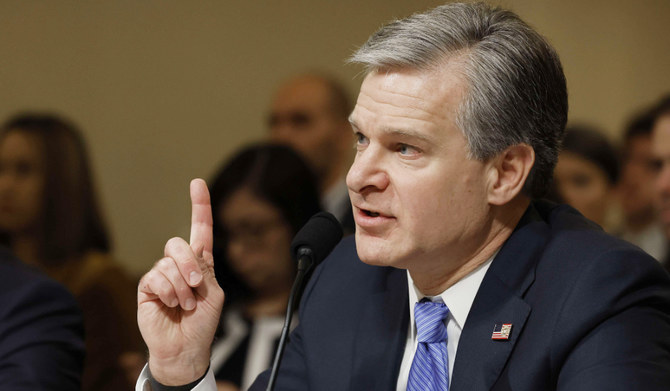
Federal Bureau of Investigation Director Christopher Wray prepares to testify before the House Homeland Security Committee in the Cannon House Office Building on Capitol Hill on November 15, 2022 in Washington, DC. (AFP)
Short Url
Updated 16 November 2022
Follow

US FBI director says TikTok poses national security concerns

  • TikTok executive Vanessa Pappas told US Congress in September that TikTok was making “progress toward a final agreement with the US government to further safeguard USuser data and fully address US national security interests”

WASHINGTON: The US operations of Chinese-owned TikTok raise national security concerns, FBI Director Chris Wray said on Tuesday, flagging the risk that the Chinese government could harness the video-sharing app to influence users or control their devices.
Risks include “the possibility that the Chinese government could use to control data collection on millions of users or control the recommendation algorithm, which could be used for influence operations,” Wray told US lawmakers.
Beijing could also use the popular app, owned by ByteDance, to “control software on millions of devices,” giving it the opportunity to “technically compromise” those devices, he added.
The US government’s Committee on Foreign Investment in the United States (CFIUS), which reviews US acquisitions by foreign acquirers for potential national security risks, in 2020 ordered ByteDance to divest TikTok because of fears that US user data could be passed on to China’s communist government.
CFIUS and TikTok have been in talks for months aiming to reach a national security agreement to protect the data of TikTok’s more than 100 million users.
TikTok executive Vanessa Pappas told US Congress in September that TikTok was making “progress toward a final agreement with the US government to further safeguard USuser data and fully address US national security interests.”
When asked about the FBI’s role in the CFIUS investigation, Wray said the agency’s foreign investment unit was part of the CFIUS process. “Our input would be taken into account in any agreements that might be made to address the issue,” he added.
Wray noted Chinese companies are required to essentially “do whatever the Chinese government wants them to in terms of sharing information or serving as a tool of the Chinese government. And so that’s plenty of reason by itself to be extremely concerned.”
A TikTok spokesperson said: “As Director Wray specified in his remarks, the FBI’s input is being considered as part of our ongoing negotiations with the US Government. While we can’t comment on the specifics of those confidential discussions, we are confident that we are on a path to fully satisfy all reasonable US national security concerns.”
Former President Donald Trump in 2020 attempted to block new users from downloading WeChat and TikTok and ban other transactions that would have effectively blocked the apps’ use in the United States but lost a series of court battles over the measure.
President Joe Biden in June 2021 withdrew a series of Trump executive orders that sought to ban new downloads of the apps and ordered the Commerce Department to conduct a review of security concerns posed by the apps.
Any security agreement with TikTok is expected to include data security requirements.


Israeli court overturns conviction of officer who assaulted Palestinian journalist, citing ‘Oct. 7 PTSD’

Updated 25 February 2026
Follow

Israeli court overturns conviction of officer who assaulted Palestinian journalist, citing ‘Oct. 7 PTSD’

  • Judge sentenced Yitzhak Sofer to 300 hours of community service, saying officer “devoted his life to Israel’s security” and conviction was “disproportionate to severity of his actions”
  • Footage shows Sofer throwing photojournalist Mustafa Alkharouf to the ground, and repeatedly beating and kicking him while he covered Palestinian gatherings near Al-Aqsa Mosque

LONDON: An Israeli court overturned the conviction of a border police officer who assaulted a Palestinian journalist, ruling his actions were influenced by post-traumatic stress disorder from serving during the Oct. 7 2023 attacks.

On Tuesday, the Jerusalem Magistrate’s Court sentenced officer Yitzhak Sofer to 300 hours of community service for assaulting Anadolu Agency photojournalist Mustafa Alkharouf in occupied East Jerusalem in December 2023.

Footage shows Sofer and other officers drawing weapons, throwing Alkharouf to the ground, and repeatedly beating and kicking him while he covered Palestinian gatherings near Al-Aqsa Mosque amid heavy restrictions.

Alkharouf was hospitalized with facial and body injuries. His cameraman, Faiz Abu Ramila, was also attacked.

Sofer had been convicted in September 2024 of assault causing bodily harm (acquitted of threats) and initially faced six months’ community service, as recommended by Mahash, the Justice Ministry’s police misconduct unit.

Judge Amir Shaked accepted the defense request to cancel the conviction, replacing it with community service.

He cited Sofer’s PTSD from responding to the Oct. 7 Hamas-led attack, noting the officer had “no prior criminal record” and had “devoted his life to Israel’s security.”

“The court cannot ignore this when considering whether the defendant’s conviction should stand,” he said, adding that while the incident is “serious and does cross the criminal threshold,” the conviction in place could cause Sofer harm “disproportionate to the severity of his actions.”

The ruling comes amid surging attacks on journalists in the West Bank, East Jerusalem and Gaza since Israel’s war on Gaza began.

The Committee to Protect Journalists reported Israel responsible for two-thirds of the 129 media workers killed worldwide in 2025, the deadliest year on record, citing a “persistent culture of impunity” and lack of transparent probes.

Reporters Without Borders called the Israeli army the “worst enemy of journalists” in its 2025 report, with nearly half of global reporter deaths in Gaza.

Foreign journalists face raids, arrests and intimidation. In late January 2026, Israel’s Supreme Court granted a delay on ruling a ban on foreign media access to Gaza.